When I began to cover Taiwan in the 1980s for The New York Times, it was a dictatorship under martial law, banning opposition parties and imprisoning dissidents. Per capita income was just $4,000, and the government once tried to bribe me to provide more friendly coverage.
Now the world has turned upside down. Taiwan today is more democratic than the United States, according to the democracy index published by the Economist Intelligence Unit. Similarly, Freedom House lists Taiwan as more free than the United States.
What’s more, Taiwan is a wealthy technological marvel: Robots assist at restaurants, and its citizens enjoy a higher per capita income than the Japanese do. Because Taiwan produces more than 90 percent of the world’s most advanced computer chips, it may be the single most indispensable hub in the global economy.
Likewise, on my first visit to Vietnam in 1989, its per capita income was about $100, and in one hotel my wife and I stayed at (one of the best in the city of Hue), rats fell like rain from the ceiling of our room.
Last month at my Sheraton hotel in Vietnam, where per capita income is now about $5,000, there was no rat precipitation. Skyscrapers line city streets, reflecting an 8 percent economic growth rate, among the highest in the world, and a stock market that soared 37 percent last year in dollar terms. Life expectancy in Ho Chi Minh City is 77 years, longer than in some American states.
So it goes across so much of Asia, transformed at a staggering pace. Some Asian countries have managed to double their economies in less than a decade. The Organization for Economic Cooperation and Development says that emerging Asian economies (including China, India, Indonesia, Vietnam and others) contributed more last year to global economic growth than the rest of the world combined, and will do so again in 2026.
I have been able to spend much of my career as an Asia watcher precisely because it was so unimportant in the 1980s that The Times didn’t mind sending a young reporter there as a correspondent. The region has been changing so quickly in recent years that, to borrow from Heraclitus, you can never step into the same Asia twice. (Actually, that’s not fully true: Sadly, you can repeatedly step into the same Myanmar and the same North Korea.)
Asia is not a monolith, but the gains that were first visible in Japan and the small “tiger” economies (Hong Kong, South Korea, Taiwan and Singapore) then spread to China and much of Southeast Asia, and more recently to Bangladesh and India. One factor was investments in human capital, coupled with prudent economic policies.
As America’s democracy and society have struggled in recent years, caught in an authoritarian riptide and mired in inequality and discontent, I’ve wondered about the lessons that we Americans can learn from some of the successes of Asia.
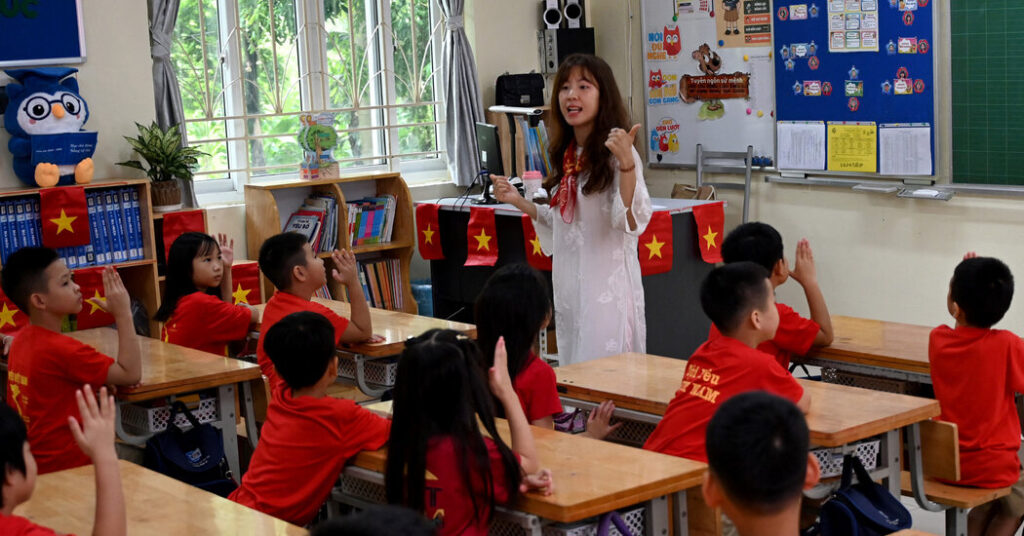
The one I focus on is the transformative power of education. It’s not a new thought, of course, and it’s one I’ve puzzled over since my wife and I began visiting schools in Asia in the 1980s and sending our kids to school in Japan in the 1990s. Every time I visit, I feel a pang of envy for societies that seem to value education more than America does.
The passion reflects a tradition in the Confucian belt of East Asia that the path to glory is to study. Even today in Chinese villages, you occasionally come across an ancient “paifang” monument to some local man who centuries ago earned a “jinshi” degree with top honors in the imperial exams. (When was the last time you saw an American village commemorating a local Ph.D.?)
In a modern echo, in some East Asian schools I’ve visited, students and teachers alike have explained that the “hot” girls and boys are the valedictorians. It’s nerd heaven, and this set of values leads many students to work extraordinarily hard.
Consider Tran Ha Hoang Chau, whom I met in Ho Chi Minh City. She didn’t have money for college but was determined to get a degree anyway. So she decided to work full time and study full time. After studying all day at university, she would then work all night at a coffee shop, seven days a week.
When did she sleep?
“My only chance to sleep was at the coffee shop, between 3 a.m. and 5 a.m. if there weren’t many customers,” she explained to me. She also caught up on weekends, she said.
She didn’t have enough money for food and often went hungry. But her grit paid off, and she began to win academic recognition for her science research, including one prize for her work on Covid and another for an investigation into cervical vertebrae. The prizes included cash payments that allowed her to eat more food.
That reverence for education is a reason Singapore’s schools may be the best in the world, with those of South Korea, Taiwan, Hong Kong and Japan also in the mix.
We Americans eagerly invest in our own children’s education, but we’re less enthusiastic about paying to educate other people’s kids. In Taiwan, by contrast, the constitution stipulated for decades that education, culture and science must account for at least 15 percent of the national budget; a law that updated it mandates that at least 22.5 percent of combined net budget revenues for government at all levels go to education. (In the United States, education has accounted for a bit more than 2 percent of federal budgets and about one-third of state and local spending.)
Obviously, not every child in Asia is a paragon, and there is plenty of poverty, inequality and injustice. Education isn’t a cure-all; North Korea appears to have decent schools yet is both impoverished and totalitarian. But especially in the countries with Confucian influences, respect for education is so deep that it can even overwhelm youthful hormones.
“Dating or having a boyfriend is not necessary,” Phan Thi My Duyen, 20, a technology student at a university in Ho Chi Minh City told me primly. “My priority is schoolwork.”
It keeps her busy. Duyen built a device to measure soil parameters so that farmers can understand how to add fertilizer to improve crops. Then she built an S-RAM device that I would tell you about if I understood it.
Duyen, who grew up in a rural area, is a beneficiary of a nonprofit called U-Go, started by a former Microsoft executive named John Wood. I admire U-Go, which provides scholarships of about $800 each so that brilliant low-income women in Asia and Africa can attend university.
Can we build this kind of education-obsessed culture in America?
In any case, many in East Asia complain that their systems work children too hard, robbing them of fun, and focus too much on memorization and not enough on creativity. Yes, that’s all true.
But couldn’t we Americans edge a little in Asia’s direction? We don’t need to build a commemorative arch outside the home of each Ph.D., but maybe we could manage a bit less complacency about educational mediocrity? Maybe we could acknowledge the inequity of local school finance that results in sending rich kids to good schools and poor kids to weak schools? Perhaps politicians could stop demonizing universities and taxing their endowments? What if we respected human capital as much as financial capital?
The Times is committed to publishing a diversity of letters to the editor. We’d like to hear what you think about this or any of our articles. Here are some tips. And here’s our email: [email protected].
Follow the New York Times Opinion section on Facebook, Instagram, TikTok, Bluesky, WhatsApp and Threads.
The post Lessons for America From Asia appeared first on New York Times.