A few hours after Tom Homan announced a drawdown of federal forces in Minneapolis this week, the rest of President Trump’s fractious immigration team gathered at the border wall in Arizona for a speech by Homeland Security Secretary Kristi Noem. Gusty desert winds coated everyone in dust and blew Noem’s hair wildly around her ball cap.
The event was tightly choreographed to project unity. Noem praised Homan, the White House “border czar” and her rival for control of the immigration crackdown. She sat beside the Homan ally Rodney Scott, the commissioner of Customs and Border Protection, whom she and her team have spent the past several months trying to sideline. Todd Lyons, the acting director of Immigration and Customs Enforcement who has also seen his authority diminish under Noem, was there too, crediting her and the president. The one notably absent figure was Greg Bovino, the Border Patrol commander Noem sent storming into Los Angeles, Chicago, Minneapolis, and other cities, turning him into the face of the rolling crackdown. Bovino’s agents killed Alex Pretti on January 24. Now Bovino was off the team, “a pretty out-there kind of guy,” Trump called him, so thoroughly erased that no one at Noem’s event even mentioned his name.
The secretary’s speech hit the familiar notes, hammering Joe Biden’s border record and celebrating the steep drop in illegal crossings under Trump. It showed the administration’s eagerness to shift attention to the border, where the president’s harsh measures are popular, and away from Minneapolis, where they are not.
Although it is too early to say whether Pretti’s killing will mark a turning point in Trump’s second administration, it has forced a pivot in his immigration team’s tactics and command structure. Homan has ended roving street patrols and told ICE officers to go back to conducting more targeted, disciplined operations that prioritize catching criminals over raw arrest numbers. “This is smart law enforcement, not less law enforcement,” he said this week. Homan, who ran ICE during part of Trump’s first term, pledged to hold officers accountable for misconduct—a much different message than the one DHS broadcast last month when it promoted a clip of Stephen Miller saying they had broad immunity.
If Miller took the Trump administration to the brink in Minneapolis, Homan seemed to be looking for a reset—but not a retreat. “We’re not backing down at all,” he said on Fox News. “Mass deportations will continue.”
Homan’s return has been welcomed by nearly all of the career ICE and CBP officials I’ve been in touch with, many of whom say that Trump’s deportation campaign—whose goals they largely share—will be more effective if it is more low-key and less provocative. That means returning to a focus on immigrants with criminal records (including those with nonviolent offenses such as illegally reentering the United States) and those who disobey deportation orders from immigration courts.
Homan has worked under Democratic administrations—he received an award from President Obama in 2015—and is well versed in the arguments about public safety and crime that ICE leaders have long used to defend the agency when its legitimacy has come under attack. It was Homan who, after Trump appointed him to lead ICE in 2017, famously said that officers would be freed from “the shackles” of tighter oversight. Now it’s Homan’s job to restore some of those restraints.
At the White House, Miller is still running 10 a.m. conference calls six days a week to issue orders and demand updates on the metrics that matter most to him: deportations, new-ICE-officer deployments, and prosecutions. ICE field commanders have not been waved off the ambitious arrest quotas he set last May, and they remain under orders to maintain staffing levels at 70 percent, even on the weekends, two current officials told me.
[Read: The wrath of Stephen Miller]
Activists in Minneapolis say they’ve seen little change, and the city still feels besieged. But Homan has made some significant moves: Border Patrol agents are now embedded with ICE, not roaming the streets on their own, and they’re under orders to avoid confrontations with activists. Homan and Chief of Staff Susie Wiles have held regular calls with Minneapolis Mayor Jacob Frey since Trump talked to him on January 26, according to a senior administration official and an aide to Frey. Trump officials want Frey to help calm protests, and Homan has withdrawn 700 federal agents and officers so far. A goal discussed inside the White House would be the withdrawal of the remaining 2,000 or so federal forces over the next two weeks, said the official, who was not authorized to discuss internal deliberations. A DHS official deployed to Minneapolis described that timeline as “ambitious,” although Homan has said publicly that the drawdown can quicken if protesters stay out of ICE’s way.
Trump has changed his tune too, telling NBC News during an Oval Office interview that aired this week: “Maybe we could use a little bit of a softer touch.”
I spoke with half a dozen current and former immigration-enforcement officials about how Trump’s mass-deportation campaign may change after Minneapolis, especially with polls showing that one of the president’s top-rated issues is becoming a political liability. Several said they expect ICE operations to continue aggressively, but with less of the publicity and propaganda that DHS has indulged in for months. “No more videos from convenience stores,” one veteran official said, referring to social-media clips made by Bovino’s film crew that show him shopping for energy drinks and high-fiving supporters.
Sixty-five percent of Americans think ICE has gone too far in conducting Trump’s crackdown, according to a poll published Thursday by Marist/PBS News/NPR, and two-thirds of independent voters disapprove of the job ICE is doing. As support for the anti-ICE protest movement has reached new heights, opposition to the crackdown has morphed into a cultural moment, illustrated by the various Grammy-speech denunciations last week and Bruce Springsteen’s new song “Streets of Minneapolis.” During a live broadcast of a pro-wrestling event in Las Vegas on Wednesday, rowdy chants of “Fuck ICE” broke out.
Three consecutive presidencies have been sidetracked by immigration-policy overreach. During Trump’s first term, he tried to stem illegal crossings by implementing a family-separation policy that stripped thousands of children from their parents at the border, triggering such a massive backlash that the president’s own family members urged him to reverse course. The cruelty of the episode galvanized Democrats ahead of the 2018 midterms, and remains one of the biggest political debacles of Trump’s first term.
Trump’s family separations mobilized liberal activist groups who helped Biden win in 2020. Biden took office under pressure to repudiate Trump’s policies and formulate a more inclusive and welcoming message to immigrants. He issued more day-one executive orders on immigration than on any other topic. His policies—a reduction in border controls and ICE enforcement—sent a powerful message to people across the world who wanted to come to the United States. Within two months, Biden’s presidency was ensnared in a crisis at the border as crossings broke records and generated politically damaging images of chaos from which he never recovered. When Biden took steps to tighten enforcement, immigration advocacy groups blasted him for emulating Trump. Conservative anger helped turn out Trump supporters in 2024, and Miller, Homan, and Scott served as surrogates for the president’s campaign, depicting him as the candidate of law and order.
On his return to office, Trump imposed strict border controls and an asylum ban that has sent illegal crossings plunging to their lowest levels since the 1960s. But if Trump has succeeded at eliminating scenes of chaos along the southern border, his team has created them in U.S. cities. Miller, the mastermind of Trump’s deportation blitz, has consistently pushed the president to take the most aggressive measures possible, but his shock-and-awe tactics raced far ahead of ICE’s ability to sustain them. The president signed his “big, beautiful bill” in July, which allots $170 billion to build more border wall, hire 10,000 deportation officers, and fund a sprawling immigration detention system with the capacity to hold 100,000 people. But a campaign against blue cities designed by Miller, Noem, and her close adviser Corey Lewandowski has burned through the president’s political capital faster than the money could be spent. ICE is now flush with cash right at a moment when public backlash is turning the agency into a pariah.
Homan is looking for modest wins in Minnesota, going county by county to request closer cooperation with sheriffs and police departments. He says that he is not asking for jurisdictions to hold immigrants who have completed their sentences on ICE’s behalf, only to notify the agency when they are set to release someone with a criminal record. ICE has sometimes struggled to complete these jail pickups even after the agency receives notice, mostly for lack of personnel. With thousands of additional ICE officers scheduled to deploy over the coming months, administration officials told me that the agency will be able to pick people up at higher rates, and take them into custody from inside jails, safely and out of sight.
Trump scored a significant legal victory late Friday when a three-judge panel from the conservative Fifth Circuit Court of Appeals backed an administration policy implemented last summer that denies bond hearings for immigrants in ICE jails facing deportation, regardless of how long they’ve lived in the United States. The matter is likely headed to the Supreme Court, but the policy change is central to the White House’s plan to supercharge the immigration detention system and the pace of deportations. Officers don’t need to seize people in the street when it can get them in courthouse hallways and mundane federal buildings when ICE calls them in for appointments.
[Read: ‘Trust has been breached’]
Republican lawmakers had been in lockstep behind the president’s mass-deportation plan, but signs of dissent have popped up since Pretti’s killing. Republican Senator Roger Wicker of Mississippi sent a letter to Noem this week opposing DHS plans to open an ICE detention center in his district. Some GOP members have questioned Noem’s leadership or called for her to resign.
Democrats’ demands for changes to ICE operations are driving Congress to another possible shutdown as soon as next week. They are calling for a ban on the use of face masks by ICE and tighter rules on the use of force and search authorities, as well as a return to policies that limit ICE operations at schools, churches, hospitals, and other sensitive locations. They also want Noem fired.
Noem has already agreed to one of their demands—expanding ICE’s use of body cameras—a move that drew frustration among White House officials who thought she too quickly gave away a bargaining chip, according to one administration official. The official said that Noem’s standing with Trump remains shaky, despite his public statements backing her.
Speaking at the National Prayer Breakfast on Thursday, Trump told the audience he’d been asked by NBC if he planned to fire Noem. “Why would I do that?” Trump said. “We have the strongest border in the history of our country.”
Michael Scherer contributed to this report.
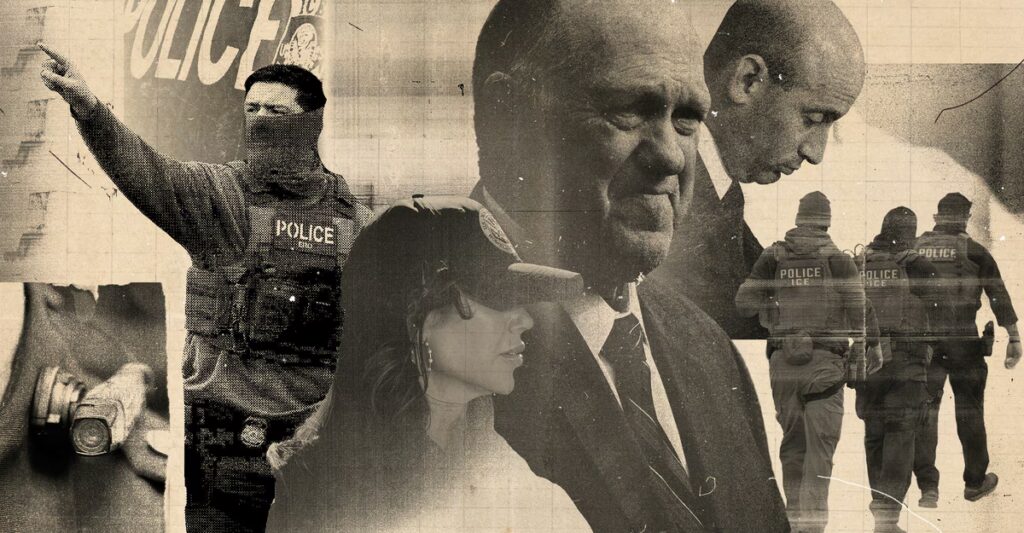
*Illustration Sources: George Frey / Getty; Olivier Touron / AFP / Getty; Stephen Maturen / Getty; Brendan Smialowski / AFP / Getty; Patrick T. Fallon / AFP / Getty; Jim Lo Scalzo / EPA / Bloomberg / Getty; John Moore / Getty.
The post ICE After Minneapolis appeared first on The Atlantic.