World Liberty Financial, the Trump family’s crypto start-up, reached a major landmark last month. The total circulation of the company’s signature digital coin hit $5 billion, cementing its place as one of the world’s top cryptocurrencies.
“New milestones achieved,” the company declared on social media. The president’s second son, Eric Trump, celebrated the moment with a series of fire emojis.
Much of that success was down to an alliance with the crypto exchange Binance — founded by Changpeng Zhao, the billionaire mogul who was pardoned by President Trump last year.
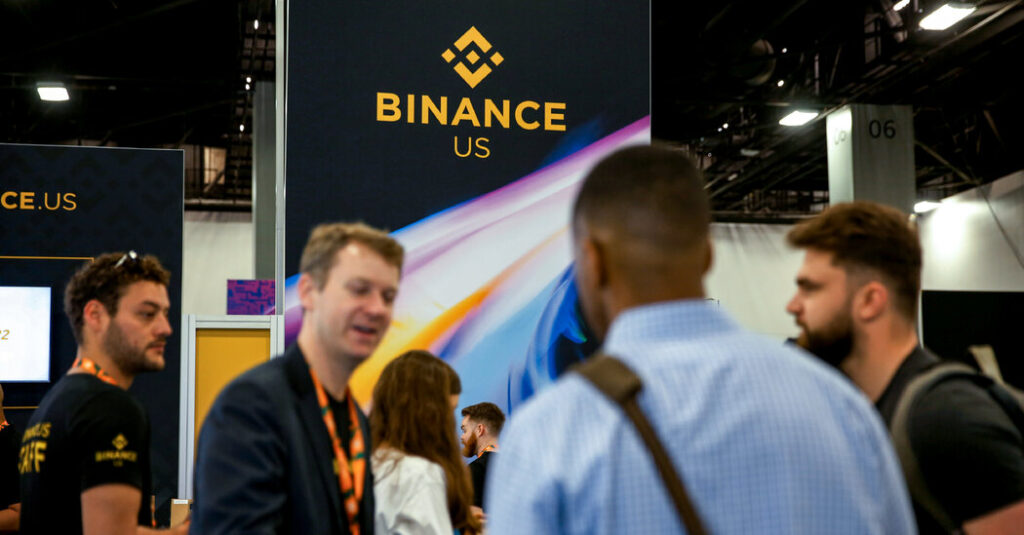
As the world’s largest platform for trading digital coins, Binance has become a vital engine of the Trump family’s business over the past two months. The exchange has offered a series of marketing promotions to encourage its customers to buy USD1 — World Liberty’s stablecoin, a type of cryptocurrency that maintains a price of $1, making it easier to use for transactions.
Of the $5 billion of USD1 coins now in circulation, about 85 percent are held in accounts on Binance, according to the data firms Arkham and Nansen, even though the exchange’s platform is available only outside the United States.
“Most of the money is sitting within Binance, and has really always sat within Binance,” said Jonathan Reiter, a co-founder of ChainArgos, another crypto data firm. “They are the main trading venue for this.”
The relationship between World Liberty and Binance has faced heavy scrutiny from ethics experts and some members of Congress, who view it as a considerable conflict of interest, because President Trump is now both a crypto mogul and the industry’s chief policy maker. The White House has voiced support for legislation, pending in Congress, that would make it easier for crypto exchanges to operate in the United States.
In October, Mr. Trump granted the pardon to Mr. Zhao, who spent four months in prison after he and the company pleaded guilty to money-laundering violations in 2023. Despite the felony record, Mr. Zhao was allowed to remain Binance’s majority shareholder, and his clemency could pave the way for the company to break into the U.S. market, where it currently is not allowed to operate.
Since the pardon, the ties between Binance and World Liberty have only strengthened, even as the Trump family’s company has faced increasing political pressure from Democrats.
Binance announced in December that its customers could convert other firms’ stablecoins to USD1 without paying a fee — a potentially significant concession, because trading fees are the primary source of revenue for crypto exchanges. In effect, Binance made it much cheaper and easier for customers to buy a coin issued by the president’s company.
The company also gave customers the chance to receive interest on USD1 holdings — a type of promotion that has become the subject of heated legislative debate in Congress. On Jan. 22, Binance said customers who stored USD1 in their accounts would receive a share of $40 million in rewards.
Over the next week, the amount of USD1 traded worldwide shot up by nearly $2 billion.
Stablecoins are a hugely profitable sector of the crypto industry. Issuers like World Liberty accept deposits from traders, give them coins in return and then invest the deposits to generate a yield that the issuers keep. Exchanges are crucial to the process, offering a platform for customers to buy the coins.
So far, World Liberty has invested most of its deposits in government money-market funds, according to financial reports released by the company. Those funds generate an annual return of about 4 percent — or $200 million in potential revenue on $5 billion in deposits.
A spokesman for World Liberty said the promotional incentives were funded by the Trump crypto company, not Binance, calling that arrangement a “standard practice” for stablecoin issuers.
World Liberty “provided a marketing budget to Binance and other non-U.S. digital asset exchanges, which they spent entirely at their own discretion,” he said.
A spokeswoman for Binance said that “it is not uncommon for large exchanges to hold large amounts of certain tokens” and that Binance offers promotions for a wide range of coins, not just USD1.
“We take legal and regulatory requirements very seriously and comply with applicable laws and regulations in the jurisdictions where we operate,” she said.
A lawyer for Mr. Zhao said that “there are no conflicts of interest or quid pro quos.” And a White House spokeswoman said that Mr. Trump’s assets are in a trust managed by his children and that “there are no conflicts of interest.”
Since Mr. Trump returned to power last year, he has orchestrated a complete overhaul of the government’s approach to crypto, ending a regulatory crackdown that had started in his first administration and embracing an industry once seen as a threat to the U.S. financial system.
At the same time, he and his sons have created a sprawling network of crypto businesses. Mr. Trump marketed a coin called $TRUMP, while his two oldest sons helped start a publicly traded Bitcoin mining business, American Bitcoin.
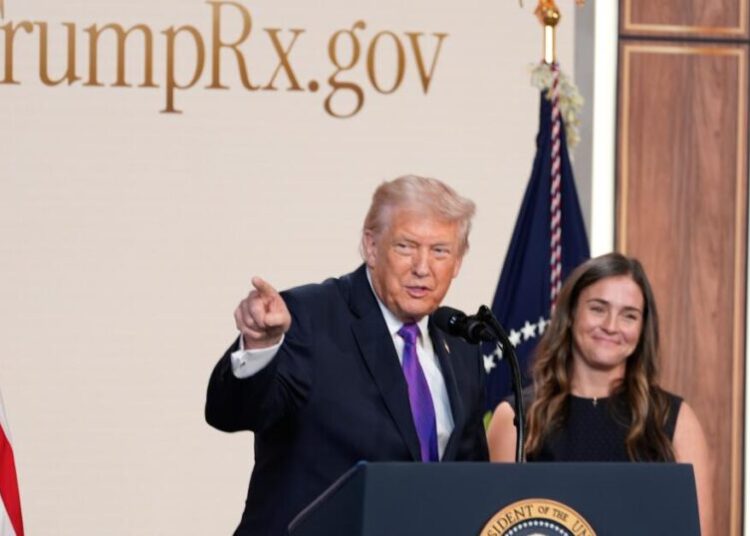
At the center of the family’s crypto empire is World Liberty, run jointly by the Trump sons and the family of Steve Witkoff, the White House envoy to the Middle East. Mr. Trump himself effectively controls a stake in World Liberty, according to his financial disclosure form.
Binance has been pivotal to World Liberty’s business from the start.
When the Trump company was developing USD1, Binance provided some of the underlying technology for the stablecoin, “but not in exchange for anything,” World Liberty’s spokesman told The New York Times last year.
Binance was also an important party in one of World Liberty’s first major business deals. Early in 2025, an investment firm called MGX, backed by the government of the United Arab Emirates, announced it would invest $2 billion in Binance.
The transaction was conducted in USD1, the largest investment ever made with a stablecoin, Binance said at the time.
Zach Witkoff, World Liberty’s chief executive and the son of Steve Witkoff, announced the agreement at a conference in Dubai last May.
“We thank MGX and Binance for their trust in us,” the younger Mr. Witkoff said. “It’s only the beginning.”
The deal created the first public link between Binance and World Liberty, setting off concerns about conflicts of interest in Washington. Mr. Zhao was publicly pursuing a pardon, after he and Binance had pleaded guilty to offenses that allowed terrorist groups and other criminals to transact on the platform.
“The opportunities for grift — in which the Trump administration offers favors to the U.A.E. or to Binance in exchange for their massive payouts — are mind-boggling,” Senator Elizabeth Warren, Democrat of Massachusetts, and Senator Jeff Merkley, Democrat of Oregon, wrote in a letter to U.S. ethics officials last year.
Though Mr. Zhao got his pardon, Binance itself has not been granted clemency. Mr. Zhao no longer runs Binance day to day, but he retained his ownership of the company when he pleaded guilty. Binance is now led by two co-chief executives, including one of its co-founders, Yi He, who has children with Mr. Zhao.
Since Ms. He took on that executive role in December, Binance has continued to work closely with World Liberty.
On Dec. 11, World Liberty announced that Binance was eliminating fees for certain USD1 trades and using the stablecoin as collateral to back another crypto token.
“Binance is giving hundreds of millions of users improved access to USD1,” Zach Witkoff said in a statement at the time.
Twelve days later, Binance unveiled the “USD1 Booster Program,” offering customers the chance to earn interest of up to 20 percent on holdings of World Liberty’s stablecoin.
Then came another promotion in early January: Every week for a month, Binance said, it would offer rewards to customers who held USD1, drawing from a “grand prize pool” of $40 million.
On social media, World Liberty’s founders have trumpeted the incentives on Binance as a crucial step in their company’s expansion. They have also spoken out in solidarity with the exchange.
Last month, one of World Liberty’s top executives, Zak Folkman, defended Binance on social media from criticism over its role in a recent market downturn. Those attacks were “a coordinated smear campaign,” Mr. Folkman suggested.
Some of the promotions offered by Binance intersect with policy debates in the United States that Mr. Trump will have a hand in deciding.
Last year, Mr. Trump signed a bill called the GENIUS Act, which created industry-friendly rules for stablecoins. The bill prohibited issuers of stablecoins, like World Liberty, from offering interest to customers.
But the legislation left open a workaround. While the issuers themselves could not offer the interest, the bill did not stop exchanges from offering it — creating room for business arrangements that might allow similar incentives on U.S. platforms. Coinbase, the largest U.S. exchange, offers customers interest on their holdings of a stablecoin called USDC, which was developed by its issuer, Circle.
Now Congress is considering a much broader bill to regulate crypto exchanges and other branches of the industry. In those discussions, banking lobbyists have pushed for legislators to block the workaround, fearing that the incentives would compete with traditional deposit accounts.
The exact details of World Liberty’s arrangement with Binance are not clear. But given that World Liberty is paying for the incentives, experts question whether the promotions would be legal under the GENIUS Act if they were offered in the United States.
And even if the promotions passed muster under the stablecoin law, they would fall into “exactly the kind of loophole” that Congress is now debating, said Corey Frayer, a former Securities and Exchange Commission official who worked on crypto issues for the agency.
The White House has helped referee that debate, convening banking and crypto representatives for a meeting this week to hash out a compromise. Because Binance operates overseas, it would be free to offer rewards regardless of what happens in Congress. But a ban on rewards — one that Mr. Trump would have to sign into law — would prevent the company from offering similar promotions in the U.S. market.
“Trump has direct skin in the game because of World Liberty and USD1,” said Lee Reiners, a crypto expert at Duke University.
David Yaffe-Bellany writes about the crypto industry for The Times from New York. He can be reached at [email protected].
The post Binance Gives Trump Family’s Crypto Firm a Leg Up appeared first on New York Times.