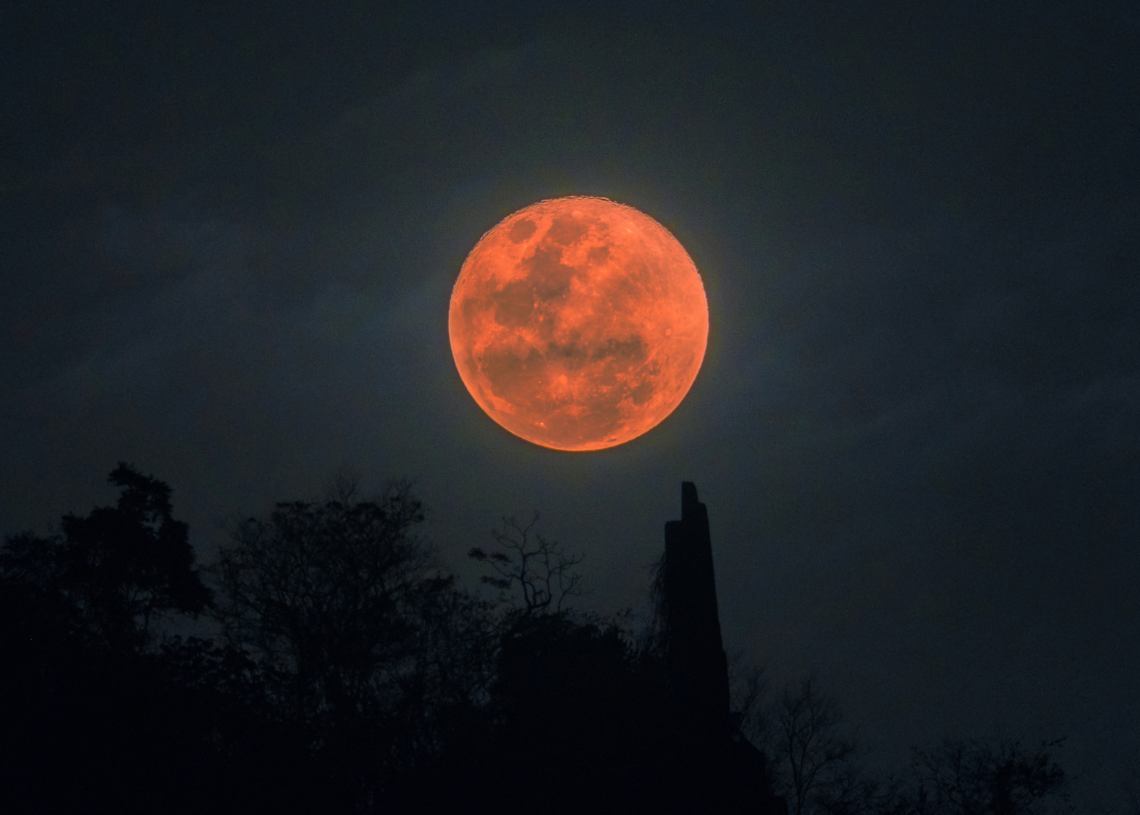
Early on the morning of March 3, you might want to make sure you set an alarm. Before sunrise (yes, it’s insanely early), much of the U.S. will be able to see a total lunar eclipse, an event that briefly turns the full moon a dark red as it passes through Earth’s shadow. It’s rare, visible without special equipment, and easy to miss if you sleep through it.
This “blood moon” happens when Earth lines up directly between the sun and the moon. Sunlight still reaches the lunar surface, but only after filtering through Earth’s atmosphere, which bends red light toward the moon while blocking most other colors. The result is a copper-toned glow that gives the moon a noticeably spooky look for about an hour.
The eclipse’s total phase will last 58 minutes, but the full event lasts way longer. The moon begins passing into Earth’s outer shadow more than two hours earlier, followed by a partial eclipse as the darker core of the shadow moves across the surface. From first contact to the final exit, the entire sequence spans about five and a half hours.
Of course, what you see will depend on where you live. Viewers west of the Mississippi River will have the best chance to see the entire eclipse from start to finish. Along the West Coast and in Hawaii, the moon will sit high enough in the sky to watch the red phase unfold fully. Farther east, including cities like New York and Boston, the moon will set while totality is underway, cutting the show short.
Here’s when to expect the eclipse where you live, according to TimeandDate.com.
- Eastern Time sees totality from 6:04 to 7:02 a.m., though the moon sets during that window.
- Central Time runs from 5:04 to 6:02 a.m.
- Mountain Time gets it from 4:04 to 5:02 a.m.
- Pacific Time lands between 3:04 and 4:02 a.m.
- Alaska and Hawaii catch it even earlier.
Cloud cover will decide everything. Clear skies give viewers in the U.S. Southwest and parts of northwest Mexico the best odds, while other regions might lose the view entirely. No telescope or eclipse glasses are required. Lunar eclipses are safe to watch with the naked eye, which makes them far more forgiving than solar events.
This eclipse also comes with a long gap on either side. It’s the first total lunar eclipse since September 2025 and the last until the end of 2028, when another appears on New Year’s Eve. Miss this one, and you’re SOL for a couple of years.
No one loves a pre-sunrise alarm. Still, watching the moon shift into an ominous red before most people hit snooze is a pretty awesome way to start your day. Miss this one, and the next chance doesn’t show up until almost 2029, which is an aggressively long wait for anything interesting.
The post A Rare Blood Moon Eclipse Is Coming: Here’s How to See It appeared first on VICE.