In recent years, Pakistan has arrested, jailed or killed dozens of Islamic State militants along its border with Afghanistan. It was praised as a “phenomenal partner” by a U.S. official after extraditing the suspected plotter of a 2021 attack in Kabul, the Afghan capital, that killed 13 Americans.
But a suicide bombing on Friday at a mosque on the outskirts of Islamabad, the capital, shows how fragile Pakistan’s progress on security has been. The attack, for which the Islamic State claimed responsibility, demonstrated the continuing threat posed by that group, one of several insurgencies Pakistan is struggling to contain as it tries to attract foreign investment to boost its moribund economy.
At least 31 people died and 169 others were wounded when an attacker detonated a vest loaded with explosives at the Shiite mosque during Friday prayers.
It was the second major assault on Islamabad in less than three months, raising fears that insurgent violence was returning to urban centers after being contained in isolated areas for years.
“The Islamic State is so evanescent,” said Iftikhar Firdous, executive director of The Khorasan Diary, an Islamabad-based research platform, meaning that its fighters were harder to catch.
“It looks for potential recruits who are ripe for terrorism and operates in small cells,” he said. “That is why it is so difficult to detect and can carry out these devastating attacks.”
The bombing was the latest in a series of deadly Islamic State assaults across the world in recent months, including the mass shooting on a beach in Sydney, Australia, that killed 15 people in December and relentless assaults on rural communities in Nigeria. U.S. officials also blamed the killing of three Americans in Syria on the group.
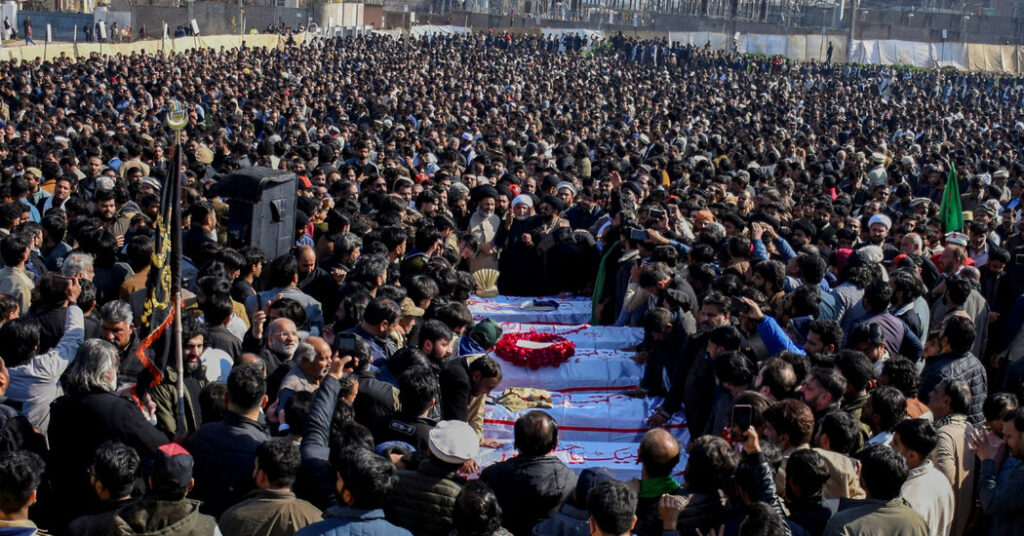
On Saturday in Islamabad, hundreds gathered outside the mosque for a funeral for victims of the bombing. Armed security personnel watched over them from rooftops and embankments.
Ijaz Shah, who regularly worships at the mosque, wept at the sight of a wooden casket that was wrapped in cloth inscribed with religious verses. “All those who died were just like my relatives,” Mr. Shah said.
The attack by the Islamic State, a Sunni Muslim jihadist group, on a Shiite mosque has also threatened to revive sectarian tensions.
Security in Islamabad was tightened in November after a suicide bombing in front of a courthouse, carried out by the Pakistani Taliban, killed at least 12 people. Yet experts and former officials say the capital remains a soft target.
“These barriers and checkpoints give a sense of security, but they don’t do much,” said Ihsan Ghani, who was once Pakistan’s top counterterrorism official.
Of recent security operations against the Islamic State, Mr. Ghani said: “You may have successes in some areas, but like a balloon, squeezing something somewhere doesn’t mean it is not going to expand elsewhere. There’s no cooperation among different Pakistani institutions on this issue.”
Raja Nasir Abbas Jafri, who leads a Shiite political party, called the mosque bombing “a grave failure to protect human lives.”
Officials identified the bomber as Yasir Khan, a 26-year-old Pakistani man who had gone to Afghanistan several times in recent months. On Saturday, the military’s communications wing said five people suspected of orchestrating the attack, including the accused mastermind, had been arrested in two cities near the Afghan border.
Islamic State Khorasan Province, as the militants’ affiliate in Afghanistan is known, has been described by United Nations experts as the major threat coming from that country, even though the Taliban government there says it has mostly eliminated the group. In Kabul last month, one of its bombers killed seven people in a Chinese restaurant.
Afghanistan and Pakistan have accused each other of harboring the group’s militants. ISIS-K, as it is often called, has maintained strongholds in the border areas of both countries, say security officials and experts, who estimate that the branch has about 2,000 active fighters.
The recent violence, from ISIS-K and other militant groups, threatens to undermine Pakistan’s attempts to court foreign investors. It renewed a vital economic partnership with China last summer, and this week it secured $1.3 billion in American mining investment under an effort by President Trump to build stockpiles of crucial minerals.
Yet its security situation has not been this volatile in years. Less than a week before the bombing on Friday, separatist insurgents carried out a dozen simultaneous attacks in Balochistan, a province with vast reserves of copper, gold and lithium where Chinese state-owned firms have invested billions of dollars, and where the United States is now signaling its own intent to invest.
Security forces have also faced relentless assaults by the Pakistani Taliban in the west, near the Afghan border, another resource-rich area eyed by the United States.
“Pakistan brands itself as ripe for investment in its mining sector,” said Adam Weinstein, an Afghanistan and Pakistan analyst at the Quincy Institute, a research center in Washington.
“A bomb blast at a Shiite mosque in Islamabad doesn’t change that, but it might change whether a U.S. delegation is going to travel to Islamabad to hear their pitch,” he said.
Salman Masood contributed reporting from Islamabad, Pakistan, and Zia ur-Rehman from Lahore.
Elian Peltier is an international correspondent for The Times, covering Afghanistan and Pakistan.
The post A Mosque Bombing Undercuts Pakistan’s Bid for Security appeared first on New York Times.