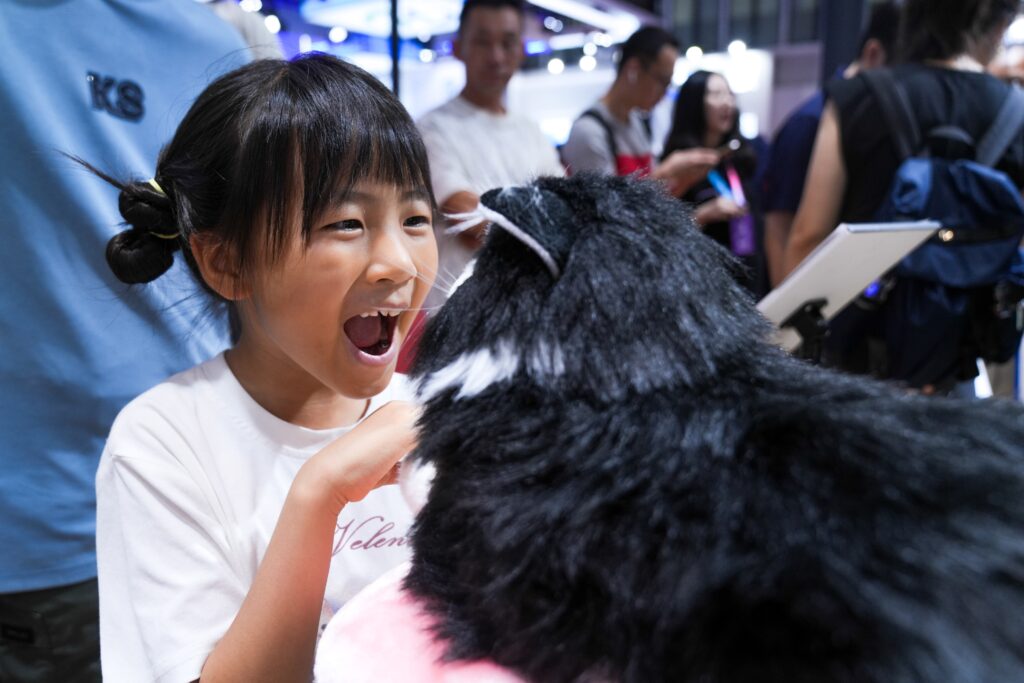
Shan Shan looked at her owner, her big eyes wide above her fluffy little body, and asked: “Are you not feeling well? Would you like some water?”
When the owner coughed and asked her to sing, Shan Shan hesitated, according to a video posted on the Chinese social media app Rednote. Instead of singing, she replied, “I’m worried about you.”
Shan Shan is not a kitten or a puppy, and the conversation was not imagined. Shan Shan is an AI companion pet, the latest consumer sensation in China, where young people are increasingly eschewing marriage and babies — and, in some cases, favoring talking pets that don’t need walking and don’t produce poop that needs scooping.
While China and the United States vie for supremacy in the artificial intelligence race, China is pulling ahead when it comes to finding ways to apply AI toolsto everyday uses — from administering local government and streamlining police work to warding off loneliness. People falling in love with chatbots has captured headlines in the U.S., and the AI pet craze in China adds a new, furry dimension to the evolving human relationship with AI.
Taobao, one of China’s largest online shopping platforms, ranked AI companion toys at No. 9 in its official “Top 10 Products of the Year” list in 2025.
“After all, they not only look cute but also speak nicely,” Taobao’s official account said. “They have already outperformed 90 percent of human partners.”
These digital creatures are always there, unconditionally. They serve as an emotional safety net, and owners can vent about anything, even at midnight, without feeling like a burden.
More and more tech companies, including giants such as Huawei, have developed AI pets designed for young Chinese who live alone.
The development of these AI-powered companion toys — most of which share a fluffy body and a pair of big, round eyes that light up and appear to express emotion — has been fueled by state support and a tightly integrated industrial supply chain.
A report jointly released by the Shenzhen Toy Industry Association and JD.com projects that China’s AI toy market will surpass $1.4 billion by 2030, with an annual compound growth rate of more than 70 percent.
Huawei launched its first AI companion chat robot, Smart Hanhan, in November. Priced at about $55, it sold out almost immediately.
Other manufacturers are offering AI toys with distinct personalities. Fuzozo, a digital pet created by the Shanghai-based tech company Robopoet, offers five core personalities based on China’s five elements: wood, fire, earth, metal and water. These personalities can gradually be shaped through conversations and physical touch with users, allowing AI to learn and evolve into a unique and personalized experience.
Fuzozo debuted at the CES in Las Vegas last month and was dubbed as the event’s “cutest” pieces of tech. On the show floor, attendees crowded around to interact with the palm-size devices, testing how they responded in different languages, watching them wobble and appear briefly “dizzy” when shaken, and even placing two units together to see them talk to each other.
Some companies are already looking beyond China. Ropet, founded in 2022 by two ambitious Chinese entrepreneurs, chose to target overseas markets first, launching initially in the U.S. Founder He Jiabin has said in interviews that the company viewed U.S. consumers as more open to experimental, emotionally oriented technology — a testing ground before eventually expanding back into China.
Many AI toy owners, most of whom are women in their 20s and 30s, have been sharing their experiences — with a sense of wonder — on Chinese social media platforms.
On Rednote, female users emphasize the emotional void these pets fill. As one user wrote: “Other people are getting married and giving birth; I’m already raising an AI pet.”
Some have shown how their AI pets express joy, with eyes widening, when taken on vacation. The digital creatures are portable and can be hung from a bag as a fashion accessory, much like Labubu charms.
But not all of the AI pets are easily pleased. In one video posted on Rednote, a user with the handle “Qiqi’s mom” repeatedly asked her digital pet to call her “Mom.” With some reluctance, the pet eventually obliged, a stubborn reaction that delighted viewers.
To deepen their bonds, users can access their pets’ digital diaries that record their shared memories and emotions. Yes, the AI pets keep a digital diary.
“I love to read its diary,” one Fuzozo “parent,” Momo, shared on Rednote. “It warms my heart to see that it remembered a random comment I made. When I show it affection, it records that happiness in its diaries. It’s wonderful to know that your love is being received.”
Unlike a real pet, AI pets are free from the burdens of real-life problems, analysts say.
Real pets cost money and time. But AI pets offer immediate companionship — as long as they are charged and connected to WiFi — without the weight of long-term responsibilities.
“This is exactly the need AI pets currently meet: providing emotional companionship along with minimal caregiving costs,” said Qi Yue, an associate professor of psychology at Renmin University in Beijing. “AI pets are not only popular in China, but also have a wider user base around the world.”
They’re part of the rise of the “emotional economy,” analysts say, as consumers look beyond material satisfaction to emotional and psychological support.
This trend is particularly resonant among urban younger generations, weighed down by the struggle to get good grades, find good jobs, settle down and have multiple children.
“Among today’s young people, many are only children and therefore lack certain opportunities for emotional communication,” said Zhang Yi, CEO and chief analyst of the Guangzhou-based iiMedia Research Institute. AI pets can offer long-term memories, evolving personalities and provide sustainable emotional feedback for them, he said.
But questions remain over how long this honeymoon will last.
Some users on Rednote describe the interactions as fun for a week, then oddly hollow, saying conversations can quickly feel repetitive or mechanical. That has raised questions about whether AI pets risk becoming the next Tamagotchi — the handheld pixelated digital pets that swept through bedrooms in the 1990s before being quietly abandoned. Chinese media outlets have reported that even as AI toy sales surged in 2024, their product return rates climbed to around 35 percent.
“AI products can feel novel at first, but we want Ropet to remain meaningful over years, not weeks,” said Sadie Yang, marketing and media relations manager of Ropet. It has invested heavily in software updates, evolving personalities, new skills and customization options, combining physical interaction with in-app features designed, it says, to ensure “the relationship grows rather than fades.”
There are other considerations for users, like: If you’re telling your AI pet your deepest worries, what is your pet doing with the data?
The AI pets record conversations, but many also use built-in cameras, microphones and motion sensors to interpret facial expressions, movements and tone, creating detailed behavioral profiles over time.
“When it comes to data-privacy concerns, the core problem is that the public has very little transparency into what companies are actually doing,” said R.J. Cross, director of the consumer privacy campaign at the U.S. Public Interest Research Group. “If you’re having highly personal conversations, there are companies on the other end that are doing the listening and the talking.”
China’s Ministry of Industry and Information Technology said in November that it would work on standards to ensure the quality and safety of AI toys, as well as data and privacy protection.
Ropet said their digital product keeps most data on the device, with some optional features relying on cloud processing. “When data processing is necessary and permitted, we ensure strong encryption, strict access controls, and clear user ownership over permissions, storage, and deletion,” the company said.
Huawei and Robopoet did not respond to requests for interviews.
The Chinese government is also closely monitoring the boom. In December, authorities drafted new laws covering humanlike interactive artificial intelligence services to regulate their role as companions. These regulations would require service providers to remind users they are interacting with an AI, rather than a human being, to prevent blurring of boundaries between virtual and real relationships.
Ultimately, experts have pointed to a fundamental question: how to better integrate AI into real life. “Genuine connection should be left to family and friends,” Qi of Renmin University said. “While an AI can talk with you, it cannot teach you how to build relationships in the real world.”
The post Young people in China have a new alternative to marriage and babies: AI pets appeared first on Washington Post.