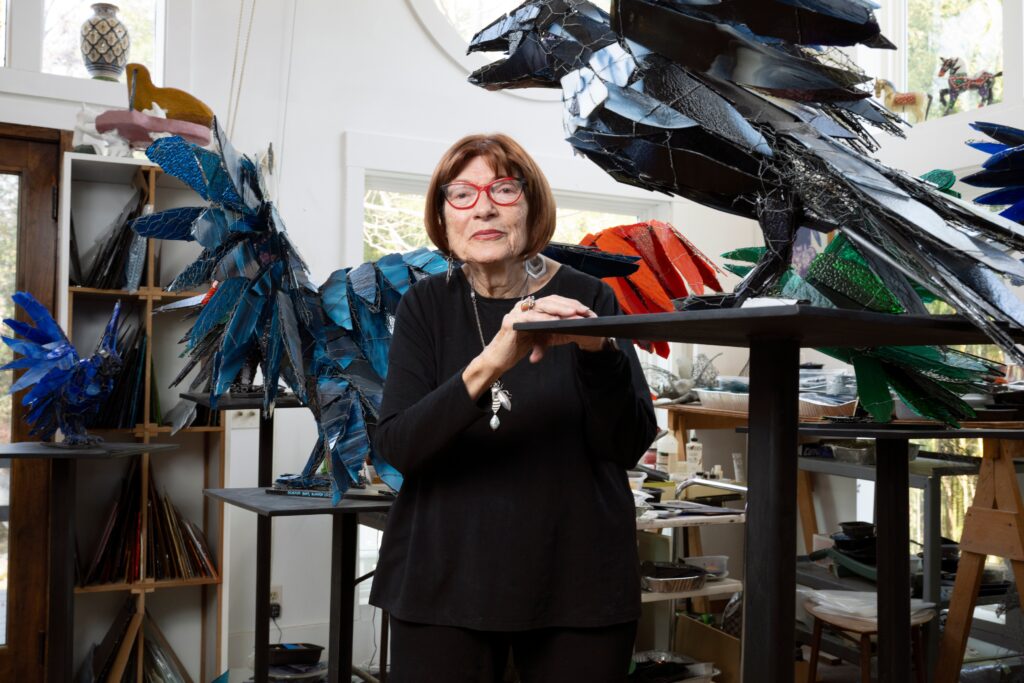
To visit Joan Danziger in her studio is to travel to another dimension.
Located in the rear of her rambling Arts and Crafts home in Northwest Washington, past a cluttered dining room and sunny kitchen, down a long, dark, wood-paneled hallway, Danziger’s studio is a Serengeti of fantastic beasts. Here, a lion and fox with human bodies ride bareback on a gigantic parrot that is suspended from the ceiling, next to the world’s largest butterfly. There, a festooned wall of beetles the size of carry-on luggage and shimmering with wings of broken glass, a Kafka novel come to life. Just outside the sliding door to her backyard is a trio of musicians, the “Sunshine Girl’s Love Band,” each a hybrid of a human and a creature. Everything that touches the eye is adorned in the colors of an acid flashback.
For nearly three years, Danziger, 91, has been populating a new universe, this one inhabited by ravens, turning bolts of poultry netting and pieces of hand-cut slag glass into magnificently menacing (or, depending on who’s looking, menacingly magnificent) birds in preparation for an exhibition opening this month at the American University Museum at the Katzen Arts Center. That show, “Ravens: Spirits of the Sky,” is paired with “The Magical World of Joan Danziger,” a concurrent retrospective — 117 pieces in all — that chronicle Danziger’s exuberant oeuvre from 1968 onward.
Leonora Carrington had her crocodile, Louise Bourgeois her spider. And even though Danziger’s works loom just as large, her name isn’t as familiar. The Katzen shows are Danziger’s klieg light, an opportunity to spotlight an artist who came of age with some of the 20th century’s most daring artists and carved her own path in D.C. as the city’s painters made their own marks. She never stopped. Her current work, she says, speaks to the time in which we are living, as fractured and broken as the wings of her birds.
“My sculptures are involved in a phantasmagorical world,” begins the artistic statement for Danziger’s series of ravens, considered by many cultures to be messengers between the material and spiritual realms. Hers are caught either landing or taking off; their curved beaks are always open, in conversation or — in the case of a purple raven clutching a yellow frog in its mouth — in brutality. Larger, hooked beaks are a characteristic that differentiates ravens from crows, along with their larger size, throat feathers that stick out like an Elizabethan ruff, and guttural croaks instead of caws.
Also, according to Danziger, “ravens have enormous mythologies.” Crows, she says dismissively, do not.
“I come in every morning and it’s like they’re talking to me,” says Danziger of her flock in a conversation this past summer. “That’s ‘Chatterbox,’” she continues, pointing to a sapphire-colored raven.
Danziger would eventually name all of her ravens. The one absconding with the yellow frog is “Amethyst Raven & the Frog Prince.” Another, “Stella Blue,” has ruffled, teal wings and a beseeching expression.
On this day, Danziger is working on a white raven, yet unnamed. “White is the hardest, because it’s white, white, white,” she says, meaning that, although the bird is all white, there are varying shades of the color that she must consider. She procures her sheets of glass in Kensington, Maryland. The white glass, opalescent with swirls of gray appearing in places like nimbus clouds, costs $104 a sheet.
With the chicken-wire armature already in place, the tedious job of cutting and setting the glass comes next. Each raven takes four to five months to complete. “Time doesn’t mean anything,” Danziger says. “You get so completely absorbed.” She doesn’t listen to music or podcasts while working. Her ravens, she says, make enough noise.
Having arrived home from the gym, Danziger is dressed in a hoodie and running shoes, and, in preparation for work, wears a wrist guard and lime-green utility gloves. Sitting in a wonky red office chair in front of a scarred wooden table, Danziger starts in on the bird’s head. She scores the glass before taking to her cutters, a technique that creates breaks that are jagged and imperfect, much like the texture of feathers. Then, Danziger will find a location for the glass, trying it here or there before securing it in place by using a small set of pliers to twist the wire around the glass, essentially encaging it. Her former studio assistant, Rebecca Ayn Lasky, will handle the feet, which require more dexterity. (In 2002, Danziger lost two fingers — middle and ring — on her left hand, the result of a horrific car accident of which she will say very little.)
“This kind of work is very hard on your hands,” she says, using a glove to push back an errant section of her paprika-colored hair, which she wears in a neat pageboy.
Danziger secures a few more pieces of glass around the raven’s head and rolls her chair back a bit. “When I look at my white raven,” she says, observing her work, “it’s starting to have a personality. I never have a failure.” In a few weeks, Danziger will land on a name for her white raven: “Snow Crystal.”
To be a female artist in the 1950s, making a name for herself in a scene dominated by men, Danziger needed to have a fortified ego. “I’m a perfectionist,” she says at one point, referring to one of her ravens. “That’s why it’s so beautiful.” She frequently uses the word “masterpiece” to describe her work. And, during conversation, she’ll pop up from her seat to fetch a catalogue or article and read aloud what flatteries others have said about her.
“There is always something about Joan’s work that is not straightforward,” says Ori Soltes, a professor at Georgetown University who has written an essay about ravens for the Katzen’s “Spirits of the Sky” brochure. He and Danziger met at a mutual friend’s party, where, after a bit of chitchat, Danziger persuaded him to write about beetles for an earlier show at the Katzen, called “Inside the Underworld.”
To explain Danziger’s surrealistic dreamscape, Soltes tells a story about Paul Gauguin and Camille Pissarro. “Gauguin wanted to paint a tree blue. And Pissarro said, ‘If you feel the tree is blue, then paint it blue with the bluest color in your palette.’” Soltes pauses to make his point before continuing: “Joan’s taken that idea and ran with it.”
What interests Soltes about Danziger’s work in particular is her ability to blur the boundaries of her mediums. “Sculpture is about shape, and paintings are about color,” he says. “Joan’s sculptures are paintings, and her paintings are sculptures.”
Danziger began her artistic life not as a sculptor but as an abstract painter. She was born in 1934 in New York City, where her mother took her to museums and she fell in love with surrealists such as Max Ernst, René Magritte and Salvador Dalí. “I’ve always been interested in dream imagery, the unknown, the unconscious,” she says. She spent a lot of time in her room, drawing animals and reading books on witchcraft and Greek mythology.
She graduated high school at 16 and attended Queens College before transferring to Cornell University, graduating with a bachelor of fine arts in painting.
In 1955, Danziger moved to Rome, studying at the Academy of Fine Arts in Rome for two years before moving back to New York City, where she spent her time visiting museums and galleries. She dated abstract painter Milton Resnick, who introduced her to artists such as Willem de Kooning. Both men lived in a building on 10th Street. “They gave a lot of parties in the evening,” she recalls with a chuckle. Photos of her around this time show a sliver of a woman with long, dark hair and a direct gaze, not unlike the young Joan Baez.
In 1958, she married her husband, Marty, an attorney, after knowing him for one week. They spent eight months in Europe on their honeymoon. Because of her interest in witchcraft, Danziger had wanted to go to Haiti to learn voodooism. “But instead,” she quips, “I went to Italy.”
When the couple returned home, Danziger got a studio near Coenties Slip, now memorialized in a book by Prudence Peiffer called “The Slip: The New York City Street That Changed American Art Forever.” Located at the tip of Lower Manhattan and then home to dilapidated and abandoned sail-making warehouses, the neighborhood attracted the likes of Robert Indiana and Ellsworth Kelly. It was there that Danziger got serious about her drawings of strange animals and dream imagery.
She soon exhibited an erotic double drawing of people and animals at the Van Bovenkamp Gallerie on 55th Street. “That’s when the police raided the show!” she says. Her husband was working in the district attorney’s office, and, according to Danziger, the police said to him, “Your wife has done a dirty drawing.” Her husband, she says, responded: “I know. It’s great, isn’t it?”
When he got a job in D.C., the couple moved and settled in Dupont Circle. By then, Danziger was tired of working on flat imagery. “Even though I was trained as a painter, I wanted to try a different medium.” Which is how she came to mixed-media sculpture.
At the time, D.C.’s art scene was dominated by the Washington Color School and painters. “She came up at a time where what she was doing was opposite of what was considered important,” says Jack Rasmussen, the director and curator of the American University Museum at the Katzen. “The world has come around to her.”
In 1970, Danziger, then 36, had her first show in the rotunda at the Corcoran. It was, she says, her proudest moment. She exhibited “Up Against the Pole,” an 18-foot sculpture composed of four animal-human hybrids stacked on top of one another, a Lynchian totem pole. It was surrounded by the “Tangiers Starkey and the Flakey Makes,” which, she says, was a big hit. In fact, the museum had to stop visitors from attempting to play the horse’s drums.
The National Museum of Women in the Arts, the New Orleans Museum of Art and the New Jersey State Museum all have pieces of Danziger’s work in their permanent collections. Her fantastical beetles, prancing horses and trees with elaborate root systems crawling with tiny animals also can be found in private residences across the country.
Reviewing her body of work for the Katzen retrospective has put Danziger in a reflective mood. According to her calculations, she has made 380 sculptures in her lifetime. “Being a sculptor is complicated,” she says with a sigh. “First of all, it’s hard to sell. One guy told me, ‘I don’t like sculpture, because, every time I turn around, I bump into it.’”
It’s a hazard that worries Rasmussen as well. As he walks through the gallery space that will house Danziger’s ravens, he begins to wonder out loud: “How will I be able to protect the viewer from all that chicken wire and broken glass?” There is also the feat of engineering that will go into suspending some of the birds from the gallery’s ceiling.
It comes with the territory. Ravens are prophecies of danger, after all. They’re also tricksters. And, unlike a murder of crows, a flock of ravens is commonly called an “unkindness” or a “conspiracy.” But Danziger asserts that ravens are also emblems of hope. “Because they can fly,” she says.
“I have a fantasy about flying,” Danziger continues. “I want to be flying in the sky and free.” After she dies, she’d like to come back as a bird of prey. “They are soaring and dangerous and strong. I’m not interested in cute little birds.”
The post The strange menagerie of sculptor Joan Danziger appeared first on Washington Post.