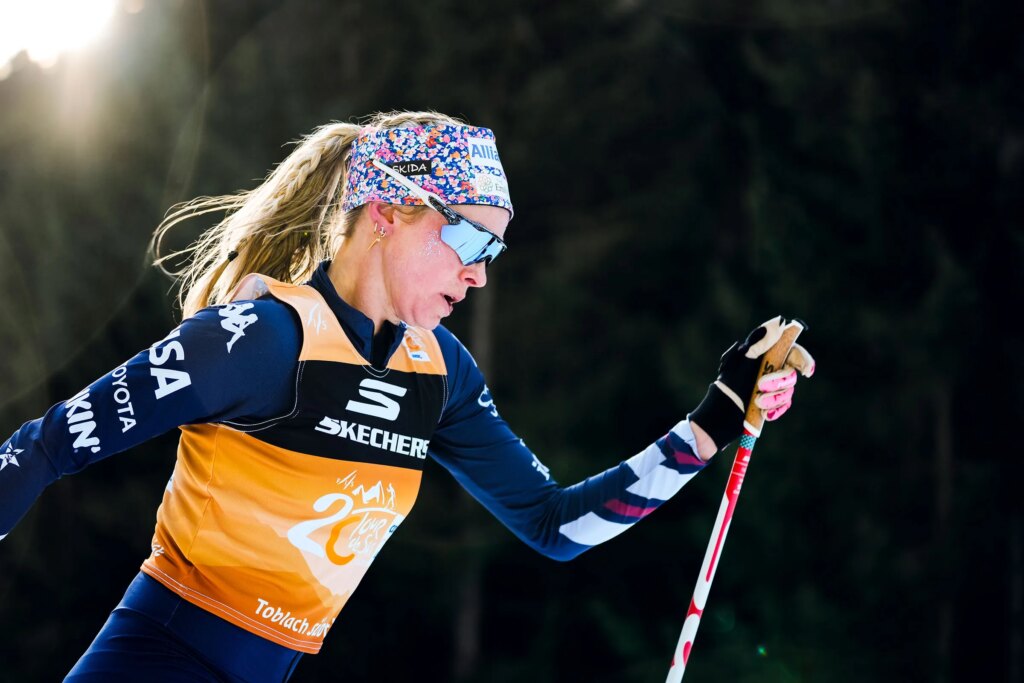
Jessie Diggins, America’s most-decorated cross-country skier ever, is plenty motivated to shine at the Milano Cortina Olympics—her fourth and final Games. Sure, there’s the matter of Diggins attempting to win the first individual Olympic gold medal for the United States, ever, in her sport. But just as important as the ultimate prize, Diggins says, is her quest to share her last Olympic experience with friends, family, and fans. This support system was absent four years ago in Beijing, where she won individual silver and bronze medals, due to COVID restrictions.
[time-brightcove not-tgx=”true”]
Win or lose, she wants to give them a thrill. “That’s why I’m here, training my brains out,” Diggins, 34, tells TIME during a conversation from Park City, Utah, in October. “It’s the challenge of, ‘How deep into the pain cave can I go?’”
Pretty deep, it turns out. Diggins often refers to the lengths she’ll push her body and mind as the pain cave, and with that mentality she has racked up her fair share of victories. She owns three career overall crystal globes (2021, 2024, 2025) as the best overall women’s cross-country skier in the world, and in January she won her third overall title in the Tour de Ski, the most prestigious multistage race in her sport. This season, she once again leads the world standings. She also made history in 2023, when she won America’s first individual gold medal at a world championships, taking the 10-km freestyle title.
Read More: How Figure Skater Amber Glenn Took Control of Her Life
In Milano Cortina, Diggins—who won Team USA’s first-ever cross-country Olympic gold in 2018, in the team sprint freestyle competition with Kikkan Randall—will compete in both sprint and distance races. The call of that victory in South Korea, by NBC’s Chad Salmela, describing Diggins’ furious comeback sprint to the finish—”Here comes Diggins! Here comes Diggins! … Yes! Yes! Yes! … Gold!”—provided an indelible moment of those Games.
That gold changed Diggins’ life. “All of a sudden you have economic stability to be able to pursue your sport as long as you want,” she says. This security also allowed her to turn her attention to others. Diggins, for example, is on the board of the Share Winter Foundation, a nonprofit that funds recreational, youth learn-to-ski and -snowboard programs across the country. She’s also a member of the athlete alliance for Protect Our Winters, a climate-advocacy organization. Lack of natural snow and warm weather have caused the cancellation of many races in recent years.

And since 2018, Diggins has partnered with the Emily Program, an organization that treats people with eating disorders in Washington, Minnesota, Ohio, Pennsylvania, North Carolina, and Georgia. The Emily Program, whose name Diggins wears on her headgear while racing, is dear to her: she went there for eating-disorder treatment after high school, and she suffered a relapse not long ago.
“I wear my past on my head at all times as not only acknowledgement that it’s OK if you’re not perfect, it’s OK if you need to ask for help, but also to keep using this as an icebreaker over and over for other people,” she says.
Diggins publicly disclosed her eating disorder in a blog post in June 2018, a few months after her Olympic team win. “When you put something out into the world, you don’t know where the ripples are going to go,” she says. “A number of coaches and athletes and adults, both male and female, have reached out to me in a variety of ways, saying, ‘Oh my God, your story is my story.’ Or, ‘I’m a parent, I don’t comment on the size of my daughter’s body anymore. I asked her what her goals are for the day.’ It’s been the most meaningful thing that I’ve ever done my entire life.”
Read More: All the Jumps Ilia Malinin Is Expected to Perform at the Olympics
In her senior year of high school, Diggins’ self-described “type-A” approach began to backfire. “I was putting so much pressure on myself to be perfect in everything that I did, and so I really started to need some sort of coping mechanism,” says Diggins. “My eating disorder essentially became a way to numb that voice in my head that was saying, ‘You’re not enough, you’re not doing enough, you will never be good enough.’ I would never speak to another human being the way I spoke to myself back then, which is terribly sad.”
Her parents noticed that Diggins, usually happy-go-lucky, became more withdrawn, anxious, and angry. “I think there’s this myth that if someone is suffering from an eating disorder, you will know because their frame will shrink,” says Diggins. “That’s not necessarily true. I was, emotionally, a much smaller version of myself, even though my exterior didn’t change.” Her parents staged an intervention, and for two months, she received daily outpatient treatment from Emily Program therapists.
Diggins attributes her relapse in the summer of 2023 to a whirlwind schedule that kicked in right after the PyeongChang Games. “All of a sudden, I became the face of U.S. cross-country skiing, and I was asked to do everything, and I didn’t want to say no, because I’m a people pleaser and I desperately wanted to give back to the ski community that has given me everything,” she says. “But I ran myself into the ground. I mean, I did 50 events in 100 days.” Even after this initial rush of commitments, she continued to attend functions outside of her skiing regimen, and worked tirelessly to bring a World Cup cross-country event to Minneapolis, just 30 miles from her hometown of Afton, Minn.
“I just forgot how to set healthy boundaries for myself and then enforce them,” says Diggins. “I was blowing through warning signals from my brain, from my body. I was like, ‘No, I can keep going. This is fine. I’m fine.’ And my body and my brain was like, ‘All right, then we’re going to bring back your eating disorder. Because we need to bench you. And this is the only thing you will listen to, because it is in your face.’” Thankfully, her past experience allowed her to understand what was happening, and she could immediately lean on her sports psychologist, her husband, her coach, and her teammates for support.
They’re her safety net. “You can have multiple bailouts within your life,” says Diggins. “You’re allowed to ask for help more than once. Long story short, I got back to a really good place and that’s where I’m at now. We continue to work on that safety net, to keep growing it and strengthening it. Because what I had to realize is that I will always need that net there. That’s hard to come to terms with. This is a part of my brain that’s going to be there my whole life. At times it’ll be silent, and maybe at times it’ll be loud. But I have to be prepared and acknowledge its existence, because it is a part of me. It’s a highly destructive but functional warning system.”
Body and mind sound, Diggins is especially pumped for the 50-km mass-start event on Feb. 22, the last day of the Games. For the first time, men and women will race the same distance in this signature event (the women raced 30 m in Beijing; Diggins took silver). “50 km, that is the iconic long-distance race, and it always has been in our sport,” says Diggins. “And women were never granted the opportunity to do it. I remember being really upset about that. I love pushing myself, that’s my whole thing. I love going deep into the pain cave and just seeing what my body’s capable of. And I was like, ‘Let me do this.’”
Ah, the pain cave; Diggins’ happy place for these Olympics. “No one’s going to give more than me,” she says. “People can expect seeing a pretty wrecked and shattered athlete crossing the finish line.”
The post ‘The Most Meaningful Thing I’ve Ever Done.’ Olympian Jessie Diggins on Opening Up About Her Eating Disorder appeared first on TIME.