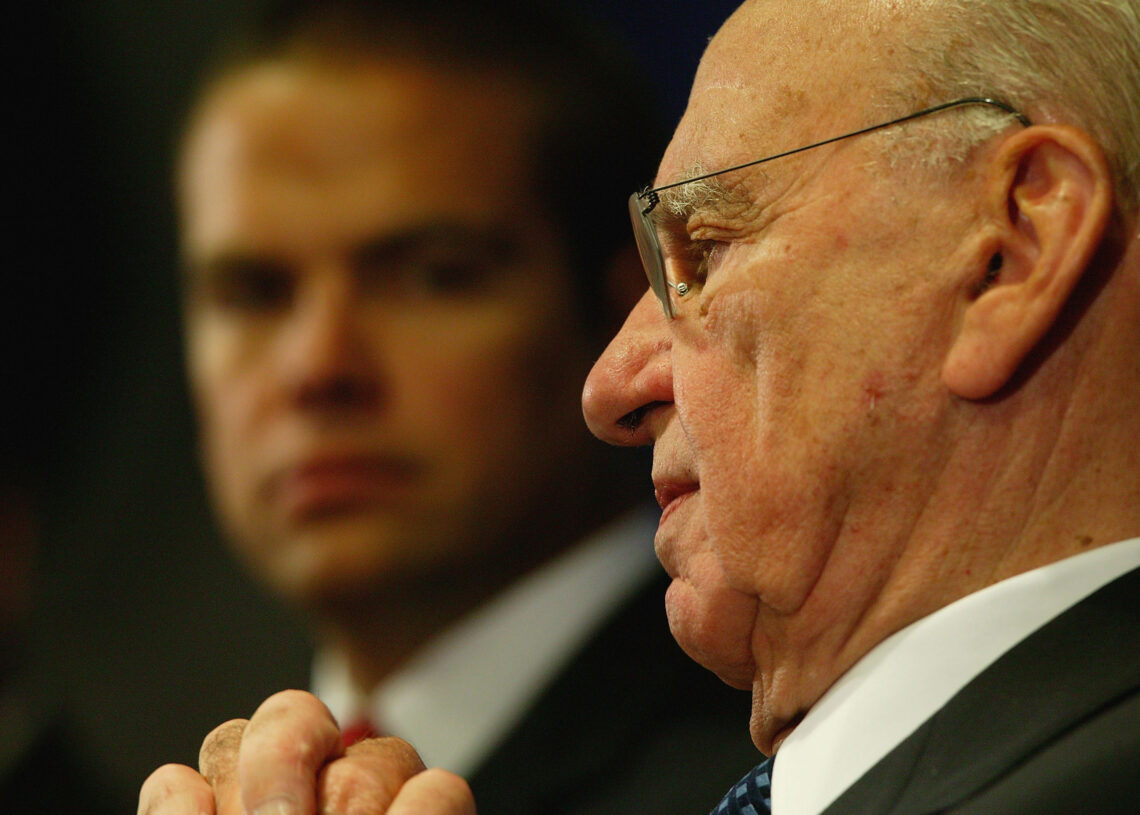
“Bonfire of the Murdochs: How the Epic Fight to Control the Last Great Media Dynasty Broke a Family — and the World,” by Gabriel Sherman; Simon & Schuster, $29
For anyone who has been missing the family feuds, boardroom conflicts and brutal tirades of the HBO drama “Succession,” a replacement has finally arrived. Gabriel Sherman’s “Bonfire of the Murdochs” takes us inside the media behemoth built by Rupert Murdoch that, at least in part, inspired the show, culminating in the epic court battle that last fall settled control of the Murdoch empire. It is a gripping account, with plenty of jaw-dropping revelations. And yet, there is also a flaw at the narrative’s heart. In the end, the author takes the wrong side in the fight. The reader may instead end up thinking: Let Murdoch be Murdoch.
Sherman treads some familiar ground when he is covering Murdoch’s rise. But it is in his detailing of his relationship with his children that the book comes into its own. Murdoch family gatherings are hardly for the faint of heart. The description of a family therapy session is excruciating, as are the withering takedowns and character assassinations that Murdoch regularly dealt out. Anyone contemplating fatherhood, especially if the proprietor of a major business, would be well-advised to read Sherman. It is a brilliant guide to how not to love your children.
But the real core of the story is this. The empire was meant to be left in trust to Murdoch’s first four children, Prudence, James, Elisabeth and Lachlan, with the two boys groomed to take operational control. And yet, by 2010 Murdoch realized something had gone dramatically wrong. “Rupert knew that James, Liz, and Prue wanted to steer News Corp to the political middle, but now the rift was out in the open,” writes Sherman (it is telling that the author views the family’s liberal wing as championing the “political middle”). Murdoch made a fateful decision. He would break the trust and put Lachlan, the only one who shared his views, in control. “I’m just sick of being told I’m dying,” Rupert Murdoch complained at a shareholder meeting, according to Sherman — when Murdoch was “pushing eighty.” He will turn 95 next month. News Corp. was his empire, and he wanted to determine its destiny.
The stakes could hardly have been higher. “More than anyone, Murdoch’s media created the presidency of Donald J. Trump,” writes Sherman. To James and Liz, this was not just a fight about personal control of a media empire. It was a battle for American democracy itself. Well, perhaps. And yet for all the gripping, fly-on-the-wall “Succession”-style shouting matches, the narrative also starts to go off the rails. The book implicitly assumes that James and Elisabeth were the good guys for wanting to shift News Corp. to the left; by contrast, Rupert, along with his docile mini-me Lachlan were the baddies for wanting to keep it on the right. Sherman leaves little doubt for which side readers should be rooting.
That is, to put it mildly, a questionable judgment. Sure, there is nothing wrong with a company changing its focus, but it needs to be done with a clear commercial rationale by those responsible for its long-term prospects, not on the whim of its inheritors. Just because your name happens to be Kellogg, would you be justified in taking the company out of the breakfast cereal business because you disapprove of processed foods? Or if it happens to be Boeing, to get out of manufacturing planes because they contribute to global warming? Not really. If James and Liz wanted to build a liberal media empire, they could have started one of their own — with their own fortunes. But to try to utterly redirect the company their father had built into a global enterprise was an act of filial disloyalty so breathtaking even a Greek tragedian might have found it a little over the top.
After all, brash populist conservatism has always been central to the Murdoch business. It is not an incidental feature that can be switched on and off. It is, at the core, what all those TV stations and newspapers are about. Even worse, while the three rebel heirs are fighting for control, none of them pauses to ask whether the liberal News Corp. they want would be viable. Would anyone watch a Democrat-cheering Fox News, given they already have CNN? Or read a progressive Wall Street Journal given that the Financial Times has already taken that space? In reality, it was monstrously egotistical of the rebel Murdoch children to want to overthrow the company’s founding principles. And Rupert and Lachlan Murdoch were surely right to oppose that. The family trust was designed to preserve the essence of the company, not to be turned into the vehicle of its destruction.
“Bonfire of the Murdochs” is a great read, and Sherman has done a magnificent job of getting inside the family feud. He is far too scrupulous a writer to abandon impartiality completely, and tells both sides of the story fairly, even if there is no mystery about where his sympathies lie. The tragedy of the tale, as he concludes, is that “over seventy years, Rupert said he was building a family business. But what he built was a business that destroyed his family.” It is very, very hard to feel sorry for a man as rich and powerful as Rupert Murdoch. By the end of the saga, Sherman, against his own instincts, just about manages it.
The post The flaw at the heart of this Murdoch narrative appeared first on Washington Post.