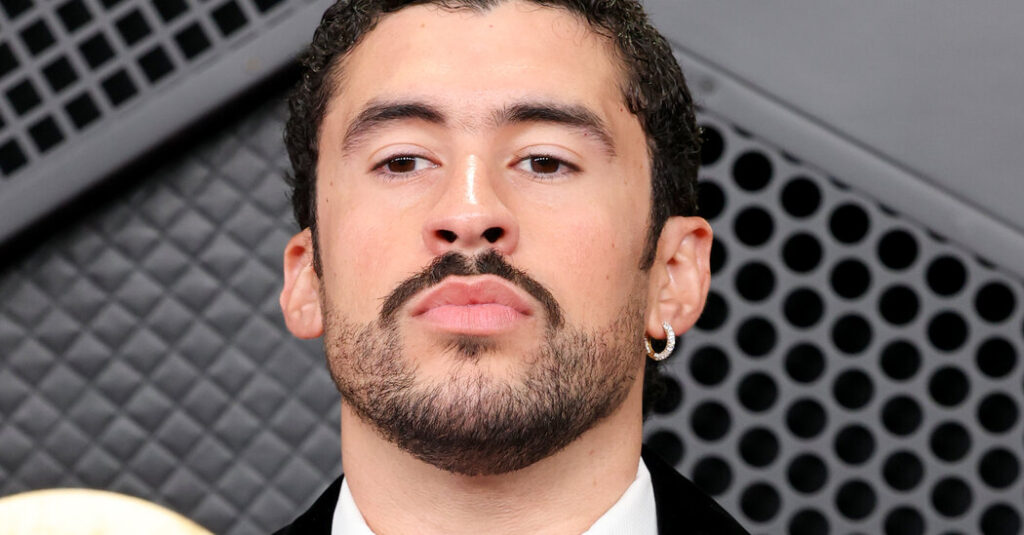
The last time the Super Bowl was in Santa Clara, Calif., a decade ago, Coldplay headlined the halftime show. Benito Antonio Martínez Ocasio was bagging groceries in Vega Baja, P.R. The remix of “Despacito” featuring Justin Bieber — the song that helped build reggaeton into a cornerstone of the American music scene — was still a year away.
So much has changed since February 2016, including in pop culture. That former grocery worker, now better known as Bad Bunny, was Spotify’s most-streamed artist in the world in 2025. At times defiantly political and always recording in Spanish, he earlier this week won the most prestigious Grammy, album of the year, while Mr. Bieber performed in his boxers. No other all-Spanish album has ever won the award. And on Sunday, after deliberately avoiding the continental United States on his current worldwide tour to protect fans from Immigration and Customs Enforcement, Bad Bunny will be the featured performer as that most red-white-and-blue of cultural moments comes back to Santa Clara.
Bad Bunny’s performance isn’t just the story of the ascendancy of a single performer, or of one genre, or even of Latin music more broadly. It’s the sign of something bigger still. America’s pop culture today is multilingual, polycultural and international at its very core.
Another character from early February 2016 — you might remember Donald Trump, the second-place finisher in the Republican Iowa caucuses — isn’t too happy about it. (“Terrible choice,” he told The New York Post, announcing he’d skip the game.) That’s the cultural equivalent of raging about the end of the eight-track tape. The change has already happened.
“Fans are connecting with music from all over the world, in different languages, because it feels authentic to how global our lives already are,” Becky G, the bilingual star vocalist, wrote in an email. “For a lot of people, it feels overdue, not controversial. It’s representation catching up to reality.” Her collaboration with Bad Bunny, “Mayores,” has been streamed more than 3.4 billion times.
English is no longer culture’s lingua franca, or at least not the only one. A third of American pop music fans listen to music in Spanish, according to the Luminate data analytics firm; nearly two-thirds listen to artists from other countries. And the younger and more engaged those fans are, the more international their tastes are likely to be. Streaming services such as Spotify and YouTube have replaced the old cultural gatekeepers, enabling fans to share songs and videos across borders. South Korea is today the fourth-biggest exporter of recorded music, by Luminate’s metrics. Puerto Rico, with its population of just about 3.2 million people, is ranked seventh.
“There are unstoppable movements that are happening and will continue to happen, whether we want it or not,” Isaac Lee, the Colombian-born chairman and chief executive of HYBE Americas, a division of the Seoul-based entertainment giant, wrote to me.
The biggest streaming movie of 2025 — by a lot — was “KPop Demon Hunters,” an American production inspired by South Korea’s hit factory. Netflix’s most popular season of all time continues to be the first season of “Squid Game.” A French role-playing adventure won video game of the year in December. A Chinese cartoon called “Ne Zha 2” beat out “Zootopia 2” as the world’s top box office hit. And in America, the manga movie “Demon Slayer: Kimetsu no Yaiba Infinity Castle” nearly doubled the take of the Oscar favorite “One Battle After Another.” According to Luminate, Latin music now gets about as many streams as country music — in the U.S. of A. Bad Bunny is the sixth most streamed artist inside the United States this year, with 600 million streams in a handful of weeks.
What’s all the more extraordinary is that he’s done so without employing many of the standard tools for crossing over: repeated collaborations with pop acts, or verses in his best English. “I never made a song thinking, ‘Man, this is for the world. This is to capture the gringo audience.’ Never,” he told GQ. “I make songs as if only Puerto Ricans were going to listen to them.” That makes him markedly different from the last Latin performers to headline the Super Bowl: Shakira and Jennifer Lopez.
If anything, he seems to relish subverting convention, telling off ICE on a network owned by Mr. Trump’s ally, wearing a dress on the cover of Harper’s Bazaar and diving from the top rope at WrestleMania. (The one time I met Bad Bunny, at a beyond-elaborate Rolling Stone photo shoot, he stopped the entire proceeding so he could get a tiny tattoo of his abuela’s name inked just below his collar bone.)
Then there’s K-pop, which takes almost the opposite approach, seemingly leaving nothing to idiosyncrasy. South Korea has become a cultural factory, exporting its artists, its songs and its methods for manufacturing stars and promoting them across the globe. It’s become so effective that it’s transcended any nationality.
Katseye, the girl group assembled by Geffen Records and HYBE, was nominated for a best new artist Grammy. Its members are Swiss, Filipino, American and Korean, and the primary writer for its hyper-pop hit “Gnarly” grew up in China and makes music in three languages. That’s something of a switch; as Will Page, the former chief economist at Spotify, notes, many of K-pop’s biggest hits are written by Scandinavians. HYBE recently set up a training and development center in Mexico City to replicate the Katseye model.
Last year was big for Korean and Korean-inspired acts. Members of the K-pop supergroup Blackpink had a breakout year: Rosé scored a top 10 hit in the United States with her song with Bruno Mars, “APT.,” and her bandmate Lisa made her acting debut in HBO’s “The White Lotus.” Then there’s the overwhelming success of “Demon Hunters” (whose K-pop hits are all sung by Asian Americans). But that’s likely a warm-up for 2026, when the biggest band in the world, BTS, will release its first studio album in nearly six years and embark on a five-continent tour.
It’d be tempting to label the rise of BTS and Bad Bunny, or the explosive growth of American country music in places like Germany, as signs of globalization, indicators of some kind of planet-wide monoculture. Tempting — and wrong. In fact, many countries have become more insular in their cultural tastes, according to Mr. Page, the former Spotify economist. Brazilians are increasingly in love with Brazilian music. Italians are consuming more Italian music. In a world of endless choice, served up by TikTok and YouTube, Mr. Page adds, a “claustrophobia of abundance” can take hold, driving people back to the familiar.
The United States is different, and more complicated. It’s really multiple markets in one, each developing and growing side by side. Spanish speakers might be watching musica mexicana videos while Caribbean immigrants and their kids are listening to dancehall, and members of the African diaspora are streaming amapiano. “When you’re that big and that culturally diverse,” Mr. Page says, “it can all happen within your borders.”
The music industry encourages these silos; there are separate charts and Grammys for Latin music, for example. But when an artist gets popular enough in one community, he starts to exert a gravitational pull on every other. Suddenly a song like Tyla’s “Water” or an album like Bad Bunny’s “Debí Tirar Más Fotos” is everywhere.
The MAGA movement initially tried to build its own popular culture silo, promoting a separate, conservative slate of streaming shows, podcasts and musical acts that ran in parallel to the rest of the entertainment industry. Lately, the movement seems to have broken for the mainstream. Nicki Minaj was invited to the world premiere of the Melania Trump documentary, and one of the five musicians getting more streams than Bad Bunny in the United States is the rapper YoungBoy Never Broke Again, whom Mr. Trump pardoned last May on weapons charges. “Whatever Trump doin’,” he rapped on an album released months later, “it’s good for the youngins.”
Still, for the Super Bowl, Turning Point USA, the MAGA-friendly group co-founded by Charlie Kirk, is staging an alternate halftime show. It stars the 55-year-old rapper Kid Rock, whose last Billboard Hot 100 hit was in 2015. One suspects the popularity contest between him and Bad Bunny will be as one-sided as Bad Bunny’s wrestling bouts. Hopefully, the Super Bowl — the part where two teams play football — will have a bit more drama.
Noah Shachtman is a former editor in chief of Rolling Stone. He writes frequently about culture and politics.
The Times is committed to publishing a diversity of letters to the editor. We’d like to hear what you think about this or any of our articles. Here are some tips. And here’s our email: [email protected].
Follow the New York Times Opinion section on Facebook, Instagram, TikTok, Bluesky, WhatsApp and Threads.
The post The Culture War Is Over. Bad Bunny Won. appeared first on New York Times.