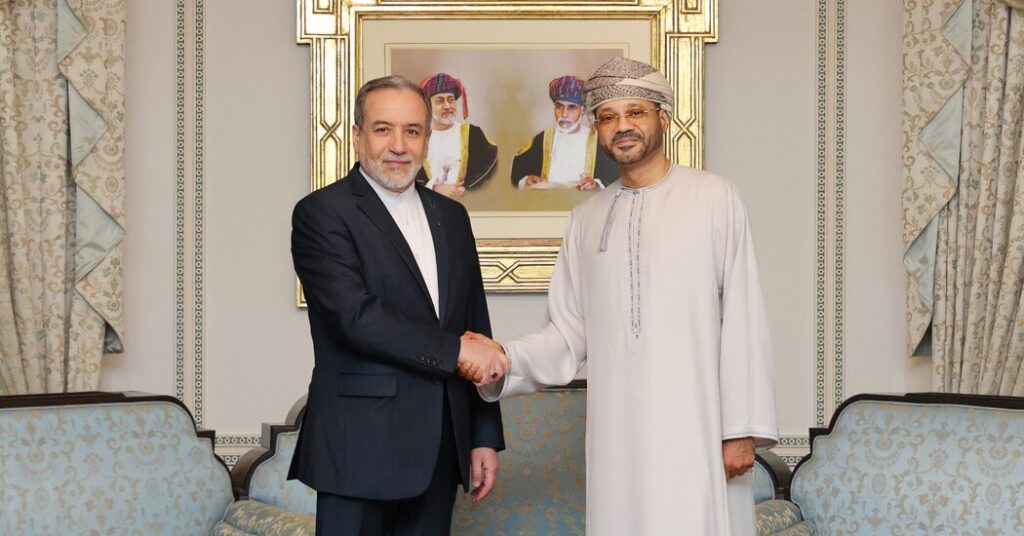
Talks held on Friday between Iranian and U.S. officials in Oman were a “good start” and “exclusively nuclear,” Iran’s foreign minister told state media, adding that the two sides had agreed to continue discussions at a later date.
Iran’s nuclear program had been expected to be part of the discussions. But before the talks began, American officials had said that they also needed to include Iran’s ballistic missiles and its support for militant groups across the Middle East.
The foreign minister, Abbas Araghchi, seemed to rule that out. “We are not discussing any other issues with the Americans,” he told Iran’s official news agency, IRNA. The American delegation in Oman did not immediately comment on how the talks had unfolded.
The negotiations, mediated by Omani officials, were the first between the United States and Iran since they went to war last June, and they were an effort to stave off another conflict.
The negotiations “can continue well,” Mr. Araghchi told Iranian state broadcasters. He said that a “lack of trust” between the two sides had to be “overcome,” adding, “Then we can define a framework for new talks.” Mr. Aragchi said the timing, location and format of the next discussions would be decided later.
Middle Eastern leaders have been pushing hard to bring the United States and Iran together, seeing it as the best chance to avoid dragging the region into yet another war.
Iranian news media reported that there had been several rounds of talks mediated by Oman’s foreign minister, Badr Albusaidi, who also met with both delegations separately. He later said on social media that the aim was to “reconvene in due course.”
“It was useful to clarify both Iranian and American thinking and identify areas for possible progress,” Mr. Albusaidi said.
The American delegation in Oman was led by Steve Witkoff, President Trump’s special envoy, and Jared Kushner, the president’s son-in-law.
Adm. Brad Cooper, the head of U.S. military forces in the Middle East, was also part of the delegation, according to an American official who spoke on the condition of anonymity to discuss sensitive diplomacy. A spokesman for the U.S. military’s Central Command declined to comment.
For more than a month, Mr. Trump has threatened to strike Iran. Last week, what he described as an “armada” of U.S. warships reached the Persian Gulf. Iran has threatened fierce retaliation against U.S. military targets across the region and against Israel, and several Iran-backed militias in the area have also vowed to join the fray.
“Today, we stated clearly that a prerequisite for any dialogue is refraining from threats and pressure,” Mr. Araghchi told IRNA on Friday.
The confrontation began when Mr. Trump warned that he might strike Iran if it killed peaceful protesters as mass anti-government demonstrations swept the country last month. The government’s crackdown on those demonstrations killed thousands, rights groups say.
Mr. Trump has not talked about the protests in recent weeks. Instead, he has vowed to hit Iran “with speed and violence” if it does not accept three demands: ending its nuclear program and discarding its enriched uranium stockpile; reducing the number and range of ballistic missiles; and ending its support for militant groups across the region.
On Wednesday, Secretary of State Marco Rubio said the talks needed to include ballistic missiles, Iran’s aligned militias and its treatment of its own people “in order for talks to actually lead to something meaningful.”
Fearing that talks about Iran’s missiles and regional proxies could cause an immediate impasse, other countries in the region had pushed for the talks in Oman to focus on Iran’s nuclear program, two Middle Eastern diplomats said. Some of Iran’s neighbors have proposed limiting Iran to minimal enrichment capabilities, likely 3 percent or less.
That would be enough for Iran to “save face” by defying Mr. Trump’s demand of zero enrichment, they said, but would effectively amount to the same result, given it is nowhere close to the 90 percent enrichment needed for most nuclear weapons.
Three Iranian officials said that Tehran may also be willing to offer a long-term suspension of its nuclear program. In return, they said, it would expect Washington to lift longstanding sanctions that have contributed to Iran’s economic free-fall.
In January, regional leaders persuaded Mr. Trump to delay his plans to strike Iran. As he ordered a military buildup in the region later in the month, they began a new round of intensive shuttle diplomacy to hold talks that could end the standoff.
Efforts to get the two sides to agree on where to meet — let alone what they will negotiate — have been fraught. Initially, the talks on Friday were to be held in Istanbul and attended by senior officials from Turkey, Egypt, Qatar and Saudi Arabia.
Iranian officials backed out of that plan, citing concerns that they were being cornered into a negotiation with the entire region. Smaller talks in Oman were planned instead, with Oman mediating between the United States and Iran.
But three regional officials said they were struggling to see a way forward on U.S. demands beyond the nuclear issue. Iran is adamant that it will not make concessions on its ballistic missiles, seeing them as key to its defense against Israel in the event of future attacks, the officials said.
Two of those officials said it would be extremely difficult to agree on a mechanism to effectively monitor whether Iran was continuing to send money or arms to allied militias around the region.
The 12-day war Israel launched against Iran last June, briefly joined by U.S. warplanes, battered Iran’s nuclear and military facilities. But Israeli officials are still concerned about Iran’s long-range missiles and have repeatedly pushed Washington to press for curbs.
“There is a deal to be had, but it’s quite narrow and it’s not a great deal,” said Farzan Sabet, an Iran analyst for the Geneva Graduate Institute in Switzerland. “I consider the odds for even such a narrow deal as comparatively low.”
If Tehran effectively gave up on its nuclear program, at least during the Trump administration, Mr. Trump could sell that as a “big victory without firing a shot,” Mr. Sabet added.
“But given the leverage that the U.S. has, and the desire that the U.S. establishment has to solve this Iran issue and move on, it’s also not a great deal from their perspective,” he said.
Erika Solomon, Ben Hubbard, Farnaz Fassihi and Natan Odenheimer contributed reporting.
Aurelien Breeden is a reporter for The Times in Paris, covering news from France.
The post Talks With U.S. Were ‘Good Start,’ Iran’s Foreign Minister Says appeared first on New York Times.