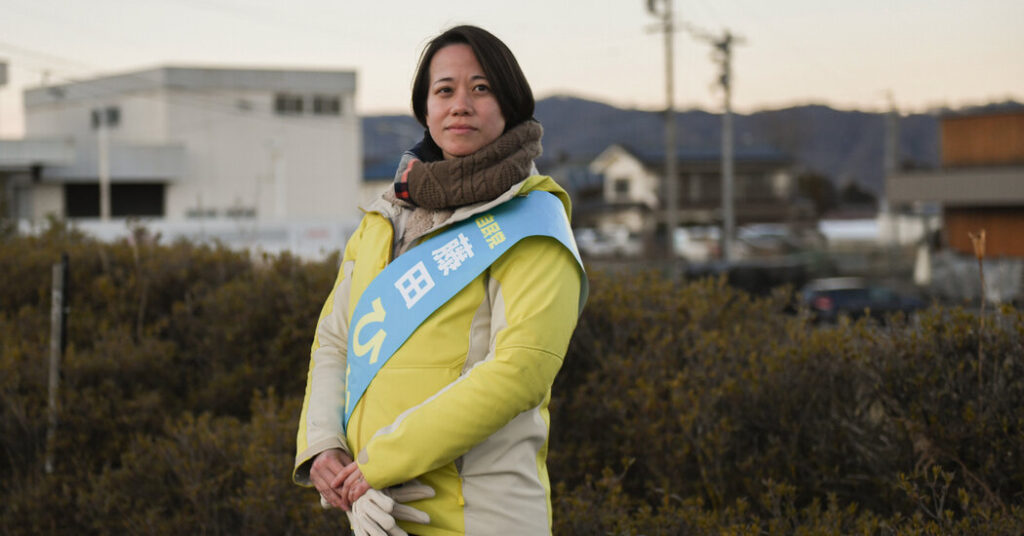
For weeks, Hikaru Fujita, a candidate in Japan’s parliamentary elections on Sunday, wrestled with a secret. She was pregnant with her first child — a joyous milestone for her and her husband.
But Ms. Fujita, 35, a Harvard-educated former diplomat, worried that publicizing her pregnancy could hurt her campaign. In late January, she set aside her fears, announcing on social media that she had been “blessed with new life.”
“I wanted to show that even pregnant women could run,” Ms. Fujita, from Nagano Prefecture, said in an interview. “I wanted to send a message to the younger generation.”
On social media, many people celebrated Ms. Fujita’s news, while others suggested that she should pursue a career as a housewife instead, and that a maternity leave would be a waste of taxpayers’ money.
With her revelation, Ms. Fujita, who is running for a seat in the powerful House of Representatives as a candidate for the governing Liberal Democratic Party, is testing Japan’s patriarchal system. She is one of a record number of women running for parliamentary seats on Sunday; 313 out of 1,285 candidates, or almost a quarter.
Despite the election last fall of Sanae Takaichi as prime minister — the first woman to serve in that role — women remain significantly underrepresented in Japanese politics. They occupy only about 16 percent of seats in the House of Representatives.
Expectant mothers rarely enter national politics; only a handful have run in local elections over the years. Many point to rampant workplace discrimination against young mothers. There is even a Japanese word for it: matahara, or maternity harassment.
Ms. Takaichi, a hard-line conservative from the same party, has avoided speaking out in public on gender issues. But she traveled to Nagano this week to campaign for Ms. Fujita. She is hoping the Liberal Democrats can pick up enough seats in the election to gain a majority and push through her agenda.
“There is no one more incredible than her,” Ms. Takaichi said in Nagano. “Please give her strength.”
Ms. Fujita previously worked on issues like economic security and North Korea’s missile program for Japan’s foreign affairs ministry; she has also worked as a consultant for McKinsey & Company. She said she was motivated to run after watching homes and fields in Nagano empty out as people left for cities. She also feels that Japan’s political system has become too fragmented and bureaucratic.
On the campaign trail, she has offered policies aimed at winning over women and families, including addressing gender pay gaps and expanding child care. She has also made a point of taking time to rest. Her campaign slogan is “Trying her best without overworking herself.”
She has frequently deployed her husband, Tomohiro Fujita, as her surrogate; he has taken time off from his job as a physics professor to help lead the campaign. He often appears alongside her, wearing a white beanie emblazoned with a Japanese word for husband.
Ms. Fujita said the negative comments about her candidacy were “discouraging, disappointing.” But she said she was trying to tune them out.
“It affects me a little bit,” she said in the interview. “But at the end of the day, all these comments are invisible.”
Still, she has occasionally encountered traditional attitudes on the campaign trail. Men often do not make eye contact with her during meetings, she said, instead looking at her husband.
“I didn’t feel comfortable about it, but I also feel that they don’t do it on purpose — they do it unconsciously,” Ms. Fujita said.
Her husband said that men appeared to be “nervous sitting in front of a powerful woman — they are uneasy.”
“They feel more comfortable talking to me,” he said.
Ms. Fujita said she hopes her campaign can help challenge conceptions about who can wield power in Japanese society.
“If I fail, I worry there will be fewer opportunities for younger women,” she said. “My job is to run a strong campaign but also to stay healthy and safe.”
Hisako Ueno contributed reporting from Tokyo.
Javier C. Hernández is the Tokyo bureau chief for The Times, leading coverage of Japan and the region. He has reported from Asia for much of the past decade, previously serving as China correspondent in Beijing.
The post She’s Upending Japanese Politics With Two Words: ‘I’m Pregnant’ appeared first on New York Times.