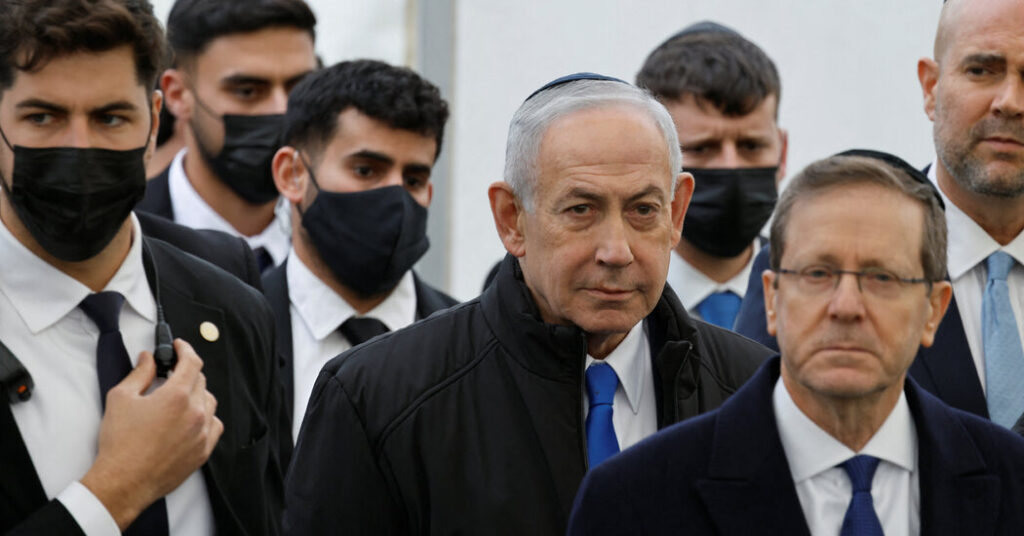
Prime Minister Benjamin Netanyahu of Israel has repeatedly refused to take direct responsibility for the security and intelligence failings that occurred on his watch in the lead-up to the Hamas-led attacks of Oct. 7., 2023, the bloodiest day in the country’s history.
On Thursday, Mr. Netanyahu indicated that he had no intention of changing course, releasing a 55-page document that appeared to direct the blame onto others, including top security and political officials.
The document was made up largely of quotes taken from official meetings in the years preceding the 2023 attack, and its release comes at a time when Israel has been divided over how to investigate the failings on Oct. 7.
Mr. Netanyahu has called for a “special” commission to lead an inquiry, which would be appointed by politicians, but the opposition has cried foul. According to Israeli law, an independent state commission of inquiry should be composed of members chosen by the president of the Supreme Court, not by lawmakers.
The document says Mr. Netanyahu prepared it in response to questions from the state ombudsman for a report about the Oct. 7 attacks.
Israelis are gearing up for national elections, the first since the October 2023 attack, and the document’s release prompted criticism from members of the political opposition who accused him of distorting the complete picture of what happened before the attacks.
“He is afraid,” Avigdor Liberman, the chairman of the Yisrael Beiteinu party, said in a post on social media on Thursday. He is quoted in the document from periods when he held the roles of defense minister and foreign minister in the government.
Mr. Liberman went on to say that when all meeting minutes were “exposed — and not just the half-truths he chose to leak tonight to evade responsibility, everyone will understand the truth.”
The document suggests Mr. Netanyahu pressed for the assassination of senior Hamas officials in Gaza but encountered fierce resistance from the security establishment.
A selected quote from a meeting in late 2016 purports to show Mr. Netanyahu as saying that Israel should kill Yahya Sinwar, the Hamas leader who went on to mastermind the October 2023 attack, only to face resistance.
The document quotes the director of military intelligence as saying at the time, “I don’t think it is right to initiate.”
Yet former senior security officials have painted a different picture than the one presented by Mr. Netanyahu’s document.
In March 2024, Nadav Argaman, who ran the Shin Bet domestic intelligence agency between 2016 and 2021, told a security conference in Tel Aviv that members of the agency had pushed for attacking Mr. Sinwar in Gaza but were rebuffed by Israeli political leaders.
The document also cites Naftali Bennett, a top political rival of Mr. Netanyahu planning to run in the upcoming elections, as saying in 2014 that he opposed “conquering Gaza.”
Yet in Mr. Netanyahu’s autobiography, published in 2022, he wrote that Mr. Bennett “advocated a full-scale ground invasion to ‘conquer Gaza.’”
“That could only be done with the wholesale destruction of Gaza, with tens of thousands of civilian deaths,” Mr. Netanyahu wrote in the autobiography. “After destroying the Hamas regime, Israel would have to govern two million Gazans for an indefinite period. I had no intention of doing that.”
A person familiar with Mr. Bennett’s comments in the 2014 meeting, who spoke on condition of anonymity to discuss sensitive information, said Mr. Bennett had pushed for an attack to destroy Hamas until he realized Mr. Netanyahu and the Israeli military did not want to pursue that path.
Adam Rasgon is a reporter for The Times in Jerusalem, covering Israeli and Palestinian affairs.
The post Netanyahu Suggests Top Officials to Blame for Oct. 7 Failings appeared first on New York Times.