Paul Putz is director of the Faith & Sports Institute at Baylor University’s Truett Seminary and the author of “The Spirit of the Game: American Christianity and Big-Time Sports.”
In many ways, America has grown more secular over the past century. Fewer Americans belong to a church or attend regularly. Prayer is no longer part of public schooling. Commerce doesn’t stop on Sundays. One area of American life, however, has bucked the trend. Major sporting events such as the Super Bowl have become more, not less, religious over time — changing how Americans see both faith and sports.
Today athletes are some of the most prominent Christians in public life, far exceeding any pastor or priest. And the interviews offered at the end of sporting events may be the only time many Americans will hear a proclamation of faith. But there was a time when Christianity and pro sports did not seem so intertwined.
In 1926, when football legend Red Grange and the Chicago Bears visited New Orleans during a barnstorming tour, an evangelist named Howard Williams saw no room for collaboration. To even attend the game was to call into question one’s faith.
“There will not be a single Christian man or woman, boy or girl, to attend that New Orleans Sunday game,” he declared.
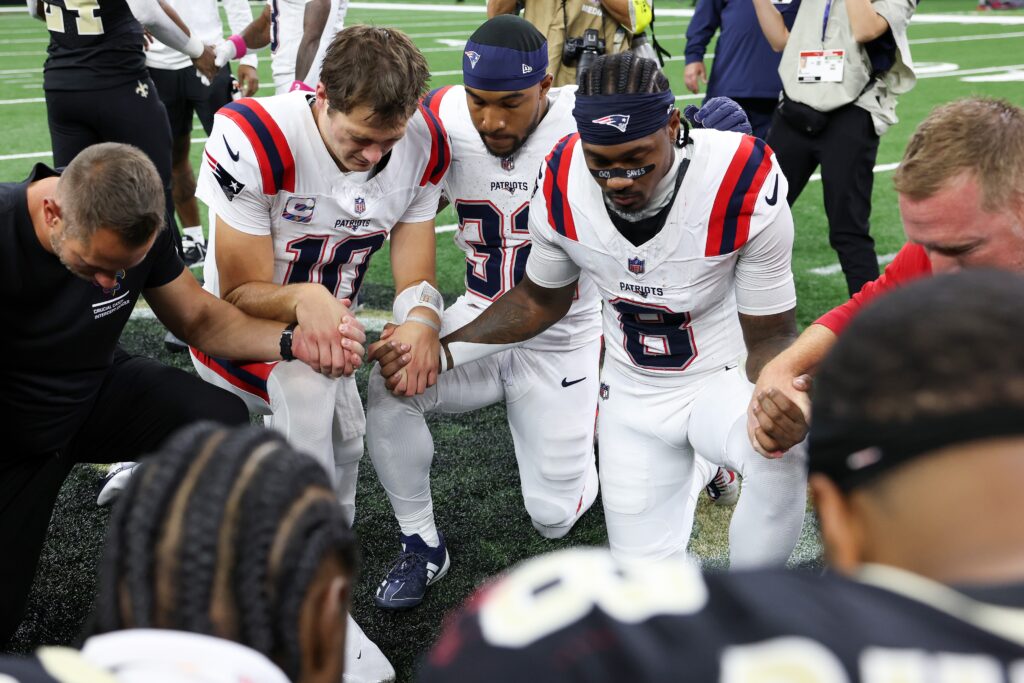
One hundred years later, Christians will be prominently featured during the biggest sports Sunday of the year. Seahawks receiver Jaxon Smith-Njigba and Patriots quarterback Drake Maye have already used the run-up to the game to share their faith in Christ.
A Super Bowl Breakfast hosted by sports ministry Athletes in Action will bring together key Christian leaders within the football industry for fellowship. As the game draws near, team chaplains on both sides will lead chapel services and share inspirational messages with the players.
When the contest starts, players will be found at various points kneeling in prayer, and pointing upward to God in celebration.
Meanwhile, for the fourth straight year, fans watching at home will see the latest Jesus ad from the “He Gets Us” campaign. And during the postgame interviews they’ll hear the winners give glory to God, while the losers try to make sense of the disappointment, perhaps turning to the Bible for solace.
It is a remarkable shift over the course of a century. Christian athletes have successfully turned pro sports — and football in particular — from a space in which Christians were rarely present into one of the most prominent arenas in American life for Christian witness and self-assertion.
This transformation did not happen by accident. It is the result of a Christian sports movement that has been growing since the 1950s, as evangelical sports ministries like the Fellowship of Christian Athletes, Pro Athletes Outreach, and Athletes in Action have built a network of Christian athletes and coaches who find spiritual meaning in and through their shared sports experience.
They have established pregame chapel services, team Bible studies, and offseason conferences where athletes can experience God’s presence and grow in their faith.
Critics of the Christian sports movement have tended to view its rise through a political lens. They usually see it as a manifestation of activism associated with the Religious Right.
But while there are certainly political implications to the movement, they are not easy to pin down, especially in the NFL, where more players align with Democrats than Republicans. The truth is that political activism has never been the primary focus for sports ministries. Instead, they have built a lasting movement by connecting the mundane aspects of an athlete’s life with a transcendent narrative.
Bill Glass, a defensive end for the Cleveland Browns in the 1960s and one of the pioneers of the Christian sports movement, once quoted a poem by Victorian poet Elizabeth Barrett Browning to explain this perspective:
“Earth’s crammed with heaven/ And every common bush afire with God/ But only he who sees takes off his shoes;/ The rest sit round and pluck blackberries.”
The Christian embrace of sports reflects broader changes in American Christianity. Over the last hundred years, Christians have developed strategies of adaptation and accommodation with mass culture. Rather than avoid worldly pursuits like sports, they have set out to transform their meaning from within.
To be sure, for all the success of the Christian sports movement, it remains a subculture within the larger ecosystem of pro sports. Christian athletes and coaches must collaborate and cooperate with teammates of all faiths and no faith at all; they must work within a pluralistic public space that they do not control or direct.
Their ability to do so has given them a voice within one of the few shared cultural spaces left in American society. Last year sporting events made up 96 of the top 100 telecasts, with the Super Bowl at the top. Amid broader secularization, the Christian sports movement testifies to religion’s continuing resonance.
The post How sports are defying secularization appeared first on Washington Post.