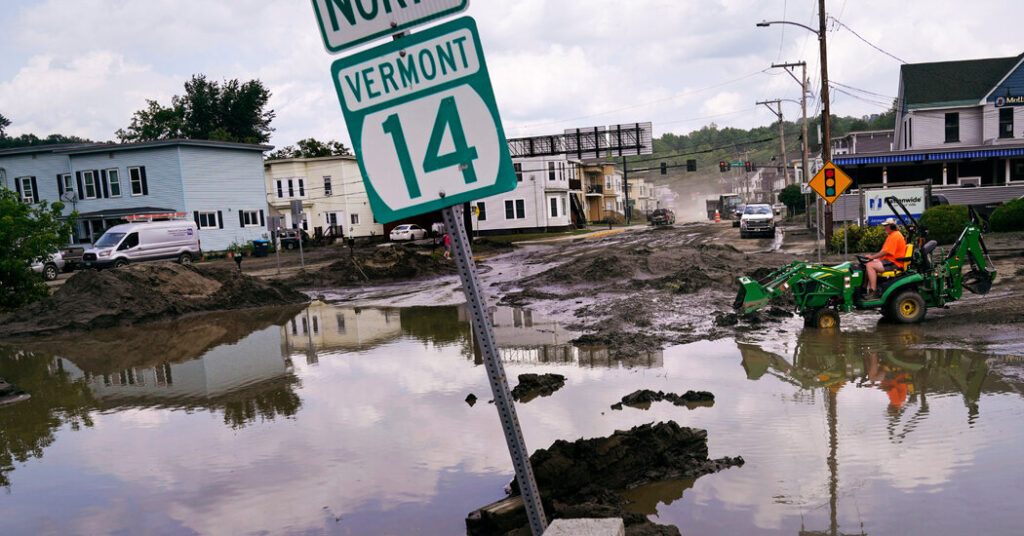
Climate “superfund” bills, based on the principle that oil companies should pay costs associated with climate change, are gaining ground in state legislatures around the country.
But it’s unclear whether the only two states to have passed such laws, New York and Vermont, will be able to defend them from legal challenges. The Justice Department, industry groups and other states have all sued to block the laws.
The laws borrow their superfund names from the long-running federal program that requires companies to pay to clean up industrial sites they polluted.
Despite the legal efforts to kill the newer, climate-focused versions of these laws, states around the country are proposing similar measures. In Maine last week, one such bill passed a committee vote, and others were recently introduced in Illinois and New Jersey, with one also expected soon in Connecticut. Related measures are pending in several other states.
Proponents say the measures are necessary to fund urgent public projects like fortifying coastal areas against flooding. “It’s not a question as to the billions and billions of dollars that have to be spent to deal with resiliency” against climate-related threats, said State Senator John McKeon of New Jersey, who represents suburban areas across the Hudson from New York City. “It’s a matter of who’s going to pay for it.”
He said the bill he sponsored has been renamed the “Polluters Pay to Make New Jersey Affordable Act,” in a nod to concerns about the cost of living. While it already faces opposition from business groups, Mr. McKeon said that it would benefit businesses in the state.
He pointed to New Jersey’s roughly 135 miles of coastline and its bustling commercial ports to make the case that the state needs to upgrade its infrastructure to protect against disasters. “This isn’t discretionary spending,” he said. “This is what it has to be.”
The original, federal Superfund program was established in 1980, at a time of great concern about toxic pollution spurred by the story of Love Canal, a neighborhood in Niagara Falls, N.Y., that has since become synonymous with environmental catastrophe. Love Canal had once been a dumpsite for chemical waste that residents blamed for birth defects, cancer and other ailments. It became the country’s first Superfund site.
Amanda Halter, a lawyer at the firm Pillsbury who specializes in environmental matters, said the original Superfund program has survived numerous legal challenges, so she was not surprised when state officials began to look to the program as a model for climate-related initiatives. Around the country, the costs of recovering from storms and undertaking adaptation measures against climate threats have strained municipal budgets.
However, she said local pollution and global climate change were not analogous problems. “The climate-change topic is so much broader in terms of geography,” she said, which “runs headlong into issues of international, federal and state authority.”
That’s a central theme in the litigation against the laws in New York and Vermont, which work in slightly different ways. Both laws, passed in 2024, take aim at the biggest emitters of global greenhouse gases since the 1990s, after the dangers of climate change became widely known.
New York’s measure requires the biggest companies to collectively pay $75 billion over the next 25 years. Vermont’s directs officials to sort out the details of the financial penalties. Neither state has yet made public the list of entities it will seek to collect from.
Industry groups are gearing up for a showdown. The American Petroleum Institute has said it considers defeating superfund bills a priority. It says that they are an existential threat to industry, alongside lawsuits that separately are trying to force oil producers to help pay the costs of climate change. The institute has also pushed for a Congressional liability shield for the industry like the one that protects gun manufacturers.
“So-called climate superfund proposals and extreme lawsuits would retroactively punish energy producers for simply meeting consumer demand,” Dustin Meyer, a senior vice president for the group, said recently. He called the efforts “a distraction from the common-sense energy policies Americans want.”
Justin Anderson, a lawyer for Exxon, discussed the relationship between the laws and the lawsuits in an online forum in the fall. Referring to the rising number of climate superfund-law proposals, he said: “The position is, ‘Well, we keep losing in court, so we’ll pass a law that says you have to pay, and you can challenge it afterward.’” He called the strategy “ridiculous.”
Supporters of the measures counter that they adhere to a simple principle, namely, clean up your mess. “Polluters, as folks that are exacerbating the conditions of global climate change, should also have to pay in to the repairs,” said State Senator Graciela Guzmán of Illinois, a bill sponsor who represents parts of Chicago.
The city has also filed a lawsuit against oil companies over their role in climate change, which remains pending.
Karen Zraick covers legal affairs for the Climate desk and the courtroom clashes playing out over climate and environmental policy.
The post Climate ‘Superfund’ Bills Spread Nationwide, Despite Legal Battles appeared first on New York Times.