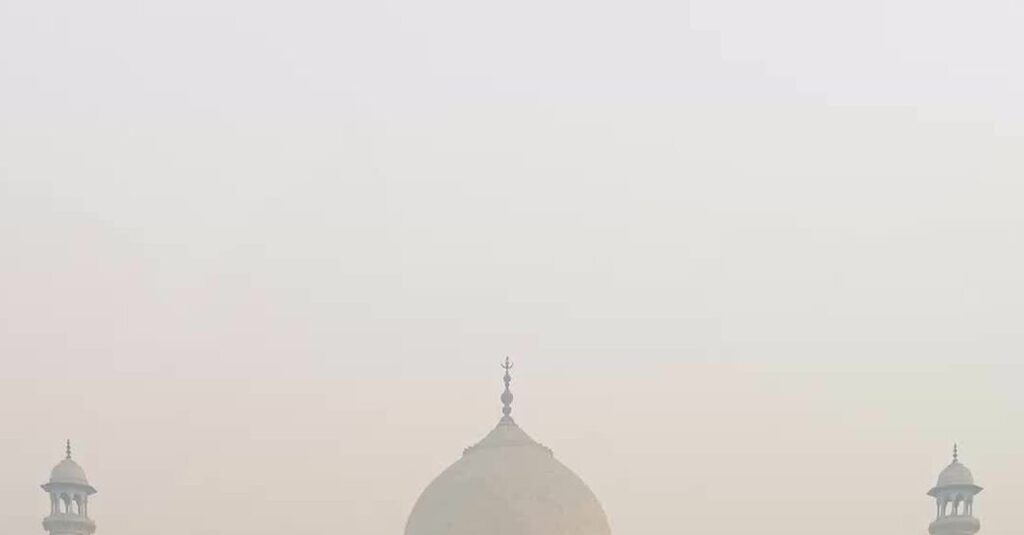
The Taj Mahal, India’s most famous landmark, is haunted by a conspiracy theory. It has been pushed for years by an ardent cadre of pseudo-historians, lawyers and religious believers who claim that everything you’ve been told about the building is a lie.
The theory is convoluted, to say the least.
The thrust is that the building is not truly a masterpiece of Indo-Islamic architecture, commissioned in the 17th century by the Mughal ruler Shah Jahan, a Muslim, as a tomb for his beloved wife, who died giving birth to their 14th child. Instead, the theory goes, its origins are Hindu, a history that has long been suppressed.
Evidence of that is conjecture — and has repeatedly been debunked. That has not put the matter to rest. Hari Shankhar Jain, a prominent lawyer in the cause, said in an interview that the authorities “did not want the truth to come out.”
Now Bollywood has weighed in. A new film, “The Taj Story,” has turned the revisionist claims into a courtroom drama, featuring a popular actor, Paresh Rawal.
The film’s promotional materials promised to “reveal the untold history” of the landmark. It doesn’t. What it has done instead is rehash discredited claims that once were relegated to the fringes of the internet, giving prominence to efforts to inflame sectarian tensions.
They include assertions that the site had previously been a Hindu palace — or, perhaps, a temple dedicated to Lord Shiva; that carbon dating of a piece of wood from a door showed it was built long before the 17th century; that 22 “secret chambers” beneath the main structure had been locked or bricked up by the authorities to shield outsiders from the truth.
The film’s writer and director, Tushar Amrish Goel, said he had settled on the concept after spending two and a half years researching the alternative claims about the monument’s past, which he called “intriguing and engaging.” It follows a veteran tour guide at the Taj Mahal who comes to question the historical narratives behind the monument and goes to court to prove his suspicions are real.
“We just put our argument in the courtroom,” Mr. Goel, 35, said in an interview in Mumbai, Bollywood’s home.
The film, which was released in late October, shows how easily popular culture can thrust conspiracy theories into the mainstream, reflecting a broader distrust of historical story lines.
It has echoes of Oliver Stone’s “JFK,” another politically charged, factually challenged courtroom drama from 1991. That film revivified the conspiracy theories over President John F. Kennedy’s assassination and foreshadowed the distrustful and paranoid politics of today’s America.
Although Mr. Goel denies an overtly political motive, the film reflects a brand of Hindu nationalism championed by Prime Minister Narendra Modi, India’s leader since 2014. It is one of a series of Bollywood films that has done so. The trend has stoked tensions between Hindus and Muslims in a country with a vibrant religious, ethnic and cultural diversity.
For adherents of Mr. Modi’s nationalism, the monuments of the Mughal dynasty, which conquered and ruled what is today India from the 16th century until the British colonization in the 19th, stand as testaments of foreign oppression. Critics counter that to deny them discounts the country’s pluralistic, multiethnic history.
Ruchika Sharma, a historian, said that in a country with roughly 200 million Muslims, about 14 percent of the population, the film amounted to “communal poison” intended to divide the nation.
Reviews of “The Taj Story” have been mixed, with film critics and moviegoers attacking it for raising conspiratorial questions, on the one hand, and saying it didn’t go far enough to support or reject them, on the other.
“‘The Taj Story’ trudges on without offering any real answers to the questions it raises,” the critic Alaka Sahani wrote in The Indian Express. “Instead, it merely stirs the pot, blending fact and fiction to serve an agenda far removed from historical inquiry.”
The film, which is expected to appear on streaming sites soon, has so far grossed more than $3 million — more than it cost to make, though not exactly a blockbuster.
It has nonetheless had an impact on the debate over the landmark’s significance as part of the nation’s identity, which has churned on Reddit, Facebook, X and Telegram, according to Archis Chowdhury, a senior correspondent at Boom, one of India’s leading independent fact-checking organizations.
“It definitely brought it to mainstream,” he said. “It’s all over the internet.”
The roots of the Taj Mahal conspiracy theories reach back decades.
In 1965, P.N. Oak, a lawyer turned revisionist historian, published a short book claiming that the Taj Mahal was originally a palace built in the fourth century. Only later, he argued, was this “gay and magnificent” place turned into the tomb the world knows today.
“The changeover has proved a shroud deluding everybody from laypersons to researchers and history scholars that the Taj was built as a sepulcher,” he wrote.
Oak, who died in 2007 at age 90, was criticized as a pseudo-historian, though he was a prolific one. In later iterations of his book, he claimed the Taj Mahal was not a palace but a temple.
He also published numerous other books claiming that Christianity and Islam were in fact offshoots of Hinduism and that many physical landmarks of those faiths, including St. Peter’s Basilica in the Vatican and the Kaaba in Mecca, were originally Hindu temples.
Oak didn’t disguise his intentions. Born in the British colonial era (and having fought on the Japanese side in World War II), he founded the Institute for Rewriting Indian History, which sought to recast the nation’s history as one of conquest and colonization of its true Hindu identity.
Historians have refuted claims like his about the Taj, saying they lacked any documented evidence or misconstrued historical details in a structure whose construction was well documented by contemporaneous scholars. Some, like the existence of hidden Hindu idols in the building’s basement, are purely fictional.
“Oak’s arguments appear compelling — except to knowledgeable scholars,” Catherine B. Asher, an art historian at the University of Minnesota, wrote in 2009. “The problem is most people lack this knowledge, so his conspiracy theory wrapped in inflammatory rhetoric is compelling to those who wish to believe.”
India’s courts have repeatedly heard legal challenges involving the Taj Mahal and its status as a religious site — from lawyers like Mr. Jain and members of Mr. Modi’s party, the Bharatiya Janata Party, or B.J.P.
None have been found to have merit. In 2022, the country’s Supreme Court dismissed a lawsuit demanding a fact-finding commission into the monument’s origins and, two years later, an appeal to reconsider its status as a solely Islamic religious site.
Historical revisionism in India has had deadly consequences. In 1992, a mob affiliated with the B.J.P. demolished a mosque in Ayodhya, another city in the same region, believing that it had been built atop the birthplace of the god Ram. Sectarian violence that followed killed more than 2,000 people.
Mr. Modi, who was a rising party leader at the time of the violence, inaugurated a new Hindu temple at the site in 2024 after years of legal disputes.
The Taj Mahal, which is in Agra, roughly 120 miles southeast of New Delhi, has legal protections as a recognized UNESCO World Heritage Site that would presumably preclude a similar fate.
The Archaeological Survey of India, the agency that oversees the country’s historical monuments, has tried to snuff out conspiracy theories. In 2022, it published a newsletter with photos of the “secret” underground rooms to dispel the claims they contained clues of an alternate history — only to stoke suspicions of a coverup.
It has since removed the photographs from its website. The agency did not respond to questions about why.
Shamsuddin Khan, who, like the film’s protagonist, is a veteran guide at the Taj, said he had watched the film and didn’t think much of it. “It was rubbish,” he said as he toured the complex on a recent morning.
Visitors do ask about the film and the claims behind conspiracy theories: the site before the mausoleum was built, the secret rooms in the basement, the Hindu symbols in the architectural details that P.N. Oak saw as proof of its true origins.
The architects who designed and erected it, he explains patiently, incorporated Islamic artistic traditions, as well as local — Hindu — motifs like lotus flowers and tridents.
“They wanted to represent all the people,” said Mr. Khan, who is Muslim. “Not like today.”
Hari Kumar contributed reporting.
Steven Lee Myers covers misinformation and disinformation from San Francisco. Since joining The Times in 1989, he has reported from around the world, including Moscow, Baghdad, Beijing and Seoul.
The post Bollywood Embraces a Taj Mahal Conspiracy Theory appeared first on New York Times.