For years, the United States was the only major country to run a full-time consulate in Greenland and it isn’t much — a little red house with an American flag poking out.
But on Friday, a new French consul general swooped in. And Canada sent a delegation to celebrate the official opening of its own diplomatic post.
Canada has obvious reasons for wanting a diplomatic toehold. For centuries, the Inuit of northern Canada have been closely connected to Greenlanders, who are predominantly Inuit, and Canada lies just a few miles off the coast.
The French connection is less clear. France says exactly eight French nationals live in Nuuk, Greenland’s capital. But the gesture comes on the heels of threats by President Trump to take over the Arctic island, which has been part of Denmark for more than 300 years.
Even though Mr. Trump backed down somewhat last month, many Greenlanders still feel uncertain about their future and welcomed the new diplomatic posts. A poll fielded in late January by Sune Steffen Hansen for the Copenhagen Post showed that 76 percent of Greenlanders don’t think it would be advantageous to join the United States and more than half said they were worried there would be a military invasion.
“It means a lot,” Pipaluk Lynge, the leader of the Greenlandic Parliament’s foreign and security policy committee, said of the new diplomatic missions. “It shows that our allies are not silent in this situation.”
She said Canada was a natural partner and that the Inuit of both places are “siblings.”
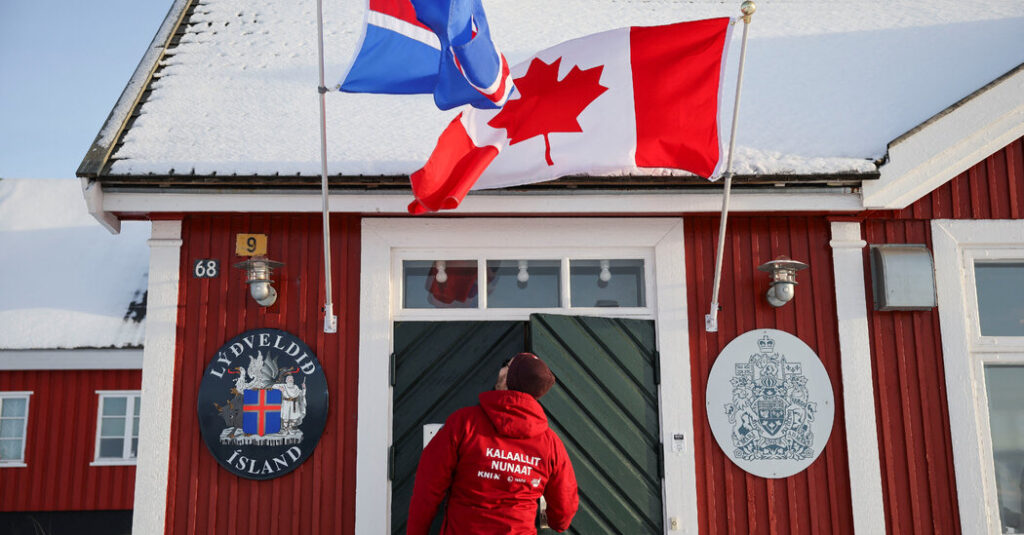
The mood was upbeat on Friday as Canadians held a ceremony at their consulate in central Nuuk, in a shared building with the consulate of Iceland, which also maintains a permanent diplomatic presence in Greenland.
Greenland’s foreign minister, Vivian Motzfeldt, welcomed Canada’s expanded diplomatic presence, calling it a reminder of the “high-stakes balance” between countries.
Canada’s foreign minister, Anita Anand, said her country’s diplomatic presence signaled a long-term commitment to cooperation on defense, security and climate change. “We will stand together with the people of Greenland and Denmark — not just in the short term, but in the long term,” she said, before the crowd joined to sing the Canadian national anthem.
Trump Administration: Live Updates
Updated
- A judge allows the release of evidence from a Border Patrol shooting.
- Officials pressed Schumer to help rename Penn Station and Dulles Airport for Trump.
- The latest U.S. boat strike kills 2 in the Pacific.
A large delegation of Inuit representatives flew in from Canada for the event including Natan Obed, the president of Inuit Tapiriit Kanatami, a Canadian Inuit organization based in Ottawa.
“This visit is not only about Canada or Denmark. It is about Inuit standing with Inuit,” he said. “Anything that weakens Inuit self-determination anywhere in the Arctic affects all of us. That is why we are here.”
The French have positioned their move as part of Europe’s pushback against Mr. Trump.
“Greenland is neither for the taking nor for sale; it is an Arctic territory and it is a European territory, and it will remain so,” Jean-Noël Barrot, France’s foreign minister, said on French radio last month.
The French foreign ministry posted a video on Friday of the new consul general, Jean-Noël Poirier, stepping off a plane in Nuuk and wheeling his suitcase across the icy tarmac. France said it is the first country in the European Union to open a consulate in Greenland.
The Canadian office has been operating since early November. It is the latest move by Mark Carney, the prime minister, to form new alliances at a time of deteriorating relations with Mr. Trump.
In a widely noted speech in Davos, Switzerland in January, Mr. Carney said, without directly naming the president or the United States, that Mr. Trump had created a permanent rupture in the world order. He urged middle powers to no longer “go along to get along.”
While Greenland is rarely the subject of attention in Canada, the two have a natural relationship. Canada and Denmark share Hans Island, a barren lump of rock in the middle of 22-mile-wide Nares Strait.
Starting in the 1980s, Canadian troops visited the island and claimed it by raising a Canadian flag and leaving behind a bottle of Canadian whiskey. Denmark responded by hoisting its own flag and leaving a bottle of Danish schnapps. This went on for years, with Danes and Canadians removing each other’s flag and drinking each other’s alcohol until 2022 when the two countries finally agreed to a solution.
They drew a line from north to south and divided the island roughly in half.
Ian Austen contributed reporting from Ottawa, Ana Castelain and Catherine Porter from Paris, and Liam Fussing Rosbach from Nuuk.
Jeffrey Gettleman is an international correspondent based in London covering global events. He has worked for The Times for more than 20 years.
The post Besides Stars and Stripes, a Few New Flags Are Flying in Greenland appeared first on New York Times.