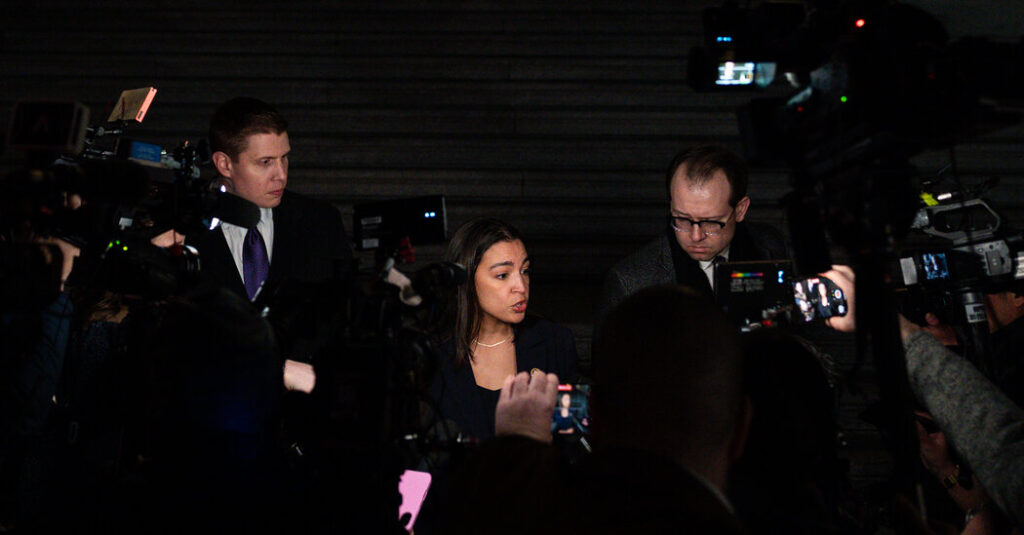
Seven years after she swept into office as a progressive agitator unafraid to hammer fellow Democrats, Representative Alexandria Ocasio-Cortez of New York has emerged as an increasingly sought-after leader within the party she set out to disrupt.
She has positioned herself as a top antagonist of Vice President JD Vance, a potential heir to President Trump’s political movement, sparring with him on social media.
She has stepped up her support of moderate and mainstream Democrats, sending a fund-raising email last month asking her supporters to donate to the Senate campaign of former Representative Mary Peltola of Alaska, a friend whose support for oil drilling and gun rights are at odds with the New York congresswoman’s stances.
And, at a time of tumult around the country and uncertainty within the Democratic Party, her direct and camera-ready speaking style is breaking through. After federal agents killed Alex Pretti in Minneapolis, she swiftly appeared on cable news and argued he had been “executed in the street.”
After years of inching closer to mainstream Democrats, Ms. Ocasio-Cortez is more forcefully trying to steer her party toward her populist, working-class message at a moment when economic worries are a top issue. Democrats of all stripes broadly agree that they need a more ambitious vision focused on bringing down the cost of living to win back blue-collar voters who fled to Republicans during the Trump era.
Plenty of Democratic politicians are now looking to Ms. Ocasio-Cortez, 36, and not their party leaders, for cues on how to get that message across, viewing her instincts as sharper than consultant-driven, focus-grouped direction out of Washington. Ms. Ocasio-Cortez routinely answers centrist Democrats’ requests for help on communications strategy and fund-raising, and has served as a mentor for young House colleagues.
“She’s a coalition builder,” said Representative Pat Ryan, a moderate Democrat in an upstate New York battleground district who campaigned with Ms. Ocasio-Cortez before the 2024 election. He said that she had, “to her credit, sought out engaging with me and, I know, other frontline members from very competitive districts to hear what’s going on for us, to get our take, to bounce ideas back and forth.”
Next week, she plans to expand her progressive pitch to foreign policy, by speaking at the Munich Security Conference in her most significant overseas trip since taking office, according to Mike Casca, her chief of staff. There, she is expected to present a left-wing alternative to Mr. Trump’s shoot-from-the-hip approach to world affairs.
Ms. Ocasio-Cortez’s heightened role comes as Democratic insiders begin to whisper more loudly about what she might do in 2028. She has long been seen as a potential presidential candidate or as a successor — or challenger — to Senator Chuck Schumer, 75, the minority leader, who has not said if he will run again.
But the congresswoman, who declined an interview request, is unlikely to announce any choice until 2027, according to interviews with more than a dozen Democratic advisers, allies, colleagues and friends. They described a politician, known to a select few as Alex, who is known for making last-minute decisions and who is keeping her cards hidden.
“That’s her life — running for president, running for Senate, whatever it is, is a very big decision,” Senator Bernie Sanders of Vermont, Ms. Ocasio-Cortez’s political mentor, said in an interview.
“I’m sure she’s looking at all of the options right now,” he added.
In the meantime, Ms. Ocasio-Cortez has been ubiquitous on social media, weighing in on the immigration operation in Minnesota and other news of the day. She frequently delivers messages through her own channels and friendly content creators, like her regular interviews on the Capitol steps with the MeidasTouch Network, a left-wing media outlet.
Last month, social media video posts featuring or referring to Ms. Ocasio-Cortez amassed at least 185 million views across TikTok, X, Facebook and Instagram, according to a rough estimate from Junkipedia, a data analysis tool that provides a partial snapshot of political discourse on social media.
That was roughly twice as many views as posts for Mr. Schumer garnered.
From Pelosi Protester to Biden Defender
Mr. Sanders, a leader of America’s progressive political movement, has often operated as something of a lone wolf. An independent who never formally joined the Democratic Party, he has a personal and political rigidity that at times angers his colleagues.
For a time, it seemed Ms. Ocasio-Cortez might take a similar approach. She marked her arrival in Washington by joining a climate protest outside Representative Nancy Pelosi’s office and had a tense relationship with the former Democratic speaker. She refused to contribute to the House Democratic campaign arm during her first stretch in Congress.
But over the years, Ms. Ocasio-Cortez has tempered her critiques of moderate Democrats, and is now a regular dues-paying member to the House campaign committee.
After Mr. Sanders lost the 2020 Democratic presidential primary race, she swiftly endorsed Joseph R. Biden Jr. — while still nudging him to the left — and was one of his key initial defenders when he faced pressure to drop his re-election campaign four years later.
Representative Paul Tonko, a New York Democrat who appeared alongside Ms. Ocasio-Cortez at a town hall last year in a Republican-held House district in upstate New York that Democrats hope to flip, said she had demonstrated a “team spirit.”
Mr. Tonko suggested that Ms. Ocasio-Cortez’s blunt, plain-spoken style appeared well suited for the moment, and that voters were finding her economic ideas more common-sense than radical.
“When we did the Plattsburgh town hall, I think it proved that her message resonates with rural and working-class Americans who feel abandoned,” he said.
If Ms. Ocasio-Cortez runs for president, her prominence and vast fund-raising potential would probably make her the leading progressive, and potentially a front-runner in a contest likely to include a dozen or more candidates to her right.
She offered a preview of what a presidential bid could look like last spring, when she swept through a dozen cities with Mr. Sanders on a “Fighting Oligarchy” tour that energized beleaguered Democrats.
But Democrats remain divided over whether to embrace a fiery liberal who could excite the base or a candidate perceived as more likely to attract Republican and independent voters. Some may be wary of nominating a millennial progressive from a deep-blue House district in New York City.
“She can’t appeal to a broad electorate — that is the problem,” said Xochitl Hinojosa, a former senior official at the Democratic National Committee. “We need someone who can reach as many people as possible outside of the Democratic Party and in red and purple states.”
Increased Visibility
In Munich, Ms. Ocasio-Cortez is expected to participate in a discussion about populist political movements and a debate on the United States’ role in the world, Mr. Casca said. Her trip will also include a town-hall-style event with students at a Berlin university alongside a politician in Germany’s Social Democratic Party.
The trip is Ms. Ocasio-Cortez’s most significant foray into foreign policy, a subject that has never been a particular strength of hers. The Munich conference is typically the realm of national security officials and heads of state.
She has been receiving regular briefings from the Center for International Policy, a left-wing foreign policy think tank in Washington. Matt Duss, a vice president at the group and a former Sanders aide, said he was among those who had tutored her on foreign policy.
“She is someone who is engaged with parts of the world that are often not represented in Munich,” Mr. Duss said.
Ms. Ocasio-Cortez’s appearance will undoubtedly ignite speculation that she is burnishing her foreign policy credentials before a White House run. But she is keeping everyone guessing. Unlike other more obviously ambitious Democrats, she has not made winking, presidential-coded trips to early primary states in recent months or written a tell-all memoir.
Still, she has been busy elsewhere.
Over the past year, she has worked on a bipartisan bill that would ban congressional stock trading, and another that would allow people to sue over the distribution of nonconsensual A.I.-generated pornographic images of themselves.
Last month, she spoke at Zohran Mamdani’s mayoral inauguration in New York. A few weeks later, she went viral grilling the chief executive of CVS Health at a congressional hearing. Days after, she went to a diner on New York’s Upper East Side with Julie Menin, the New York City Council speaker.
On Thursday, she hosted a town hall in her New York House district, where constituents asked her about immigration raids and how best to “tax the rich.”
Ms. Ocasio-Cortez noted that Democrats were stuck in the minority in Congress and had little power. But she exhorted attendees to keep the pressure on them, suggesting that voters’ anger over the party’s failure to pick a fight over funding last spring had given Democrats the “spine” to shut down the government in the fall.
“There were a lot of moderates, especially in the Senate, that just wanted to fold right away, and they experienced a lot of backlash after that,” she said. “So just know that this is starting to work.”
Her heightened platform, allies suggested, reflects her desire to rise to the moment, be it now or in 2028.
“She’s going to be attuned to any election-year cycle to where she can do the most good for the most people,” said Representative Jamie Raskin of Maryland, whom Ms. Ocasio-Cortez counseled in his own deliberations about whether to run for the Senate. “She has profound ambition for where she wants New York to go and where she wants the country to go.”
Sally Goldenberg and Matt Zdun contributed reporting.
Kellen Browning is a Times political reporter based in San Francisco.
The post Alexandria Ocasio-Cortez Steps Onto a Wider Stage appeared first on New York Times.