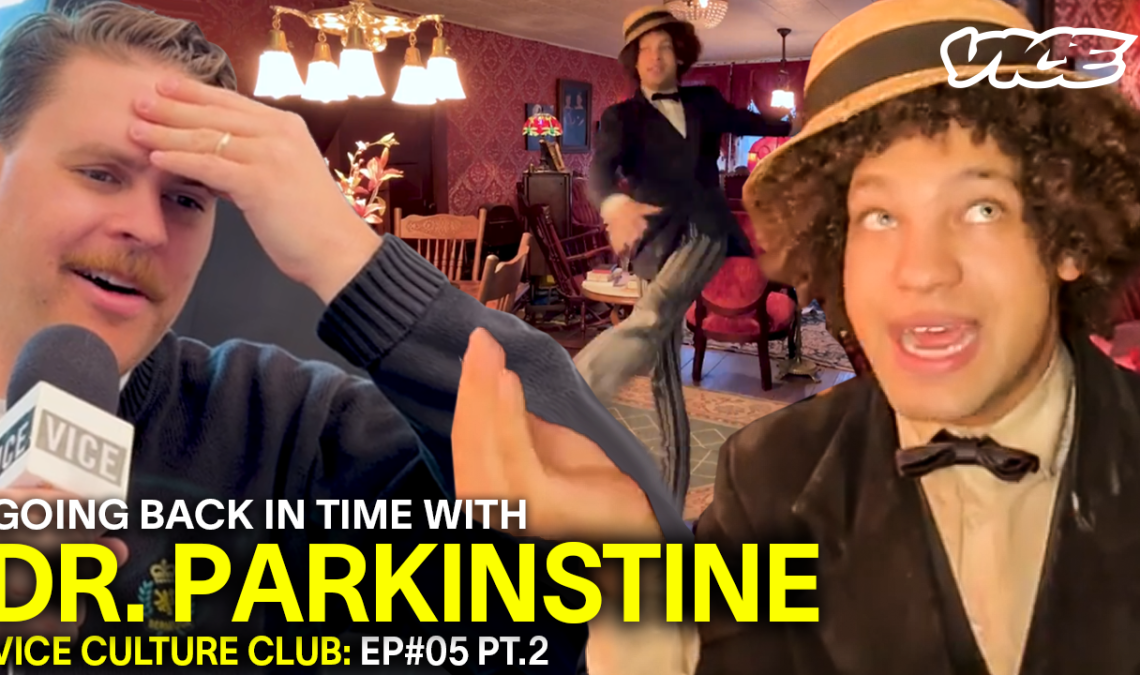
On the latest episode of VICE Culture Club, host Jackson Garrett talks with Parker Edmondson, better known online as Dr. Parkinstine. He’s a Jacksonville, Texas–based creator whose feeds revolve around one central idea: modern life took a wrong turn somewhere after the early 20th century. His TikTok following is north of 1.2 million, built on a platform designed for constant novelty, as he documents a life structured around obsolete voltages and antique appliances.
Parkinstine describes himself as a collector, but that undersells it. “Basically, I collect antiques, and I’m kind of like a mad scientist along the lines of Tesla or Einstein,” he says, before clarifying that Thomas Edison is “doo doo garbage.” It isn’t a bit so much as a worldview. He’s interested in systems that predate planned obsolescence, when objects were built to be repaired, and electricity still felt slightly dangerous.
That mindset governs his entire living situation. He lives in a 1915 Sears mail-order home and treats it like a rebuttal to modern construction. He gives Garrett a virtual tour of his home, pausing to highlight construction details built to last, such as joints, fixtures, and even the materials. A contrast to today’s profit-making, short-cycle products.
The tour keeps getting sidetracked by objects that catch his attention. He shows off a 1906 phonograph, a 1870s calendar clock, early push-button light switches, and a “gossip chair” designed for long phone calls and juicy eavesdropping. In the kitchen, he opens a fully original 1934 refrigerator and explains, a little too casually, that the refrigerant is tear gas. “It’s from 1934, and it’s all original down to the refrigerator, which is tear gas,” he says.
Then things veer into electricity, one of Parkinstine’s favorite subjects. He says he built a magnifying transmitter capable of transmitting wireless electricity 918.6 miles, and that he lost a TikTok account with roughly 880,000 followers shortly before a science conference. He doesn’t elaborate much on that and drops the subject.
Despite the prewar aesthetic, platform economics still dictate reality. “TikTok is only paying me $0.30 per thousand views. YouTube pays me $3, and I think $0.28 per thousand views,” he says, explaining why his attention is shifting platforms. The long-term plan feels pulled from the same century as his appliances: buying a Victorian house, turning it into a museum and bed-and-breakfast, and using the income to bankroll bigger experiments.
What makes Parkinstine compelling isn’t just the antiques or the algorithms. It’s the way he’s integrating an obsolete lifestyle into a very real way of living. And, of course, sharing it for millions to watch.
The post Why Millions Are Watching Dr. Parkinstine Live Like It’s 1915 appeared first on VICE.