When Venezuelan oil comes to the U.S.
When Venezuelan oil is shipped to the United States, where does it go?
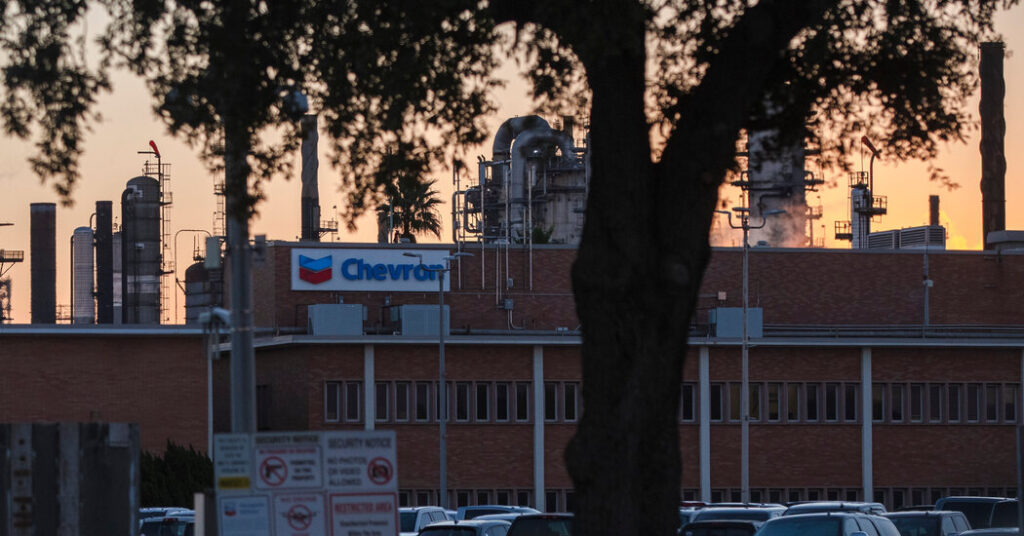
That simple question led me to the city of Pascagoula, Miss., home to Chevron’s flagship refinery on the Gulf of Mexico, where residents have long complained about pollution from the facility and other industrial sites along the coast. (Read my article on the community’s worries here.)
It’s one of a handful of sophisticated refineries in the country that have been processing Venezuela’s heavy crude oil into gasoline, diesel and jet fuel.
Operating under a special license, Chevron is the only American company that has continued drilling for oil in Venezuela in recent years, even while other oil giants left the country. As the U.S. government asserts control over Venezuelan oil production, Chevron is among the companies that could reap benefits most quickly.
Pascagoula residents now worry that more Venezuelan oil is headed their way, adding to their pollution worries.
The prospect is giving fresh momentum to an unusual proposal by people who live near Pascagoula, in a neighborhood called Cherokee Forest. They’re asking Chevron and the owners of other industrial facilities in the city to buy their homes so they can move away from the pollution entirely.
Under their buyout plan, their homes would be converted into a “blue-green buffer” of forests, waterways and wildlife habitats between the industrial corridor and remaining households, aiming to alleviate chronic flooding and helping to filter industrial emissions.
“Let them drill over there, do what they’ve got to do,” Julie Hambey, who has lived in Cherokee Forest for more than 30 years and who works at a nearby Walmart, told me. “Just get us all out.”
How refineries generate pollution
Refining sulfur-heavy crude oil requires more energy for processing than lighter kinds of oil. That results in higher emissions of planet-warming gases, as well as hazardous air pollutants, research has shown.
It also leaves behind petcoke, a solid fuel sold to cement makers and other industrial facilities. Studies have found that petcoke contains heavy metals and other pollutants that can escape during storage and transport. Chevron’s own monitors show periodic spikes of benzene, a carcinogen, around the refinery.
So far, Chevron has been noncommittal about the buyout request. It says it tackles pollution with emissions-control equipment like scrubbers and leakproof valves and that its emissions meet Environmental Protection Agency requirements.
I asked other environmental groups along the Gulf Coast, a region with several other refineries that could also soon be receiving more Venezuelan oil, whether they shared the Cherokee Forest residents’ concerns.
Ana M. Parras, a co-founder of Texas Environmental Justice Advocacy Services, a nonprofit organization that works with low-income and minority neighborhoods in the Houston Ship Channel, which is home to a large refinery, said that she had “major concerns” about what more Venezuela oil could mean for nearby communities.
“Heavy crude is harder to move and process,” she said. She worried that this would create a higher risk of “upset events” — meaning leaks, equipment failures and the “flaring,” or intentional burning off, of natural gas — which can release substantial amounts of pollutants in short bursts, sometimes before community warnings can be issued.
She noted that St. Charles, in Louisiana, was already contending with a refinery processing Canadian oil sands, another thick form of crude oil. (One question is whether imports of Venezuelan crude might displace the use of these oil sands, in effect replacing one dirty fuel with another.)
Two linked problems
Communities like those in Pascagoula and St. Charles share another concern: They increasingly face hazards both from pollution and from the growing storm and flood risks driven by climate change. Nearly a third of properties in Cherokee Forest, for example, are already empty, mainly abandoned after devastating flooding from Hurricane Katrina.
Kelly Leilani Main, executive director of Buy In Community Planning, a nonprofit organization that helps relocate communities threatened by climate change, said the effects of industrial pollution and climate change should no longer be considered separate problems. The burning of fossil fuels is both a driver of local pollution and the major cause of global climate change, through the release of greenhouse gases that trap the sun’s heat. (Main’s organization is working with Pascagoula residents on relocation and restoration plans.)
These communities, she said, are facing “the compounding hazards of industrial pollution and threats of climate extremes.”
Trump Administration: Live Updates
Updated
- TrumpRx, a website that will connect patients directly with drugmakers, will go live on Thursday.
- Marco Rubio has given up his role as the acting head of the National Archives.
- A new policy will make it easier for Trump to remove or discipline tens of thousands of federal workers.
Renewable energy
A Trump ‘blockade’ is stalling hundreds of wind and solar projects nationwide
While President Trump’s attacks on offshore wind have been highly visible, his administration has also been hobbling hundreds solar and wind energy projects on land by halting or delaying federal approvals that were once routine.
Many projects are facing potentially fatal delays, according to interviews with more than a dozen energy companies, industry groups and analysts.
The extra layer of scrutiny for wind and solar contrasts with actions by the Trump administration to make it easier and cheaper for companies to produce oil, coal, gas and nuclear power. And it sets the United States apart from other countries that are embracing renewable energy.
Some 73,000 megawatts of solar projects on land are currently at risk from political interference, according to the Solar Energy Industries Association, which called Trump’s policies a “blockade.” — Brad Plumer and Rebecca F. Elliott
More on trump’s ‘blockade’
“In Indiana, Patoka Solar is a proposed 250-megawatt solar array on private land that could affect local wetlands. To apply for a federal water permit, the developer needs to use a taxpayer-funded database to document the effects on wildlife. Yet the Interior Department has barred wind and solar companies from using that database, making it “impossible” for the project to advance, according to court filings in a lawsuit against the agency by a coalition of clean energy groups.”
From The World newsletter
Fewer people, fewer climate problems?
Decades ago, many within the environmental movement called for a smaller population as a means of curbing carbon emissions and lessening the effects of climate change.
Most climate experts are now focused on other solutions, but the arguments have had a lingering cultural impact: Whenever I write about the negative effects of falling fertility rates around the world, I hear from many readers who are certain that the emission-reduction benefits will outweigh the other costs of a smaller population.
But when a team of researchers at the University of Texas at Austin and Hunter College in New York City ran the numbers, they found that population decline was likely to have only a negligible impact on climate change.
The reason? The timelines just don’t match up. Because human life spans are long, the researchers wrote in a recent working paper, falling birthrates will take a long time to meaningfully change the size of the world’s population. The threat of climate change is much more immediate — today’s emissions will have a lasting effect on the Earth’s atmosphere. — Amanda Taub
More climate news from around the web:
-
Carbon Brief estimates that solar power, electric vehicles and other clean energy technologies drove more than a third of China’s economic growth in 2025, reaching $2.1 trillion in total. That is equivalent to 11.4 percent of China’s gross domestic product and comparable to the economies of Brazil and Canada.
-
Bloomberg has another remarkable data point about China: “Since 2021, China has added more power capacity across all energy technologies than the U.S. has in its history.”
-
Long-term exposure to tiny particulates from wildfire smoke contributed to an average of 24,100 deaths a year in the lower 48 states, according to a study highlighted by The Associated Press.
Read past editions of the newsletter here.
If you’re enjoying what you’re reading, please consider recommending it to others. They can sign up here.
Follow The New York Times on Instagram, Threads, Facebook and TikTok at @nytimes.
Reach us at [email protected]. We read every message, and reply to many!
Hiroko Tabuchi covers pollution and the environment for The Times. She has been a journalist for more than 20 years in Tokyo and New York.
The post When Venezuelan Oil Comes to the U.S. appeared first on New York Times.