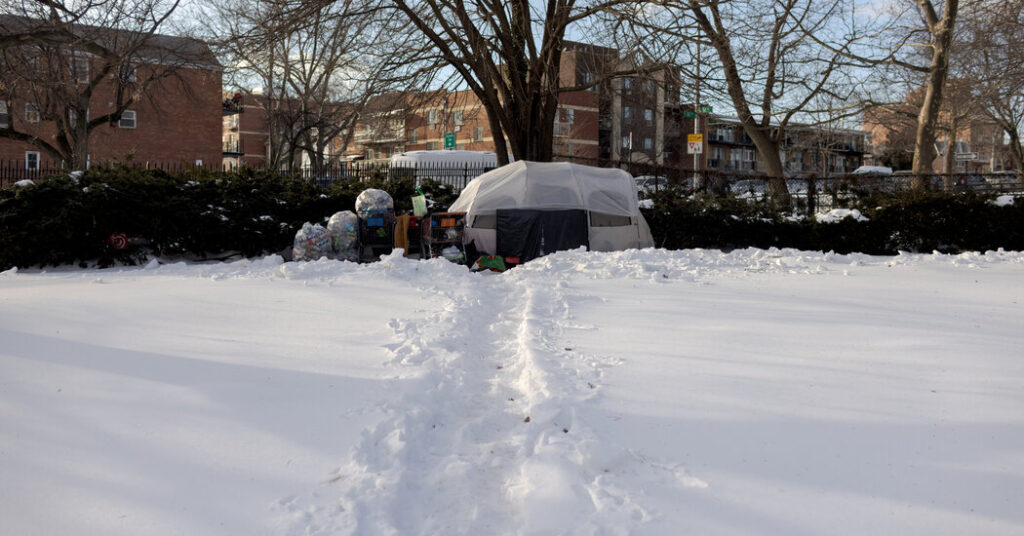
As 8.5 million New Yorkers huddled in the comfort of their homes during the unusually long cold snap that has gripped New York City, 17 of their neighbors died after exposure to the brutal conditions — on street corners, in parks and outside hospitals.
In the annals of New York City weather events, it is a large enough death toll to prompt questions about what the city could have done differently. More New Yorkers have died during this cold spell, according to the city-compiled death toll, than the 14 who died in the aftermath of Hurricane Ida in 2021.
The death toll poses a problem, both practically and politically, for Mayor Zohran Mamdani, who took office on Jan. 1 with almost no management experience at 34 years old and who is now grappling with his first major test as chief executive.
His Jan. 5 decision to pause the clearance of homeless encampments on city streets is under particular scrutiny, even as the mayor says that the city has, thus far, been unable to trace any deaths to encampments. He has also pointed to data showing that the encampment sweeps under his predecessor, Eric Adams, were ineffective at connecting New Yorkers to housing.
The Mamdani administration has rolled out several initiatives to shield more people from the cold, which was accompanied by about a foot of snow. The city has deployed warming buses, set up warming centers and offered overtime to outreach workers to canvass more.
The city has opened 150 beds in specialized shelters that offer more privacy. And it has made more than 1,100 placements into shelters and safe havens during the cold snap, Mr. Mamdani said this week, though it was not clear if some of those placements were “duplicates” — people who were placed on multiple nights and counted multiple times.
Mr. Mamdani even appears in a video now playing on the 2,000 LinkNYC kiosks on city streets, urging New Yorkers to call 311 or 911 for help getting indoors.
And yet, the death toll has continued to climb in a city that prides itself on its willingness and ability to care for its most vulnerable.
Unlike most cities, New York is legally obligated to shelter anyone who needs a bed. It spends about $4 billion a year on homeless services and houses more than 100,000 people in shelters. It has its own housing subsidy system akin to the federal government’s Section 8 program. It runs a mammoth emergency response operation encompassing the police, the fire department and emergency medical services. It deploys an army of homeless outreach workers.
But the number of deaths keeps creeping up, from 10 announced last Tuesday, to 13 on Friday, 14 on Saturday, 16 on Monday and 17 on Wednesday.
The city has not released the cause of death for any of the people, saying that it is still awaiting autopsy results. But Mr. Mamdani has said that exposure to the cold may have played a role in 13 deaths, while at least three others may have involved drug overdoses.
Crystal Hudson, who chairs the City Council’s Committee on General Welfare, said the increasing death toll is “wild to me.”
“As a lifelong New Yorker, I can’t remember the last time we had such a massive number of fatalities in such a short time frame because of extremely cold weather,” said the councilwoman, who plans to hold hearings Tuesday on the outdoor deaths.
When the temperature drops in New York City, homeless outreach workers worry about people like Rivaldo Menezes, 70, a former roofer who on Saturday was camped out in a cardboard box on 103rd Street in the Corona neighborhood of Queens.
At the start of the coronavirus pandemic, Mr. Menezes checked himself into a shelter, after a fight with the daughter who was putting him up. It did not go well.
“When I went there, there’s drugs, there’s alcohol,” Mr. Menezes said. “You can’t sleep. There’s yelling and screaming.”
Kesha Berry, who has lived in a parked van for more than seven years, feels similarly. She has been in a city shelter before, she said, but she does not want to go back.
On Tuesday, workers with Breaking Ground, the nonprofit group contracted by the city to do street outreach in Queens, Brooklyn and parts of Manhattan, knocked on Ms. Berry’s window to see how she was doing.
“Blessed,” Ms. Berry said. A shovel leaned against her van, the snow cleared in front of her sliding door. She nodded toward the outreach workers. “They came through for me,” she said.
Ms. Berry, who is in her 50s, said she had grown accustomed to hardship, but sometimes she still needs help. The outreach workers recently brought her propane so she could run a small heater.
“This one was severe,” she said of the weather. “It was difficult. But because of my perseverance, I go forward. I get prepared.”
People like Mr. Menezes and Ms. Berry present a quandary for outreach workers. Many have chosen to live rough because they experienced violence or theft inside the shelters, where dozens of people often sleep in one barracks-style room. Others chafe at shelters’ curfews and restrictions on drugs and alcohol.
“We’ve been sounding the alarm on this for many years,” said Donovan Richards, the Queens borough president. “You’ve got to have safer shelters, otherwise you’re going to have people sleeping on the streets or on the subways.”
Elioth Gonzalez, 41, who had been sleeping beside friends in a doorway in Corona, Queens, for at least a week, said on Saturday that shelters had nothing good to offer him. “Why would I go to a shelter, for what?” he said. “It’s better to rely on the kindness of people around here.”
In the past two weeks, that reluctance to enter the shelter system has coincided with one of the longest cold spells in recent years.
From Jan. 24 to Sunday, New York City had a streak of nine days when the temperature did not get above freezing, the longest such streak since a two-week stretch in December 2017 and January 2018. The Mamdani administration said that 12 people died during that earlier cold snap, a tally that includes both those with homes and those without.
Since Monday, temperatures have risen above freezing during the day but dropped into the 20s or teens at night. Frigid temperatures are expected to return by the end of the week, with a wind chill of minus 10 on Saturday night.
The city received almost 80,000 complaints about lack of heat or hot water in January — the largest monthly sum on record.
From 2006 to 2020, an average of four homeless people a year died from exposure to the cold, according to city data. But the number of deaths has risen significantly in recent years: From 2021 to 2024, an average of 14 homeless people died from cold exposure annually.
The reasons for the increase are not clear, but it coincides with rising opioid use among homeless New Yorkers that led to a steep jump in overdoses, as well as a rise in the homeless population in general.
Since 2018, the number of New Yorkers living unsheltered in streets and subways has grown to more than 4,000, from the high 3,000s, according to an annual city estimate. At the same time, New York’s army of homeless outreach workers does not appear to have kept pace. In 2021, a deputy city homeless services commissioner said that the city had 600 outreach workers. This year, Mr. Mamdani has said the city has just 400. The population in city shelters has also increased substantially since 2018, from about 70,000 to more than 100,000 today, in part because of the influx of migrants that began in 2022.
A city spokeswoman said the budgeted head count remains the same and that the 2021 number included back office workers.
As of now, it appears that at least two of the 17 people who died during the current deep freeze had homes. The city has released little if any information about the victims, but they include Doreen Ellis, 90, who had dementia and was found dead outside her apartment building in Brooklyn; Michael Veronico, a homeless man found dead in Brooklyn; a 52-year-old man who was found dead in Queens with discharge papers in his pocket from a city hospital; and an unidentified man found dead outside a city hospital in Brooklyn.
If the rising homeless population might have played a role, other explanations abound.
Mr. Adams, the former mayor and a frequent antagonist of his successor, has pinned blame on Mr. Mamdani’s decision to suspend cleanups of homeless encampments early last month. Advocates for the homeless argue that such sweeps not only sour relationships between homeless people and city workers but can also prove dangerous, particularly when city officials throw out blankets and tents that might otherwise keep people warm.
Mr. Mamdani disputed any connection between the policy shift and the death toll. But this week, City Hall acknowledged that at least 13 of the dead had had interactions with the city’s homeless services system.
Others have questioned whether City Hall should have made greater use of its ability to involuntarily remove New Yorkers from the streets when they are putting their lives in danger.
“If you are homeless and you want to stay on the street, I get it,” said Mr. Richards, the Queens borough president. “But we have to have a conversation, because if you’re staying in weather below 0 degrees, that to me signals that there are challenges there.”
On Wednesday, Mr. Mamdani said the city had involuntarily removed 20 people. He said last week that while the city considered such actions a last resort, his administration was “not going to leave someone out in the cold if they’re a danger to themselves or to others.”
Despite the city’s stepped-up outreach effort, some homeless people said it had not yet reached them.
Mr. Gonzalez, in Corona, Queens, said he had not received a visit from an outreach worker in more than six months, and had not received forewarning of last weekend’s blizzard, despite the mayor’s saturation of the airwaves. “The truth is we don’t have any place to watch the news,” he said.
During the current cold spell, calls to the city’s informational 311 line about vulnerable homeless people have been rerouted to 911.
The resulting inundation of calls has increased wait times, according to a city official who sought anonymity so he could speak frankly. This past weekend, as some responses to “cold calls” were taking more than two hours, city officials decided to staff 12 of the Fire Department’s so-called rapid response vehicles — four-door utility trucks — with firefighters working voluntary overtime, he said.
It seemed to work well. On Sunday, he said the vehicles responded to more than 150 calls, and helped arrange transport for people to the hospital and to warming shelters. Response times fell.
Then the firefighters union came out against the measure, and the effort all but ceased. A spokesman for the union had no immediate comment. A spokesman for the mayor also declined comment.
Catherine Trapani, assistant vice president of public policy for Volunteers of America Greater New York, which operates shelters and supportive housing, praised some of the mayor’s response efforts and urged him to open more shelters with low barriers to entry: pet-friendly shelters, for example, and shelters where the definition of a “family” is interpreted loosely, so as to accommodate social groups.
She also called on the city to allow for more placements directly from the streets into supportive housing. Right now, her organization runs a pilot program that does just that, but is capped at 81 units. But she said it has at least another 69 units available, should the city lift the cap.
She said she had been having conversations with city officials about the idea. “I don’t recall a time when this many people have passed away in a stretch,” Ms. Trapani said.
But a spokesman for the mayor said the lag time for processing people into supportive housing made Ms. Trapani’s suggestion impractical during this crisis.
Miles G. Cohen contributed reporting.
Dana Rubinstein covers New York City politics and government for The Times.
The post When the Cold Turns Deadly, What Should New York City Do? appeared first on New York Times.