About two-thirds of California’s 3- to 5-year-olds are on track to enter kindergarten, according to new federal data. But being ready for school involves a lot more than a child’s ability to count or recite their ABCs.
The effort to get a snapshot of kindergarten readiness is part of the National Survey of Children’s Health, which collected information from thousands of parents and guardians about their child in five areas — early learning, motor skills, social-emotional development, self-regulation and health. The goal was to answer an overall question: Is your child ready for school?
Readiness in California is on par with the nation’s average, which also puts kindergarten readiness at two-thirds of 3- to 5-year-olds. But immense disparities exist. The gap in kindergarten readiness between the poorest families and the wealthiest is approximately 20%.
While there’s growing interest in assessing school readiness, education experts differ on what to measure and how. And some dispute whether children should be ready for school or if schools should be better prepared to address the needs of kindergartners.
Despite the complexities, what a young child learns before they enter classrooms can set the course for the rest of their academic career, experts said.
What is kindergarten readiness?
Kindergarten readiness encompasses the foundational skills necessary to engage in a more formal learning environment, said Ohio State University educational psychology professor Laura Justice.
Although there is not a universal definition, many experts and educators rely on guidance from the bipartisan National Education Goals Panel, which has criteria similar to the questions asked by the federal survey.
School readiness is a relatively new concept, with the panel’s guidelines emerging in the 1990s. Historically, there weren’t many expectations for children entering kindergarten, although some students — typically from higher-income families — arrived in classrooms with more advanced skills than others, said Robert Crosnoe, a sociology professor at the University of Texas at Austin. That meant states had to provide enriching learning opportunities before children set foot in a kindergarten classroom — so they could learn not only their ABCs but also skills such as carrying on a conversation and problem-solving during playtime.
“If we just focus on those strictly academic things, it’s only going to get us so far,” Crosnoe said.
Is your child ready for kindergarten? It’s not an easy answer
There are a few ways to measure readiness, but each method has its drawbacks, said Jill Cannon, a senior policy researcher at global policy think tank Rand.
Parents can answer questions about their child — such as in the National Survey of Children’s Health — but can be biased or misinterpret questions, especially if English isn’t their first language. Teachers can assess children instead, but interpretations of a child’s behavior can often depend on the teacher who is doing the assessment.
When to measure readiness can also be a factor.
A child’s age when they enter kindergarten, typically at age 5, can influence readiness, as children who are several months older are often in the same class with younger 5-year-olds.
“Six months now to me means nothing, but back then … I had a lot of learning to do. I grew a lot,” Cannon said. “These kids, they grow a lot over the kindergarten year.”
How to prepare your child
If your child is scheduled for a kindergarten readiness assessment, don’t worry. Most experts agree that readiness tests are important in identifying what supports kids will need.
When it comes to social-emotional readiness, most children often catch up within the first month or two if they don’t come in ready, said transitional kindergarten teacher Amy DiStefano, who also taught kindergarten for 22 years. Based on guidance from the National Education Goals Panel, kindergartners should be able to take turns and cooperate. They should also be able to understand others’ emotions and express their own feelings.
DiStefano, who teaches at Taper Avenue Elementary in San Pedro, said she evaluates kindergarten readiness based on students’ ability to follow one-step directions and their ability to communicate among themselves and with adults, especially when it comes to problem-solving, sharing and asking for help.
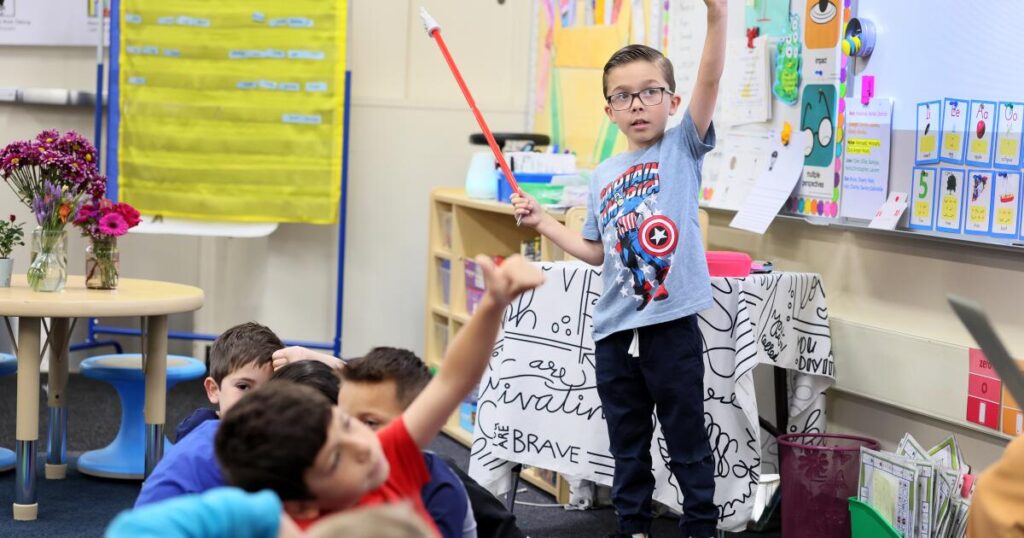
Readiness can be observed in different ways, UC Berkeley education professor emeritus Bruce Fuller said. Pre-literacy skills and math concepts can be important for school districts and policymakers as children get ready to begin state testing in later years. Teachers often look at a child’s classroom behavior: Do they raise their hand, stand in line? For parents, the ability to make friends and use cooperative skills can be vital.
Benchmarks from the National Education Goals Panel indicate that children should have awareness of sounds and letters, understand how a story works and be able to represent ideas through drawings. They should be curious and persistent on tasks, have gross and fine motor skills and a concept of numbers.
“Early learning activities in the home, the complexity of language that families use, the quality of pre-K — all these drive a huge difference in the pace of the child’s development,” Fuller said. “It doesn’t mean that certain kids won’t catch up, but on average, kids that are not ready for school — kids that are not developing at typical rates — are likely to fall further behind in elementary school.”
How is kindergarten readiness measured in California?
California doesn’t have a statewide assessment to evaluate kindergarten readiness.
To truly assess kindergarten readiness, the approach would have to be holistic — and as a result, costly. Early childhood advocates in California tend to err on the side of limiting testing as well, Fuller said.
“Children’s advocates rightly point to kids’ emotional happiness, well-being and social skills as the foundation,” Fuller said. “Assessing social and emotional dimensions of growth is an inexact science. We could assess all 4-year-olds, but we might not be measuring the right thing.”
Teachers, however, are able to monitor their children and adapt activities to encourage development in appropriate ways, said Gennie Gorback, president-elect of the California Kindergarten Assn.
“Teachers, especially kindergarten teachers, are so good at meeting children where they are, assessing them and knowing what their needs are and preparing activities and lessons, surrounding where they need to grow,” Gorback said.
How to boost kindergarten readiness
Research suggests that attending a high-quality preschool program is one of the best ways to boost kindergarten readiness.
However, preschool curricula vary vastly across the U.S., with some prioritizing certain development areas, such as literacy. And the quality of preschool can vary drastically.
In California, Gov. Gavin Newsom recently oversaw the expansion of transitional kindergarten, which sought to provide all 4-year-olds with free early childhood education in public schools. It has provided children with “the gift of time,” to develop their social-emotional skills in preparation for kindergarten, Gorback said.
But some kindergarten expectations are getting pushed to the younger grade level, including social-emotion development, she said.
Some measures of preschool quality are universal. Many early childhood education experts rely on the National Institute for Early Education Research’s 10 quality benchmarks to make broad assessments in all states that offer public preschool programs. Parents can use the standards as a guide for choosing a preschool that’s most likely to help prepare their child for the next step.
Sequeira reports for The Times’ early childhood education initiative, focusing on the learning and development of California children from birth to age 5. For more information about the initiative and its philanthropic funders, go to latimes.com/earlyed. Seminera writes for the Associated Press. Todd Feathers of the Associated Press contributed to this report.
The post What it means to be ‘ready’ for kindergarten in California appeared first on Los Angeles Times.