After just three hours, Russia, Ukraine and the United States declared themselves done with the latest round of peace talks on Thursday, offering scant sign of progress toward ending a war that is nearing a fifth year despite the Trump administration’s diplomatic interventions.
A familiar pattern played out as two days of negotiations wrapped up in Abu Dhabi, the capital of the United Arab Emirates. Everyone said the talks were productive. More talks were planned. Yet with little to show for them but an announced exchange of prisoners of war, the major sticking points in any peace deal appeared a long ways from being unstuck.
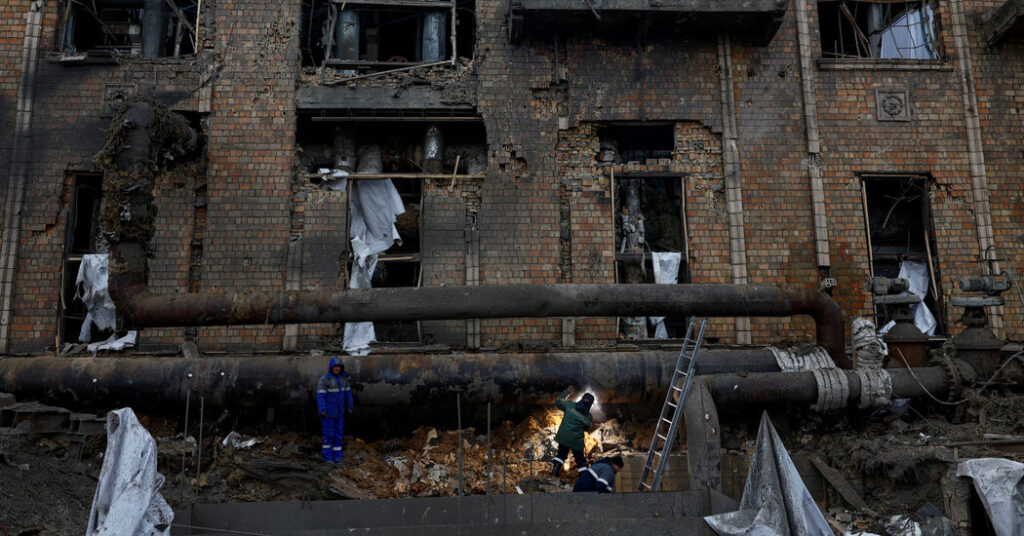
Officials did not say what was discussed behind closed doors. A louder message came a day before the talks, when Russia unleashed another huge attack on Ukraine’s power grid during a frigid winter.
The delegations in Abu Dhabi had been expected to focus on the two main obstacles to a peace deal: the fate of Ukrainian-controlled territory in the east and guarantees over Ukraine’s postwar security.
Kyrylo Budanov, the chief of staff for President Volodymyr Zelensky and a member of Ukraine’s negotiating team, told a Ukrainian news outlet that the talks were “really constructive.” He spent more time praising the Emirates and the United States, however, “for the high-quality organization and mediation.”
Steve Witkoff, President Trump’s special envoy, tried to cast the results of the talks in a positive light, saying that Russia and Ukraine had agreed to swap 314 prisoners. But this represented no particular breakthrough in diplomatic efforts that have stretched on for months, long past Mr. Trump’s campaign promise to end the war in 24 hours. Ukraine and Russia have regularly exchanged prisoners of war and the remains of the dead for years.
“This outcome was achieved from peace talks that have been detailed and productive,” Mr. Witkoff said on social media. He added: “While significant work remains, steps like this demonstrate that sustained diplomatic engagement is delivering tangible results and advancing efforts to end the war in Ukraine.”
Mr. Witkoff said the trilateral discussions, first held over two days last month, would continue “with additional progress anticipated in the coming weeks.”
Within a few hours, Russia and Ukraine traded 157 prisoners, the first swap since early October. It was unclear if this exchange was related to the peace talks, as prisoner releases usually take days or even weeks to arrange. The U.S. European Command also announced that because of the talks, the U.S. armed forces would resume high-level military dialogue with Russia.
Getting Moscow to budge on any of the major hurdles in the peace talks is a far more difficult challenge, analysts say. Russia believes it is winning on the battlefield and has no need to compromise, they say, despite its huge losses of troops and glacial territorial gains.
Russia now controls about 20 percent of Ukrainian territory. While the Russian Army’s progress has been slow, it picked up somewhat in the final months of last year.
Publicly, the Kremlin has so far not stepped back from the aims it laid out when it launched its full-scale invasion almost four years ago. It wants all of an eastern area known as the Donbas, made up mostly of the Luhansk and Donetsk regions. Ukraine still holds onto about 20 percent of Donetsk.
On Thursday, the Russian delegation in Abu Dhabi doubled down on this goal. The state-run news agency Tass said Russia did not just want Ukraine to surrender all of the Donbas as part of any deal. Negotiators, it reported, also insisted on the recognition of the Donbas as Russian territory by all other countries.
Moscow also opposes any security guarantees for Ukraine that would mean Western soldiers in the country or membership in NATO.
Ukraine has indicated that it would be willing to freeze the border along the line of contact on the battlefield, at least for now. It has accepted that it will not be allowed to join NATO, also at least for now. But it has opposed the idea of trading away any territory it now holds. Accepting the idea that other nations would consider the Donbas anything other than Ukrainian is a nonstarter, even if territory has to be ceded for now.
The actions of Russia during the trilateral talks show that President Vladimir V. Putin has become adept at telling Mr. Trump what he wants to hear — “tapping me along,” as the American president has put it — while continuing to pursue the war in Ukraine.
Negotiators from Russia, Ukraine and the United States first met in Abu Dhabi on Jan. 23 and 24 for the initial round of talks, on the heels of Russian attacks that devastated Ukraine’s power grid during the country’s harshest winter in more than 10 years.
Everyone described those talks as “constructive” afterward. Ukraine and the United States even reached a theoretical deal on American security guarantees, although there’s no indication that Russia would agree to those.
Last Thursday, Mr. Trump announced that he had won an agreement from Mr. Putin to stop hitting Ukraine’s power infrastructure for a week because of the extreme cold.
But on Friday, Mr. Putin’s spokesman, Dmitri S. Peskov, clarified that the truce applied only to Kyiv, the capital; that it would end on Sunday, when the second round of trilateral negotiations was originally supposed to start; and that the reason Mr. Putin had agreed to Mr. Trump’s request was “to create favorable conditions for negotiations.”
On Saturday, Mr. Witkoff held a surprise meeting in Florida with Kirill Dmitriev, the Kremlin’s special envoy and head of Russia’s sovereign wealth fund. The Ukrainians were not at the table.
As is typical, neither side released details of what was discussed. Mr. Witkoff said on social media that the meeting had been “productive and constructive.”
While Russia stopped hitting Ukraine’s power grid for several days, it continued to strike at the country’s logistical hubs supporting the energy grid.
The trilateral negotiations scheduled for Sunday were delayed several days. And then the truce, such as it was, was over. The “favorable conditions for negotiations” described by Mr. Peskov quickly evaporated.
Early Tuesday, the day before the trilateral negotiations were set to begin, Russia again pummeled Ukraine’s power plants, attacking them in at least six regions with 450 drones and 71 missiles. It was the most Russian missiles fired into Ukraine in a single night since Christmas 2024, according to Air Force statistics compiled by The New York Times.
It was also a record number of ballistic missiles fired at the power grid, Mr. Zelensky said. Ukraine’s military intelligence agency estimated that Russia had spent almost $325 million on the drones and missiles for the attack.
Mr. Zelensky said these strikes would change Ukraine’s approach to the trilateral negotiations, although it is not clear how or if they did.
After the attacks, Mr. Trump told reporters that he was satisfied that Mr. Putin had “kept his word” on the energy truce.
But others were not, including Mark Rutte, the secretary-general of NATO, who visited Kyiv on Tuesday and said that the attacks called into doubt Russia’s “seriousness about peace.”
Analysts predicted that little progress would be made this week in Abu Dhabi.
“I didn’t have high expectations for this round of negotiations, especially after the very controversial situation around the so-called energy cease-fire,” said Volodymyr Fesenko, a leading Ukrainian political analyst. “I think this round was purely an interim one.”
Oleksandra Mykolyshyn and Nataliya Vasilyeva contributed reporting.
Kim Barker is a Times reporter writing in-depth stories about the war in Ukraine.
The post Ukraine-Russia Talks End With Little Progress and Hints of Impasse appeared first on New York Times.