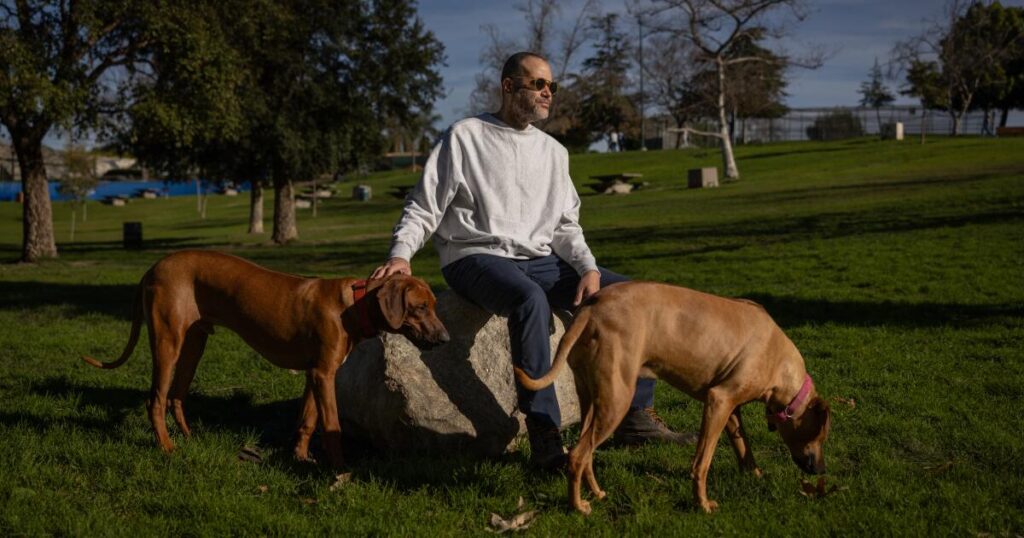
In the days after Charlie Kirk was fatally shot in September while speaking at a Utah college campus, stunned followers of his conservative movement mourned online, condemning political violence. From his Los Angeles home, Johnathan Perkins, a Black diversity, equity and inclusion director at UCLA, had a different take.
“Good riddance,” he wrote on Bluesky. In another post: “It is OKAY to be happy when someone who hated you and called for your people’s death dies — even if they are murdered.”
Later: “I’m always glad when bigots die.”
Perkins said he was exercising his right to free speech on his own time about a divisive public figure. Screenshots of his posts spread across conservative news sites and social media. He received online death threats. Complaints poured into UCLA inboxes.
Officials swiftly placed Perkins on paid leave and opened an investigation. UCLA also issued a rare statement about an employee: “Violence of any kind — including the celebration of it — is completely unacceptable and will not be tolerated.”
Last week, UCLA fired him, and his last day on the payroll was Friday.
The termination letter, which Perkins allowed The Times to review, cited violations of policies on “workplace violence prevention,” including posts that “referenced or appeared to endorse violence or death” and made “demeaning or generalized remarks about demographic groups.”
“Given the nature of your role as a Director of Race and Equity, the university has determined that this conduct significantly undermined trust in your leadership and adversely affected the office’s effectiveness and credibility,” it said.
Perkins’ story is among more than 100 cases nationwide of college faculty or staff who were disciplined for comments about Kirk. The incidents included dozens where employees wished Kirk harm, said he deserved to die, or expressed happiness at his death, according to a Times review of social media, news reports and legal cases.
Several disciplined workers have since returned to campus, sued, or received settlements, including a Tennessee professor reinstated after a $500,000 payout and a Fresno State lecturer back on the job after suspension, according to local news reports and faculty groups. Other suspensions are still under campus investigation, litigation or settlement talks.
Perkins’ firing, however, appears to be an outlier and has raised concerns among free speech advocates who question whether political considerations contributed to UCLA’s decision at a precarious time for the university as it faces Trump administration pressure to clamp down on diversity measures.
“Discipline for offensive speech that’s nevertheless protected under the law” is worsening as universities face federal pressure to limit DEI, pro-Palestinian protest and the recognition of transgender people,” said Zach Greenberg, director of the Faculty Legal Defense Fund at the Foundation for Individual Rights and Expression.
At the time, Vice President JD Vance urged universities to fire employees for speaking out against Kirk after he was killed, warning that campuses that refused could face federal funding cuts — an issue UCLA was already confronting. Weeks before the Kirk shooting, the Trump administration demanded that UCLA pay a $1.2-billion fine to settle federal civil rights investigation findings of it mishandling antisemitism complaints and called for sweeping policy changes in exchange for restoring frozen grant funding.
In a statement, UCLA did not elaborate on the Perkins firing. “This person is no longer an employee at UCLA following the completion of an internal investigation,” it said.
Perkins, who holds a law degree from the University of Virginia, was also given a roughly 250-page set of investigation findings by UCLA that detailed a history of social media controversies. He declined to allow The Times to review the file because he intends to file a lawsuit challenging his dismissal and cite the report in his case.
His social media activity shows a strident, polemical voice on racism and systemic injustice.
He’s out of the $137,000 job he’d held for five years since UCLA recruited him after he worked at Harvard’s legal office. In Westwood, he led DEI programs around campus training, hiring and student access to learning. Perkins has raised about $10,000 on GoFundMe to relocate to his hometown of Philadelphia and fund his suit.
He’s now searching for his next job.
Controversy over Kirk
Kirk and the organization he founded, Turning Point USA, aligned with President Trump and fueled youth conservatism. He was best known for campus visits — like the Utah Valley University stop — where he sparred with students over immigration, gender, abortion and other hot-button issues.
Kirk called himself a free speech advocate. Critics said he stifled it by promoting intolerance. His group — now led by his widow, Erika Kirk — runs Professor Watchlist, which university faculty blame for harassment and doxxing of those the website deems to be “radical professors” tied to feminism, LGBTQ+ studies and diversity.
Representatives for Turning Point USA did not respond to a request for comment about Perkins and other cases of faculty and staff suspensions or firings in response to speech about Kirk. On Professor Watchlist, where Perkins has been featured since 2022, Turning Point calls him “no stranger to racially incendiary remarks.”
Kirk also faced criticism for what critics saw as inflammatory statements. In 2022, after a man attacked Rep. Nancy Pelosi’s husband, Kirk urged supporters to bail out the “amazing patriot.” He cited Leviticus 20:13, which suggests that a man who has sex with another man should be put to death, as “God’s perfect law.” In a 2024 podcast, he mocked DEI’s influence on hiring, saying, “If I see a Black pilot, I hope he’s qualified.”
Those were the kinds of comments Perkins said offended him about Kirk, who was a fierce critic of the rise of campus identity politics and its role in scholarship.
Not Perkins’ first time in spotlight
“It boils down to me and other Black people and other brown people … simply not being sad that this man who was so openly hateful was against all of us,” said Perkins, who is the grandson of civil rights activist John M. Perkins of Mississippi.
Perkins remains a prolific social media user. On his Bluesky profile, he calls himself the “foremost” expert on Project 2025, the Heritage Foundation’s conservative government and cultural blueprint — many of its proposals were adopted by Trump — which calls for DEI’s elimination and mass deportations.
Across more than 47,000 Bluesky posts, Perkins frequently derides the Trump administration, including posts this year criticizing Homeland Security Secretary Kristi Noem amid Minneapolis immigration raids.
“Stay woke,” said a recent post.
He’s also not new to controversy.
While a student, he entered the spotlight in May 2011 when he recanted an article he wrote in a campus law publication. In the piece, he alleged that University of Virginia police racially profiled him during a search while he walked home from a party.
Later, in a 2017 article he wrote in the Marshall Project, Perkins alleged that the FBI and University of Virginia police approached him and that, under pressure, he agreed to go back on his story because he was “just scared.” He wrote that — once officers explained the potential ramifications of their investigation — he feared “a swarm of FBI agents would descend upon Charlottesville to question my friends, family, and classmates” and future Philadelphia law firm employer as part of a civil rights inquiry.
In the Marshall Project article, Perkins described what happened after he changed his story, as news reports and commentary “branded me a liar, a race-baiter, the Boy Who Cried Wolf, and a prime example of the problem with affirmative action. I lost the law firm job I had secured.”
Perkins said he stands by the article. He said the episode instilled in him the importance of speaking his mind no matter the consequences, a belief that led to regular sparring on social media.
In 2022, when employed at UCLA, Perkins tweeted that “no one wants to openly admit [we all] hope Clarence Thomas dies,” calling him “Uncle Thomas”. The posts drew attention from Fox News and conservative outlets. Two years later, he speculated that Catherine, the Princess of Wales — who was undergoing cancer treatment — was faking her condition, attracting criticism of Perkins from British and American tabloids. Perkins, who was in remission from lymphoma at the time, defended his comments.
In both cases, UCLA distanced itself. A manager warned him more flare-ups could lead to discipline, Perkins said.
As a Black DEI director, he said he felt compelled to keep speaking up.
“I will always speak out against racism … I would post my thoughts [about Kirk] again,” said Perkins, who was part of the legions of social media users who quit X for Bluesky after Trump’s 2024 presidential win. He put a disclaimer in his bio: “ALL posts are personal and DO NOT represent my employer’s views.”
He thought the smaller platform would draw less attention.
It didn’t — not after Kirk’s death.
Faculty and staff trends
Erwin Chemerinsky, dean of UC Berkeley Law and a 1st Amendment scholar, said it would probably “violate the First Amendment for professors at public universities to be disciplined or fired for such speech.” Off-duty remarks on public issues, he said, are protected “unless their disruption outweighs their value.” That threshold, he noted, is rarely met.
“There is no doubt that comments about Charlie Kirk involved what courts deem a matter of public concern,” Chemerinsky added. “It’s highly unlikely a university could show those remarks were so disruptive as to justify firings.”
Still, protections differ by role. Faculty have broad latitude through academic freedom, experts said. Staffers such as Perkins have narrower — but still significant — protection for speech outside work duties.
Todd Wolfson, president of the American Assn. of University Professors and a faculty member at Rutgers University, said the UCLA case seemed “relatively mild.”
“Those statements may be offensive to some,” Wolfson said. “But they feel like they absolutely should exist within the bounds of acceptable political speech to me, and are not and should not be grounds for firing somebody.”
The post UCLA fires a DEI leader over Charlie Kirk comments. Did his speech go too far? appeared first on Los Angeles Times.