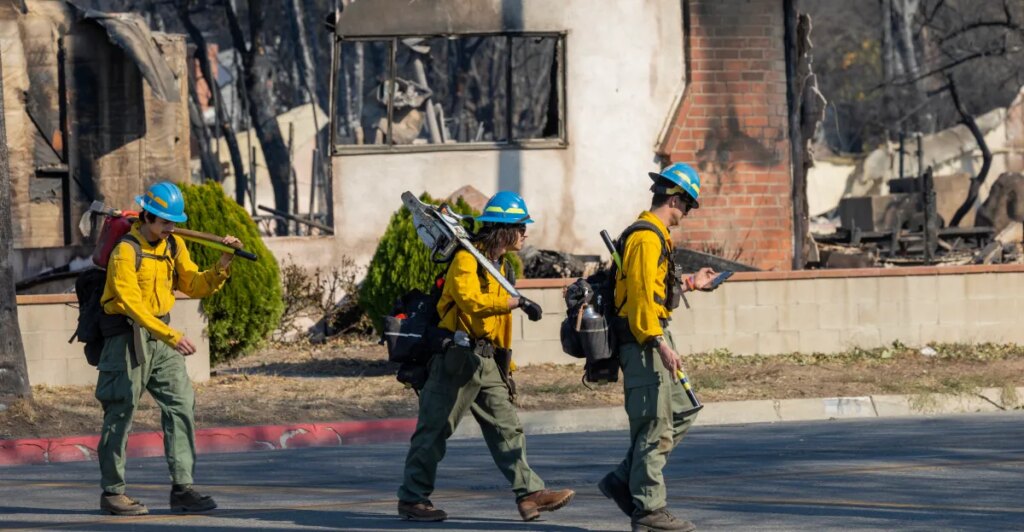
Wildfires have consumed thousands of buildings, killed dozens of people, and smothered millions in choking smoke in recent years. Blazes like the Los Angeles wildfires in 2025 have also revealed that fighting these massive blazes continues to be hampered by bureaucratic traps — which agency is in charge of the response, who is on the hook for the cleanup, what layer of government is accountable for prevention, and who has to pay for it all?
“In too many cases, including in California, a slow and inadequate response to wildfires is a direct result of reckless mismanagement and lack of preparedness,” President Donald Trump said last year in an executive order.
That confusion is one reason why the Department of the Interior announced last month that it is taking steps to create a new Wildland Fire Service. The idea is to streamline disparate firefighting efforts across 693 million acres of federal land into one agency.
Key takeaways
- The Department of the Interior is creating the Wildland Fire Service to streamline its firefighting efforts. Wildfire management is currently split among multiple agencies, adding cost, delays, and frustration to fire response efforts.
- However, Congress did not approve the proposal to merge firefighting efforts across the Interior Department and the US Department of Agriculture, home to the US Forest Service. The Interior Department is focusing on internal reorganization for now.
- Experts say removing bureaucracy in firefighting is a good idea but express concern that focusing on fire suppression could lead to neglect of broader fire risk mitigation as the nature of wildfires evolves.
- Managing wildfires effectively requires going beyond putting out blazes, including tactics like forest management and updated building codes. This is often outside of federal jurisdiction and requires coordination with local authorities.
The idea has promise, and the move to bring in Brian Fennessy, a veteran Southern California fire chief, to helm the agency was applauded by many in the firefighting community. But the agency is already off to a shaky start. The Interior Department requested a budget of $6.55 billion for the new Wildland Fire Service initiative, but Congress pointedly did not include funding for it in the recent spending package in January because it would have required changes across multiple federal departments. Lawmakers did say they are open to studying the idea.
The debate over the funding aside, few doubt that there is a real problem here: Dealing with wildfires is a convoluted and costly endeavor that spans state, local, and federal agencies. Over the past five years, the federal government has spent an average of $2.4 billion on average to fight wildfires per year. Inside the Interior Department alone, there are multiple divisions with a hand in fire operations, including the Office of Wildland Fire, the National Park Service, and the Bureau of Land Management. Meanwhile, the US Forest Service, which conducts the bulk of federal firefighting, is currently a part of the Department of Agriculture.
As the federal government dithers over who should take the lead on fighting wildfires, the dangers are only growing.
“The US fire management system itself is strained close to the breaking point,” said David Calkin, a wildfire consultant and a former scientist at the US Forest Service. “The way we prepare for fire is a heavily bureaucratic intergovernmental process that is not agile to the rapidly increasing complexity of fires.”
But is a new wildfire service the solution?
Some of the experts I spoke to said there’s merit to the idea of putting the government’s wildfire-related work under one roof. However, there are worries among firefighters, land managers, and researchers about how this effort will play out, particularly if it places too much emphasis on putting out fires and not enough on the slow, tedious work of reducing their overall threat in the first place.
“I think there’s a lot of concern, but it’s based on uncertainty and a bit of fear,” said Christopher Dunn, a former wildland firefighter and now an assistant professor studying wildfire risk at Oregon State University. “It could come out to be very helpful to the workforce, helpful to our landscapes if it’s done right. It could also crash and burn.”
What we know about the Wildland Fire Service so far
The Interior Department said the goal of the Wildland Fire Service is to increase efficiency and lower costs. The new unit would not just fight fires, but manage fuels and rehabilitate burned areas.
However, since Congress didn’t provide the money to consolidate fire-related offices across different agencies, the Interior Department said that right now, it’s only reorganizing internally. “No new funding is being obligated, and no structural changes requiring congressional authorization are being implemented at this stage,” an Interior Department spokesperson wrote in an email.
That limits the impact of the new service because the bulk of federal firefighting capacity is at the US Forest Service. “The Forest Service currently represents somewhere between 70 and 75 percent of all suppression capacity,” Calkin said. But only 20 percent of wildfires ignite on federal land, which means most of the initial responses come from state and local fire agencies. There’s only so much the federal government can do in the early stages of most fires.
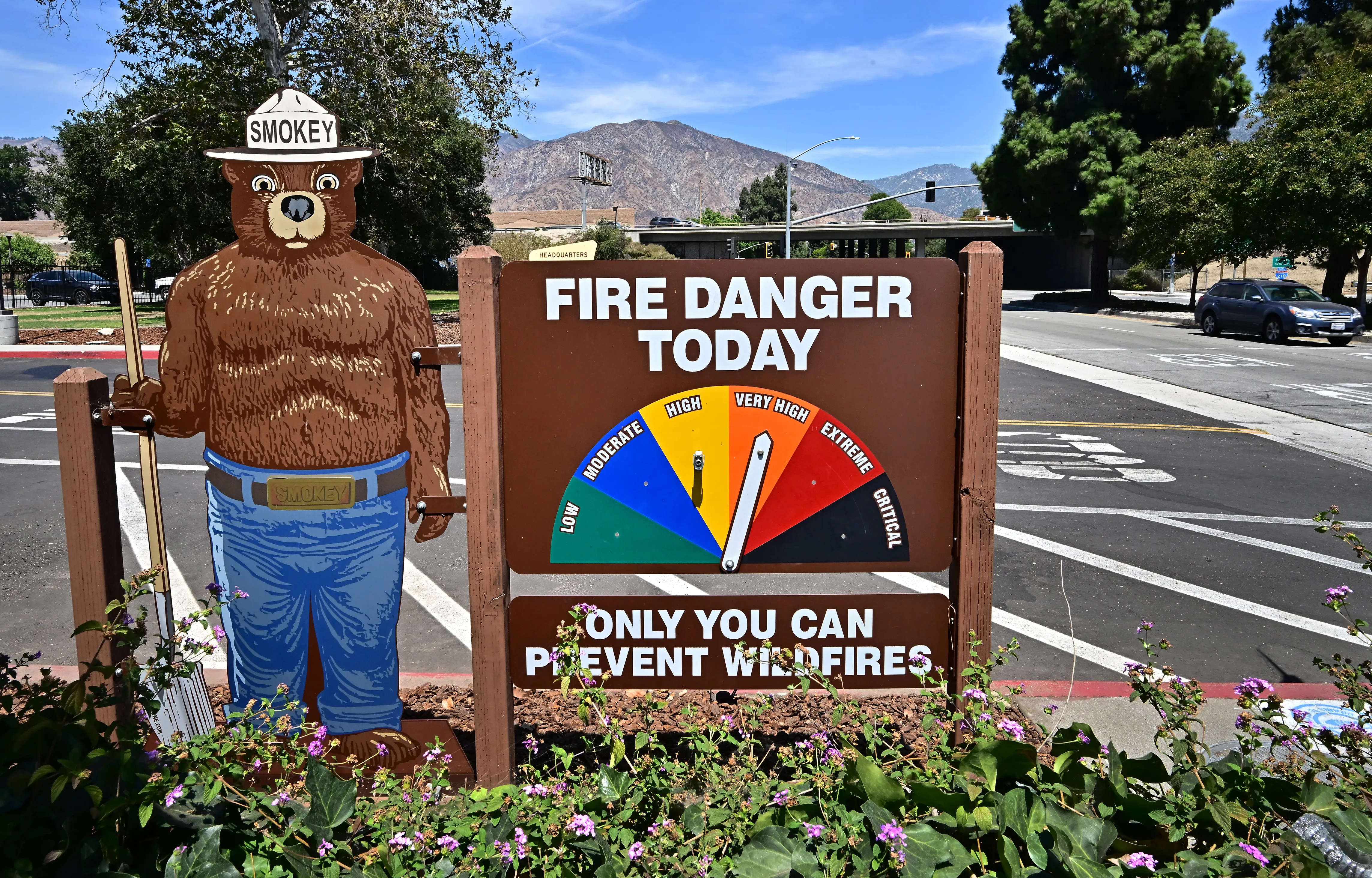
A “Very High” fire danger warning is posted at Angeles National Forest Headquarters in Arcadia, Californiafont-family: -apple-system, BlinkMacSystemFont, “Segoe UI”, Roboto, Oxygen-Sans, Ubuntu, Cantarell, “Helvetica Neue”, sans-serif;”>.
| Frederic J. Brown/AFP via Getty Images”
There are also concerns about how the Wildland Fire Service will set its priorities. “There are valid reasons to support creating a fire management agency, but this is a firefighting force, and that is part of the problem,” said Timothy Ingalsbee, director of Firefighters United for Safety, Ethics, and Ecology and a former firefighter. “Waiting around for a wildfire during these hot, dry, windy conditions that are becoming more frequent due to climate change, we’ll never get ahead of the problem.”
“Our primary purpose and mission is wildland fire suppression,” wrote Fennessy, the veteran fire chief named to lead the Wildland Fire Service, in a January 12 email to staff. “At the same time, we have a duty to improve fire mitigation strategies and programs across all bureaus.”
That latter part is especially tricky because fire mitigation strategies — things like forest thinning and controlled burns — can conflict with or detract from other priorities for federal land managers, like protecting wildlife, encouraging recreation, promoting economic development, and facilitating the extraction of resources like timber, oil, and gas. On the other hand, taking firefighting off the plate of divisions like the US Forest Service and the Fish and Wildlife Service could allow them to better focus on other aspects of their missions that could help reduce fire dangers over the long term.
There’s a huge backlog of fire risk reduction work as well. Back in 2019, the Government Accountability Office estimated that there are 100 million acres of federal land that need fuel treatments to reduce fire dangers, but only about 1 to 3 million acres per year receive this mitigation.
Another worry is that a sudden change in the organizational structure that, even if it ultimately leads to a more effective response, could create dysfunction in the short term. “If you rush this and the system is more dysfunctional at least for some period of time while it’s trying to build and find its footing, you’re exposing firefighters to greater hazards,” Dunn said.
The nature of wildfires is changing. So should the response.
It’s important to remember that fires are an essential part of many healthy ecosystems, and the history of over-emphasis on suppression has fueled the wildfire crisis we face today. Decades of trying to contain natural wildfires and barring Indigenous burning practices have allowed vegetation to accumulate, including invasive plant species that can readily ignite. More people are living closer to grasses, forests, and shrubs, increasing the odds of igniting a fire and worsening the damage that results.
These sprawled-out communities also create political pressure to suppress fires because people don’t want their homes threatened and don’t want to breathe smoke. Fire risk-reduction tactics like controlled burns pose their own risks to communities, and the windows of ideal temperature, rain, and wind conditions for conducting them are shrinking. But none of this changes the fact that after decades of determined suppression, we owe a debt of fire to the landscape.
“The more you fight fire, the more you have to fight fire, and the worse you get at it,” Calkin said. “Not really addressing the fundamentals of the fire paradox would perpetuate and exacerbate the problems we have.”
All the while, humans are heating up the planet, amplifying the conditions that can lead to major blazes. “The fires are faster and more intense and just fundamentally different than they were 30 years ago,” Dunn said. “That’s really stressing that workforce.”
One of the biggest challenges for firefighters is the rise of urban conflagrations. Some of the deadliest and most destructive wildfires are not sparked in the middle of the forest, but inside vulnerable communities on private property.
Dunn explained that municipal firefighters are trained to enter structures, rescue people, and prevent the flames from spreading to nearby buildings. Wildland firefighters typically don’t enter structures at all and focus on breaking up lines of trees and grasses that serve as fuel. But fires like the ones that burned in Los Angeles in 2025 are a sort of hybrid between urban and rural fires, where entire blocks ignite at once, the homes themselves are the fuel, and winds send torrents of embers miles away. It’s a scenario that demands a new suite of tactics and training, something that a Wildland Fire Service could theoretically provide.
Private property owners will have to step up as well. Many may not realize how vulnerable their homes are to wildfires because historical models of wildfire risk vastly underestimate the dangers they face today and into the future.
Homeowners will have to invest in more fire-resistant materials for their houses, while neighborhoods will need to clear larger defensible perimeters and build in fire breaks. But enforcing these measures is a task outside the purview of the federal government. “Public land management in the forest is not going to have a significant reduction of those types of events,” Calkin said.
And of course, there’s the Trump element.
After the Los Angeles wildfires in 2025, Trump threatened to withhold federal disaster aid money from California. A federal firefighting agency could potentially be used as a political lever during a crisis.
“For such an organization to be successful, it has to have a long-range vision that includes a really significant component of fire on the ground, it has to be responsive to local conditions, and it has to be protected from the political whims,” Calkin said.
Smoothing over bureaucratic trenches would definitely be a step in the right direction, but curbing the growing danger of wildfires is a generational project that demands continuous effort long after the flames die down and long before the next ones ignite.
The post Trump’s new Wildland Fire Service is failing to ignite appeared first on Vox.