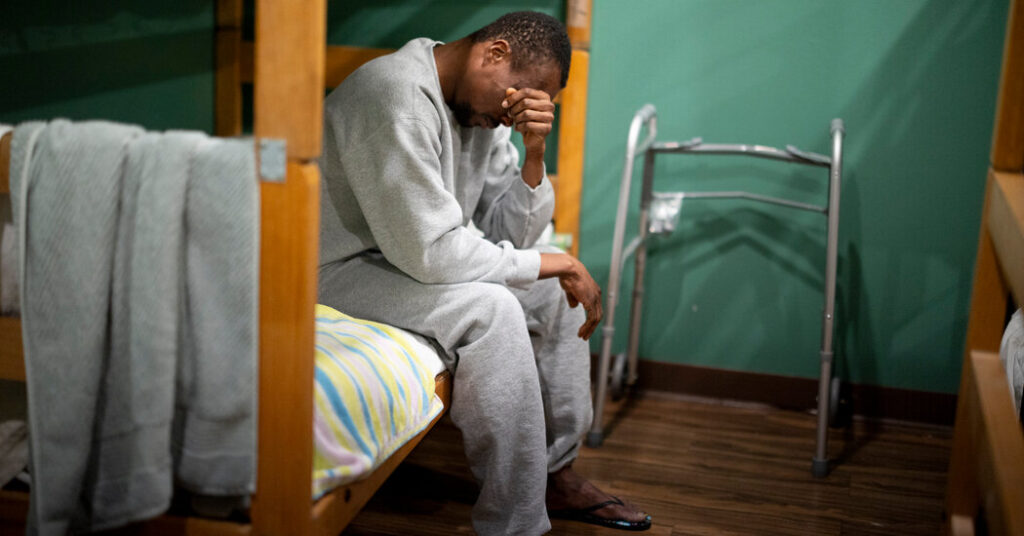
Judeson P. was driving through his southern Minneapolis suburb to pick up his paycheck on Jan. 22 when federal agents grabbed him from his vehicle, shoved him onto the icy pavement, shackled his arms behind his back and hauled him to an Immigration and Customs Enforcement facility in Minnesota.
The next day, handcuffed, feverish and injured, Judeson, 36, a Haitian immigrant in the country legally, at least temporarily, landed in a desolate detention camp in the desert of West Texas, only to be released six days later to an El Paso migrant shelter, with no money and no obvious way home.
“I cry every day,” he said on Friday as he sat in the shelter two days after his release. He spoke on condition that he be identified only by his first name and last initial for fear of retribution. He clutched his head in his hands and gazed at the ground. “It’s a really bad situation right now.”
Judeson, whose record only includes two misdemeanor traffic violations, ultimately returned to Minneapolis on Wednesday, thanks to a group of concerned Minnesotans who have begun pooling money to fund flights back from the newest front in the deportation wars battering the Twin Cities, this one more than 1,300 miles away. Even as President Trump’s mass deportation drive continues in Minnesota, one part of the drama now extends to El Paso County, Texas, where many immigrants apprehended in the Twin Cities are ending up.
Federal officials say the detainees have been picked up as part of targeted operations against sex offenders, drug traffickers and other undocumented criminals, and that they are being held in safe and secure environments. Polls suggest many Americans — especially Republicans — continue to support the president’s aggressive immigration enforcement.
But Minneapolis and El Paso reveal what those policies have meant in practice. El Paso County leaders, immigration lawyers and advocacy groups say ICE officials are leaving people to languish in harsh conditions in hopes that they will choose to self-deport, even if some have temporary legal status or may be eligible for asylum.
Those who successfully challenge their detention are often left stranded at shelters along the border and forced to find their way home.
“It’s a torture situation,” said Melissa Lopez, the executive director of Estrella del Paso, a group that provides immigrants with legal services.
It is not clear how many migrants have been sent to El Paso. Of 45 ICE flights out of Minnesota in January, 39 flew to Texas, 35 of them to El Paso, according to ICE Flight Monitor, a data project under the nonprofit group Human Rights First.
Nicolas Palazzo, director of legal services for an immigrant advocacy group called Las Americas, estimated that 30 to 40 percent of inquiries his office received in recent weeks for detained individuals came from Minnesotans with loved ones in El Paso. He said the office received more than 60 requests for assistance last week.
El Paso, a Texas border city, houses two detention facilities, and a third one sits about 20 miles north in neighboring New Mexico. The largest, Camp East Montana, was hastily constructed last year at Fort Bliss Army Base.
Lawyers, immigrant advocates and detainees themselves have raised concerns about inadequate medical care, food and maltreatment by private security guards. Three people have died in the facility since it opened in August. One man died on Dec. 3 of alcohol-related liver disease, an autopsy found. On Dec. 8, human rights groups urged ICE to stop detaining people there. Homeland security officials said the deaths last month of a Nicaraguan man, Victor Manuel Diaz, 36, and a Cuban, Geraldo Lunas Campos, 55, were suicides.
But the El Paso County medical examiner ruled Mr. Lunas Campos’s death on Jan. 3 a homicide, and legal and medical documents suggest guards choked him.
One witness, Ricardo Andrade, 29, said in an interview in Spanish that he saw two guards rush into Mr. Lunas Campos’s holding room after he shouted that he needed his asthma medication. Mr. Andrade, a detainee at the time, then heard what sounded like a scuffle and Mr. Lunas Campos’s feet kicking against the plastic walls as guards tried to handcuff him.
“‘They are suffocating me, they are suffocating me,’” Mr. Andrade said he could hear Mr. Lunas Campos screaming. Mr. Andrade, a former Uber delivery driver from Venezuela who was detained in New York, spoke by phone from Tapachula, Mexico, where he was deported. He said he still wakes up with nightmares over the incident.
In a statement on Jan. 21, the Department of Homeland Security said, “ICE takes seriously the health and safety of all those detained in our custody.” It added that ICE investigates all deaths in custody and the investigation of Mr. Lunas Campos’s death was still active.
An autopsy report for Mr. Diaz, the Nicaraguan who was arrested in Minneapolis on Jan. 6, has not been released.
“We want to know how my brother died, so we can be at peace,” Mr. Diaz’s brother, Lenin Diaz, who resides in Nicaragua, said in Spanish on a phone call.
Since he moved to Minnesota in February 2023, Judeson had worked so many odd jobs he had lost count. He was an Uber driver, delivered dinners through DoorDash and Grubhub, washed dishes at the airport and assembled cake boxes for a food company, sending money to Haiti for his 3-year-old daughter, her mother and friends.
“My mission is to take care of my family,” he said.
At the time of his arrest, Judeson had the authority to work in the United States through the Temporary Protected Status program, which provides deportation protections to people from some of the world’s most troubled nations.
Federal agents smashed Judeson’s driver’s side window anyway, he said.
Now, back in Minnesota, he fears he has become a financial burden as he wonders whether he can find work.
The same conveyor belt from Minnesota brought Heidy Samantha Coral Loja, a Spanish Ecuadorean college student with no criminal record, to the Texas desert, just hours after she was detained Jan. 14 as she drove to class in a northern Minneapolis suburb. She spent eight days in Camp East Montana, where she said food, water and shower access were scant, and toilets were splattered with blood, excrement and urine.
She was denied medication for a thyroid condition and said she suffered from stomachaches and headaches constantly. The guards taunted detainees and hurled racist insults, she said.
Akima Global Services, the private contractor supplying security guards, did not return requests for comment.
Other immigrants there said they and other detainees fell ill because of the dust, bad food, lack of medication and stress.
Representative Veronica Escobar, a Democrat from El Paso, visited Camp East Montana five times and said that during her most recent, on Jan. 29, she met a woman who was six months pregnant and had lost 10 pounds, an elderly woman who had collapsed because of high blood pressure, and a woman who said she had H.I.V. and had not received medication. All the women were wearing snow boots and winter attire, Ms. Escobar said, the same clothes that they had been arrested in three weeks earlier.
Ms. Escobar said letters she sent to Kristi Noem, the homeland security secretary, and to Todd Lyons, the ICE director, have gone unanswered.
“It couldn’t be more obvious that this administration doesn’t care about human beings,” Ms. Escobar said.
The pipeline from the north has shelters and immigrant advocacy groups that had grappled with record levels of migrants during the Biden administration struggling once again.
Ruben Garcia, the executive director of the El Paso shelter Annunciation House, said his organization had received 183 immigrants from ICE custody in January, 51 of them from Minnesota and the vast majority released from Camp East Montana. He added that the detainees often have no idea where they are and show visible signs of distress.
When Ms. Loja, 18, was released last month, she was left at another nearby shelter with an ankle monitor clasped to her leg. Her lawyer helped her mother bring Ms. Loja home on a plane the next day, but federal officials did not return her identification and immigration records, Ms. Loja and her mother said.
Ms. Loja had been granted temporary legal status to live and work in the United States in 2023 when she applied for a visa for domestic abuse survivors, and she had presented officers with her identification, Social Security and work authorization cards but said they refused to recognize them.
“Every time a car follows behind me too close, I feel fear,” she said from her home in Minneapolis. “I am so afraid of getting stopped again.”
On Friday afternoon, an El Salvadorean who asked to go by his nickname, Nando, for fear of repercussions, arrived at Annunciation House after spending about three weeks in Camp East Montana.
He had been detained in St. Cloud, Minn., on Jan. 11, even though he said he showed officers his Social Security card and driver’s license and had work authorization that did not expire until March. He said he came to the United States in 2000 under Temporary Protected Status and lived in New York and New Jersey before relocating to Minnesota with his girlfriend.
After six days of not receiving his heart medication, he said he woke up in the middle of the night in his bunk at Camp East Montana unable to breathe. A security guard escorted him to a medical area where he received his medicine, he said.
Nando, who was told on his release to appear for a check-in with ICE on Feb. 23 in St. Paul, worried he did not have money to buy a plane ticket back home until he connected with the Minnesotans helping with airfare.
Judeson was brought back by that same group on Wednesday. He said he felt nervous to return to a place where federal agents had killed Renee Good and Alex Pretti, but he had to come back to handle his affairs — a towed vehicle he had a loan on, an apartment he rented with his sister and his belongings.
He does not know what he will do next. If his protected status expires, he said he would return to Haiti and find work as a driver. He just needs time.
“If they give me a chance,” he said, “I can save money and then go back to my country.”
Albert Sun contributed reporting. Georgia Gee contributed research.
Pooja Salhotra covers breaking news across the United States.
The post Trump’s Migrant Detention Pipeline Extends From Minnesota to El Paso appeared first on New York Times.