When some of the most promising Democrats running for Congress visited Washington for a “candidate week” last fall, the people besieging one of them for photos or brief introductions weren’t the usual lobbyists or lawmakers.
It was the restaurant staff.
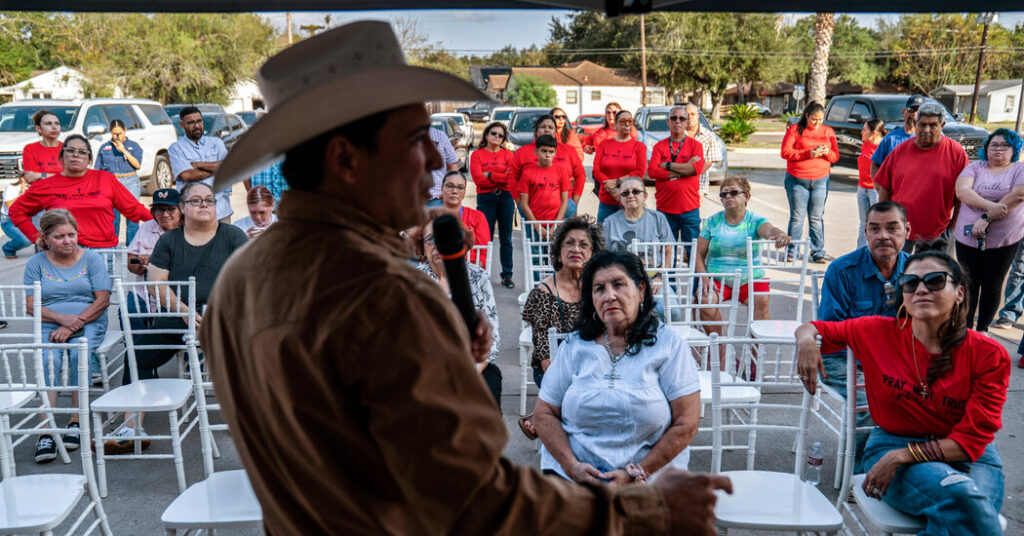
They had recognized Bobby Pulido, the Tejano music star, who had put his music career on pause to try to flip a deep red Texas district that the Republicans drew to be Democrat-proof.
“Happens a lot, to be honest with you,” said Mr. Pulido, who hopes that his star power and conservative Blue Dog positions will help him win. “That’s the people I want to fight for.”
All across the country, the Democrats trying to take back control of Congress have been scouring, scouting and recruiting candidates with compelling biographies to compete in seemingly lopsidedly red regions — with remarkable success.
“In a change versus status quo election, in the overwhelming majority of instances, the absence of formal political experience is not a weakness, it’s a strength,” Representative Hakeem Jeffries of New York, the top Democrat in the House, said in a recent interview at his party’s headquarters, sitting at a table scattered with maps of the House battlefield.
In western North Carolina, a fourth-generation farmer with deep political roots is running from the front porch of his family farm. In Montana, a 31-year-old smokejumper has injected new energy into Democratic efforts to win a House seat in the state for the first time this century. In Arizona, the former head of the Navajo Nation is aiming to build on his stronger-than-expected performance in 2024 in a strongly red seat. And in Middle Tennessee, a moderate mayor is seeking to oust a scandal-tarred ally of President Trump.
Mr. Trump carried each of those districts by roughly 10 percentage points or more. No House Democrat currently holds a seat in a district Mr. Trump won by that wide a margin.
Some of the Democratic expansion strategy is driven by necessity. There are fewer and fewer competitive seats in America. But a series of stronger-than-expected performances in special elections — most recently in a Texas State Senate race — has left party strategists emboldened.
A Star With a Son Named Remington
Just two years ago, Texas was especially inhospitable to Democrats. Hispanic support for Republicans had surged there. Then Republicans tried to put it even further out of reach by literally redrawing the state’s congressional lines.
But Democratic strategists believe that Mr. Pulido could be the kind of political unicorn who can put a seat that Mr. Trump won by a whopping 18 percentage points in play this fall by appealing to working-class Latino voters. A five-time Latin Grammy nominee and the son of a migrant farmworker, he endorsed deporting criminals in his announcement video. His first son is named Remington.
“After the Remington 700 bolt action,” Mr. Pulido explained, his favorite out of the roughly 100 guns that he owns.
He knows the district is tough. But Mr. Pulido said his music has provided a rare “open door” for a Democrat. “Even if they voted red — because there’s a cultural connection — they’ll listen to you,” Mr. Pulido said.
The 2026 cycle began with only a handful of House Republicans in districts that Mr. Trump did not carry. And fewer than a dozen of them hold seats in districts that the president won by less than 5 percentage points. But, with history suggesting that newly elected presidents face a backlash in the midterm elections, Mr. Jeffries said Democrats plotted to aggressively contest seats he won by even wider margins.
“It was our theory of the case very early on that there would be expansion opportunities,” Mr. Jeffries said, “based on Donald Trump and Republicans going too far.” Indeed, Mr. Trump’s approval rating has dropped.
To fund the expanded effort, Mr. Jeffries has been stockpiling cash. He raised, according to figures first provided by his team to The New York Times, a combined $241 million in 2025, which went into the Democratic Congressional Campaign Committee, shared accounts with Democratic incumbents and House Majority PAC, a super PAC, and its nonprofit arm.
Mike Marinella, a spokesman for the campaign arm of House Republicans, said that national Democrats were “chasing political mirages” in red areas.
“While they fantasize about recruiting in districts they’ll never win, they’re already bleeding cash defending a long list of highly vulnerable, Trump-won seats held by their most radical members,” Mr. Marinella said.
Running in the ‘Blue Dog’ Lane
A common thread connecting many of these longer-shot candidates is that they’re running as a different kind of Democrat, seeking distance from a damaged national brand.
“You don’t see many rural white farmers as Democrats,” said Jamie Ager, the leading Democratic candidate in a western North Carolina district that his party last won when it recruited a former football star, Heath Shuler, two decades ago.
Mr. Ager said that when he tells voters that he’s a Democrat that they’re sometimes surprised because they say he doesn’t look the part. “I don’t think people paint me with that brush,” he said, even though he has a deep local lineage. His brother is in the state Legislature, and his grandfather represented the region in Congress decades ago. “Running in that sort of rural ‘Blue Dog’ lane is part of — part of who I am,” he said.
Mr. Ager is hoping to take out Representative Chuck Edwards, the Republican incumbent, and sees a particular opening because of the slow recovery — and flow of money — following Hurricane Helene. “He failed us,” Mr. Ager said.
Former Representative Cheri Bustos, who led the House Democratic campaign arm during Mr. Trump’s first term, said that a lot of candidates were jumping in “because of everything that’s going on in this nation.”
The leading House super PAC commissioned early vetting research into would-be candidates even before they declared. What’s known as “opposition research” in the industry was then gently presented to nudge some potential candidates out of running if past positions, such as embracing calls to “defund the police,” were seen as too left-leaning to win in red areas.
Ms. Bustos cautioned that all candidates are not created equal. “If you’re going to run in a Trump +10 district,” Ms. Bustos said, using shorthand for a seat that Mr. Trump won by 10 percentage points, “you don’t want some far-left influencer type to run.”
A Smokejumper Jumps In
Many of the challengers are hoping to tap into a local circumstance beyond the national political environment.
In Montana, Sam Forstag, a smokejumper (“We get to the fire different than other folks,” he explained. “We jump out of a plane at 3,000 feet.”) took the leap into politics after growing frustrated with the current leadership. Mr. Forstag, a union leader, said he was unable to secure a meeting for his local with his congressman, Representative Ryan Zinke, last spring as the federal government slashed forestry jobs during the Elon Musk era at the Department of Government Efficiency.
“It’s the same damn story it always is, right?” Mr. Forstag said. “It’s poor, working people getting screwed while somebody else is getting rich off this thing.”
Now he’s seeking to replace Mr. Zinke.
But Mr. Forstag, like many other top Democratic recruits, faces a primary fight first — a sign of just how many Democrats are running in 2026. The risk is they exhaust resources, bludgeon each other or drag the winner too far left. The other leading candidate is the party’s 2024 nominee for governor, Ryan Busse, a former firearms executive.
“It truly felt like the national Democratic Party did not have a plan for how we start winning back places like Western Montana,” Mr. Forstag said. “We were about to run all the same kind of candidates and expect a different result.”
A Local Mayor Sees an Opening
Democrats are also hoping some scandal-plagued Republicans in otherwise safe seats could be vulnerable against the right challengers.
In Tennessee, Representative Andy Ogles, a Republican, was the subject of an F.B.I. search apparently related to his campaign’s finances in 2024 when federal officials seized the congressman’s phone. Mr. Ogles is one of the House’s most outspoken Trump fans and he has pushed legislation to attempt to make him eligible for a third term. The Justice Department appears to have since dropped the case.
Democratic officials are excited about Chaz Molder, a local mayor, who pitched himself in an interview as a pragmatist with deep community ties.
“I go to the same church and sit in the same pew I did as a kid,” Mr. Molder said.
Mr. Molder raised $1.2 million in his first four months and entered 2026 with nearly $1 million. Mr. Ogles has been one of the Republican Party’s worst fund-raisers and began the year with more debt than cash.
The very nature of recruiting in such red areas is that many of these candidates are likely to lose. But tilting the playing field could still help Democrats secure a majority — or expand it — by diverting or diluting Republican resources.
A Former Admiral Enters the Ring.
The possibility of a blue wave — and the chance to provide a check on a Republican-controlled Washington — has had some Democrats coming out of the woodwork, including a former Navy admiral, Nancy Lacore, who was fired by Defense Secretary Pete Hegseth and who just announced a run in South Carolina.
“Just because I am no longer in uniform doesn’t mean I can’t serve,” said Ms. Lacore, who raised $500,000 in her first two weeks.
Ms. Lacore is one of 12 House candidates this cycle backed by the Bench, a group led by veteran Democratic strategists that recruits and advises candidates in both traditional battleground seats and harder-to-win areas.
For Mr. Jeffries, the recruiting season began almost the moment 2024 races were called. He recalled dialing up Janelle Stelson, a former television newscaster who had just narrowly lost a Pennsylvania House race, not long after the election to urge her to run again. He told her the story of Barack Obama, Bill Clinton and George W. Bush all losing their first congressional races — only to eventually become president.
“A knockdown,” he recalled telling her, “is different than a knockout.”
Ms. Stelson is running again.
2024 presidential margin data for South Carolina, Tennessee and Montana come from The Downballot. North Carolina and Texas have undergone redistricting and margins are from New York Times internal analysis.
Photo credits: Gabriel V. Cárdenas for The New York Times; Ager for Congress; Sam for Montana; Chaz Molder for Congress; Tyra M. Watson/U.S. Navy
Graphics by Lily Boyce.
Shane Goldmacher is a Times national political correspondent.
The post To Win Back the House, Democrats Take the Fight to Deep-Red Areas appeared first on New York Times.