The Winter Olympics are back, which means you’re about to have your quadrennial dose of lutzes and salchows, McTwists and cab double corks.
And yes, you will suddenly care desperately whether some dude from Minnesota slides a stone across the ice closer to a target than a Scottish fella can.
Here’s what to know so you are ready for all the schussing.
Where are the Olympics this year?
There are two main host cities, both in Italy. Milan and its environs will be the site of indoor events like ice hockey and figure skating. About 150 miles to the northeast, Cortina d’Ampezzo in the Alps will host the hardier outdoor events, like luge and Alpine skiing.
The other sites are Antholz-Anterselva, Bormio, Livigno, Predazzo, and Tesero.
When do the Games start?
While some preliminary hockey and curling events started on Wednesday, the Games officially kick off with the opening ceremony at San Siro Stadium in Milan on Friday at 8 p.m. local time, 2 p.m. Eastern. Scheduled performers include the Italian singers Andrea Bocelli and Cecilia Bartoli, as well as an international contingent including the American singer Mariah Carey and the Chinese pianist Lang Lang.
The sports events start in earnest the next day.
How do I watch?
NBC will again have the exclusive rights to show the Games in the United States, having spent a boatload of money to do so. Milan is six hours ahead of New York, so most events will have wrapped up by prime time on the East Coast of the United States, and evening broadcasts will largely be delayed recordings, instead of live broadcasts.
Peacock, NBC’s streaming platform, will stream every event live.
International broadcasters include Nine (Australia), CBC (Canada), RAI (Italy), TelevisaUnivision (Mexico), NRK (Norway), and the BBC (U.K.). A full list of international broadcasters is available on the Olympics website.
What are the biggest events?
For American audiences, figure skating is always No. 1, with Alpine skiing and hockey generally close behind.
The men’s figure skating headliner will be the American two-time world champion Ilia Malinin, known as the “Quad God” for his ability to land quads, or jumps with four rotations. A seemingly wide-open women’s field includes the strongest American contingent in years — Amber Glenn, Isabeau Levito and Alysa Liu — plus Kaori Sakamoto and Mone Chiba of Japan and Adeliia Petrosian of Russia.
Alpine skiing has some American star power, with the dominant Mikaela Shiffrin in the technical events and the return of the legendary downhiller Lindsey Vonn at age 41 — though a severe knee injury she sustained last week put her participation in doubt.
After two Winter Olympics with mostly lesser players in the men’s ice hockey competition, the best from the National Hockey League are returning to the Games this year, including some big names like Sidney Crosby and Connor McDavid of Canada. Not Alex Ovechkin, though, as Russians are barred from team competitions because of the invasion of Ukraine. (Some Russian athletes will compete in individual sports under a neutral status.)
But the best of the Olympics is in the eye of the beholder. Norway and Sweden will revive their cross-country skiing rivalry. South Koreans love short-track speedskating, and the Dutch love long track. Every country with a little snow or ice has its favorites.
OK, so tell me about the rest of the sports.
A breakthrough star of the Games could be Jordan Stolz, a 21-year-old from Wisconsin who will be a top contender in the sprint long-track speedskating events, including the 500, 1,000 and 1,500 meters. Short-track speedskating is harder to predict, given how often the skaters collide and fall, but Canada’s men and women are expected to do well.
The king of cross-country skiing is Johannes Klaebo of Norway, who is so great they named a hill after him in Pyeongchang, South Korea (the legendary Klaebo bakken). He is likely to add to his five career gold medals this month. Jessie Diggins, who crossed the line in 2018 to win the United States its first ever gold in cross-country, could win more as well.
Biathlon takes cross-country skiing and adds rifle shooting for some reason; Norway and Sweden dominate.
Ski jumping continues to be the scariest-looking event (it’s mostly an illusion; the flying skiers are only about 15 feet off the ground). There’s also Nordic combined, which takes ski jumping and throws in cross-country skiing.
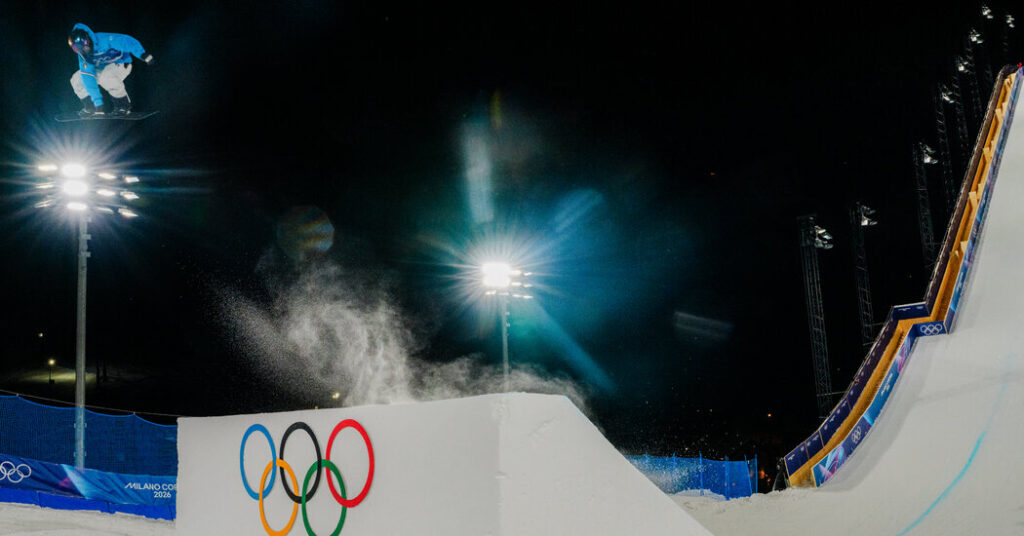
They are relatively new to the Games, but snowboarding and freestyle skiing have successfully established daredevils who launch off platforms and spin countless times in the air as Olympic stars. Depending on the event, Italy, Japan, South Korea, China, Canada and the U.S. will contend for medals.
Luge is the one where they sled down a track on the backs; in skeleton they go on their stomachs. Bobsledders get to sit.
Who is sure to win?
Shiffrin, in the women’s slalom, is the biggest Alpine favorite, although one mistake on two tight, tricky runs can end a skier’s medal hopes.
In cross-country, Klaebo will be tough to beat in any event, but especially in the sprint. His country, Norway, dominates the relays.
Someone from Germany will be favored in nearly every bobsled event.
What’s new?
The new sport is ski mountaineering, an event for those who look at downhill skiing and say, “Yawn, so what? They took a lift up the hill.” In this race, athletes climb the hill first, partly with skis on and partly without. Then they ski down to the finish line.
There are several new events as well, including a mixed-gender skeleton relay and a side-by-side moguls race in freestyle skiing. And female ski jumpers will finally leap off both the big and small hill, instead of just the small.
When does it all end?
The closing ceremony shifts over to Verona and its amphitheater, which has hosted opera, jousts and gladiator shows since around the first century.
And mark your calendars for Los Angeles (2028), the French Alps (2030), Brisbane (2032), and Salt Lake City (2034).
Victor Mather, who has been a reporter and editor at The Times for 25 years, covers sports and breaking news.
The post The Winter Olympics: What to Watch; How to Watch appeared first on New York Times.