On a frigid white January in 1982, an airplane took off from Ronald Reagan Washington National Airport for Florida, remained aloft for about 30 seconds, and then stalled out and collided with the 14th Street Bridge, plunging into the ice-floe-studded waters of the Potomac River. In The Washington Post’s newsroom, an aghast 24-year-old college-basketball reporter named Michael Wilbon watched live reports of the disaster on the mounted TV banks, heard the urgency among those around him, grabbed a notebook and his jacket, and ran toward the riverbank to report on the rescue efforts, because that was what he’d been schooled to do. He never got a byline—his name never appeared on the story.
Reminiscing in a phone call with me last night, Wilbon recalled that the old offices of the Post’s editors, at the newspaper’s former building on 15th Street, had glass walls inside—so on the night of the crash, he could see Ben Bradlee, the executive editor, and his deputies huddling. “They were meeting,” Wilbon remembered. “They kept meeting. So finally, I said, Well, let’s just fucking go.” Trailing Wilbon was another 20-something college-sports reporter named John Feinstein. They interviewed witnesses and rescuers, then hustled over to an old Marriott hotel at the Arlington mouth of the bridge, where they huddled by a phone reading their notes to someone in the office taking dictation. Feinstein, who died last year, didn’t get a byline either; cub reporters often didn’t. It was just what he’d been schooled to do. (He did become a best-selling author, though. Wilbon later got famous co-anchoring ESPN’s Pardon the Interruption.)
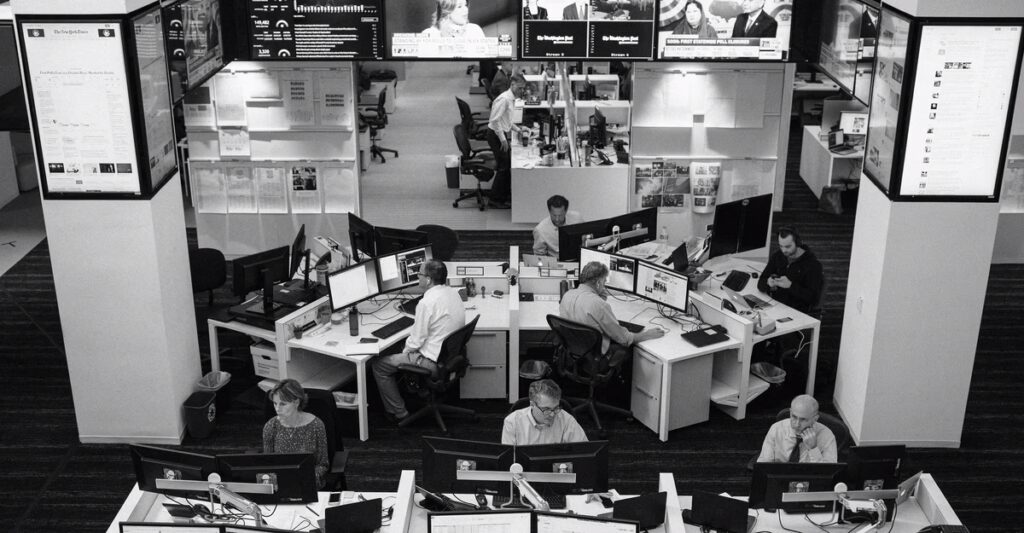
For some years now, the Washington Post newsroom has defied gravity, thanks to the internal ethic just described. Usually, when people in an office distrust feckless leaders, when they are subjected to corporate verbiage that bounces off the face and leaves a rage headache behind—phrases such as reevaluating our model and reposition, used to obscure the catastrophic fact that approximately 300 jobs, or a third of the newsroom, have been “eliminated” (the contemptible formulation by which Post staffers were laid off today)—they will subtly gear down their efforts. But my former colleagues do the opposite. For every half-wit decision by a poseur in a 42-long, slim-fit suit, they report even harder. This ethic has been especially true in the renowned Sports section, which was killed in a Zoom announcement notable for its belly-wriggling cowardice and self-owning incompetence. The Post’s publisher, Will Lewis, and its executive editor, Matt Murray, apparently did not have enough brace in their back to face the newsroom in person.
[Read: The murder of The Washington Post]
The Post Sports section is, was, no ordinary section, in heritage or in coverage. It was habitually young, because it required hiring people with no sense of off-the-clockness: Events happen at nights and on weekends, on tough deadlines that require sprinting stadium stairs and downing a pack of smoked almonds for a late dinner. Donald Graham, the Post’s longtime publisher, spent time as Sports editor when he was learning the family trade. His Sports successor, George Solomon, liked to spot good young talent cheap and let us run—and ran us ragged. “Hey,” he said to me once during a hectic NFL season, “I need you to stop in Green Bay on your way home from Dallas.”
We moved in a close group. Every two years, eight or 10 of us would fly off to the Olympics in some international city. For two and a half weeks, we’d have a choice between eating and sleeping; the deadlines didn’t allow for both. We reported shoulder to shoulder in narrow press pens in stadium bowels so dank and sweaty that, as my ex-colleague Barry Svrluga has said, “it’s like working inside someone’s mouth.”
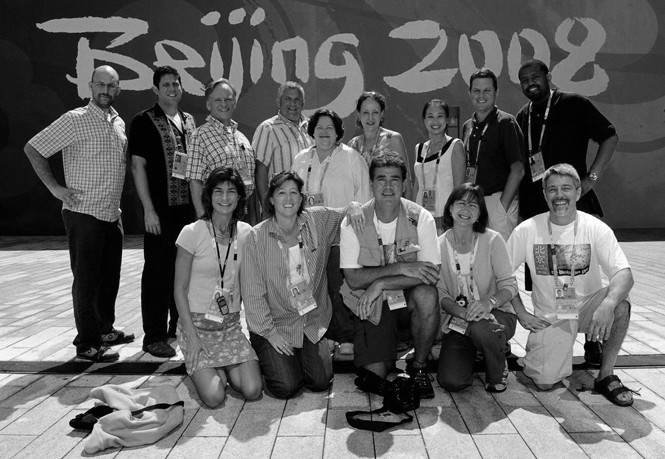
At the Beijing Summer Olympics, in 2008, we were so exhausted from the round-the-clock work that we threw blankets and sheets over a table to make a tent and stuck a pillow on the floor beneath it. You could crawl in there and catch a nap. We named it “the Happy Place,” and when someone was sleeping, we’d put stick-’em notes on their clothes—I once drew a picture of a gas gauge with the needle on empty and stuck it on a colleague—and take pictures of them. When deadline was finally over, at 3 a.m., we’d entertain ourselves with a liquored-up singing game that our colleague Liz Clarke named “Stupid-Guy Anthems.” In Sochi, we learned a Russian hockey anthem from a couple of young guys running an all-night cafe. At the end of every Olympics, our editor Tracee Hamilton would crack open a Guinness and recite the St. Crispin’s Day speech from Henry V, about “we happy few.” We laughed so hard that the New York Times staffers sitting in their office beyond a plywood wall would shush us—for which we would toss pencils at them.
We came from all over, competed desperately to outwrite one another, teased one another mercilessly, loved one another. One day, Feinstein said to John Ed Bradley, our mellow-voiced football writer from Louisiana, “Hey, John Ed, did you marry your huntin’ dog Red yet?” I loved to kid my desk mate Christine Brennan, who was from Toledo, “Hey, Chris, what’d you do for fun yesterday? Leave the butter out overnight?”
We had the best writers in the country and did more with less, and we knew it with a swagger. In addition to Wilbon and Feinstein, Solomon found a young writer named David Remnick, who once wrote of the basketball player George Gervin that he was “sinuous as smoke.” That was before Remnick got an urge to become a foreign correspondent and went off to win a Pulitzer covering the demise of the Soviet Union—it was what he’d been schooled to do. (Eventually, he became the editor of The New Yorker.)
Remnick was trained by Solomon, as we all were, to grab the pen and go, and to regard sportswriting as merely another portal through which to report on the broadest subjects: labor issues, performance enhancement, domestic violence, racism, sexism, terrorism, global corruptions such as vote-buying in the Olympics. Journalism as Solomon, Graham, Bradlee, and others had taught us didn’t change with the subject. And it was an ethic as much as a job, about responsibility to other people. “If you’re late, we’re all late,” Solomon told me. “If you’re wrong, we’re all wrong.” Not a bad way to mature an unfinished young person.
The Washington Post’s sportswriters could cover anything—and did—because we were taught to look with a hard eye, write vividly and observationally, and hit our deadlines no matter what, which made other section bosses always want us. Remnick was just one of the earliest examples of the Sports section turning out great foreign and national correspondents. Isabelle Khurshudyan, a hockey writer, won honors covering the war in Ukraine and became the Post’s Kyiv bureau chief. Chico Harlan, a baseball writer, became a foreign bureau chief in East Asia and then Rome. Eli Saslow, a sports feature writer, went on to win a Pulitzer writing about American poverty. David Nakamura, a college-sports writer, broke stories about poisoned drinking water in Washington, D.C.; corresponded from Afghanistan and Pakistan; and now covers the Justice Department.
In 2011, Rick Maese, a sports feature writer, went to Japan on vacation with his wife, the Metro staffer Erin Cox. While they were there, an earthquake hit, followed by a tsunami, followed by a nuclear meltdown. They spent their trip covering the Fukushima disaster. The baseball writer Chelsea Janes, like me, also covered presidential campaigns; the plundering of our staff by National editors was a continual irritant to our Sports bosses, though they were proud of us.
The now-retired Liz Clarke wrote a memorable magazine story about Bruce Springsteen and spent years doggedly investigating the Washington Commanders owner Dan Snyder for allowing a culture of sexual harassment and assault to fester within the team office; after Clarke and her fellow reporter Will Hobson finally chased down the story and got it into print, the fallout eventually forced Snyder to sell.
Clarke, a North Carolinian, worked with a gentle singing voice with which she asked the toughest questions of NFL billionaires. I liked to imitate her talking with an NFL owner this way: “Of course, a role as lofty as yours does come with certain prerogatives of judgment,” she’d say with a soft smile. “But I wonder if it might not be the smallest misstep and breed the teeniest bit of mistrust in the team to go with a quarterback who thinks hydration is tequila and ranch water?”
In addition to writing political profiles, I was recruited to cover the September 11 attacks in New York—I stuck my driver’s license and a $20 bill in my sock and ran all the way downtown—as well as two hurricanes. Right after Katrina struck the Gulf Coast, I stood in front of a huge map in the newsroom with the editors Liz Spayd and Phil Bennett, who were trying to decide exactly where to send me. After a pause, Bennett said, “Texas is big.” We settled on Mississippi. I met up with the photographer Jonathan Newton, a hurricane veteran who had pallets of water and gas cans strapped down in an SUV, as well as a boxful of cigarillos. He handed me one. We smoked them to kill the smells.
Only the people who live their work in a newsroom will understand this: One of the best things I ever tasted was shots of Maker’s Mark, neat, shared in a Mississippi motel parking lot at 1 a.m. with Newton and other photographers, out of a makeshift bar in the back of an SUV. We’d spent the day covering the damage that Katrina, with its 26-foot wall of water and 160-mile-per-hour winds, had wrought—had seen boats on freeway medians and a piano in a treetop at Jefferson Davis’s old home—and our dinner was whiskey and fried pickles, and it was good. We shared a room at a Hampton Inn where the door wouldn’t lock because the floods had ruined the electronics, and we brushed our teeth together.
You’d think a newspaper that has so botched its finances, and that is trying to do more with less, could use people with such ethic and versatility. “We should have been the last ones in the room,” Wilbon told me last night.
One of the most valuable things lost with the killing of the Sports section will be the Post’s sense of proper training of the young. After I covered my first Army-Navy game, the great columnist Thomas Boswell took me to dinner and talked writing. My first Olympics was the Calgary Games in 1988, and I wrote well out of sheer excitement. When I got home, the columnist Tony Kornheiser, now Wilbon’s longtime Pardon the Interruption co-host, told me, “You did great. But listen. This is your level now, all the time. You don’t retreat from this level.” I did 10 Olympics for the Post. At the Athens Games, in 2004, I took pleasure in watching the young Svrluga lift his own writing game out of sheer excitement. “This is your level now,” I told him. “You don’t retreat from it.”
That’s who we were, and who we are. I say “we” because I left The Washington Post for The Atlantic five months ago, after 30 years at the paper, and I still have the reflexes and the friends. I also feel an anger at the demise of the Sports section—about 40 of 45 people fired, the rest thrown to other sections—that cannot be extinguished, and that only grows as more details emerge. This superb section was treated the following way:
The Post’s Olympics writers were notified just 10 days ago, right before some of them were scheduled to depart for the Milan Games, that their coverage was canceled—with little explanation. Just 36 hours later, management reversed itself and quietly suggested: Well, okay, four writers could go, but with the understanding that they could be laid off during the assignment. This is the sort of managerial aimlessness the Post is being governed by, just one example of the missteps and squandering of opportunity framed as strategy.
The Olympics writers were given a choice: If laid off, they could either fly home or finish the assignment. “I know what they’ll do,” the Sports editor Jason Murray told me on the phone last night. “I know who they are.” They will finish the assignment. Svrluga, the most knowledgeable Olympics writer in the country, who has been “eliminated,” filed a comprehensive story on Mikaela Shiffrin while knowing that the knife was at his neck. This morning, I texted him: “Will you keep filing from there?” I got a one-word answer.
“Yes.”
Another of those laid off was the deputy Sports editor, Matt Rennie, a quarter-century veteran of the paper who happens to be the single finest thinker and pencil-wielder I have ever worked with at any level. Rennie cleared out his desk Monday and last night without a single piece of straight information from leadership about his fate; he simply assumed that he was laid off because no one said anything to him, and no one stopped him, either. At home, he wrote a note to colleagues that hit the nail on the head: “The people making these decisions have failed in their responsibility to our readers, whom they never took the time to know, and have undermined—likely irreparably—the ideals of an institution they never bothered to try to understand.” These moves, he added, “ultimately, will power the Post’s competitors.” The best Sports section that ever was has been destroyed by people who failed to even notice what a jewel they had.
[Anne Applebaum: Readers don’t trust dirty tricks]
The irony in this situation is that Will Lewis and Matt Murray have rendered themselves unemployable anywhere else (who would have them after this?), whereas Post Sports staffers will no doubt be much in demand. As Rennie wrote to his colleagues, “Whenever and wherever we land—and we will—we’ll be comin’. And hell is comin’ with us.”
I disagree with Rennie about just one thing: I’m not sure the damage to the Post is irreparable. Jeff Bezos, its billionaire owner, only thinks he owns the Post, and Lewis and Murray only think they run it. At the heart of the institution is something that no one can ever own: the Wilbonian core trained into all of us, an impulse to run to the riverbank that these bumbling strangers who have hobbled the publication will never grasp.
The post The Sports Section With Swagger appeared first on The Atlantic.