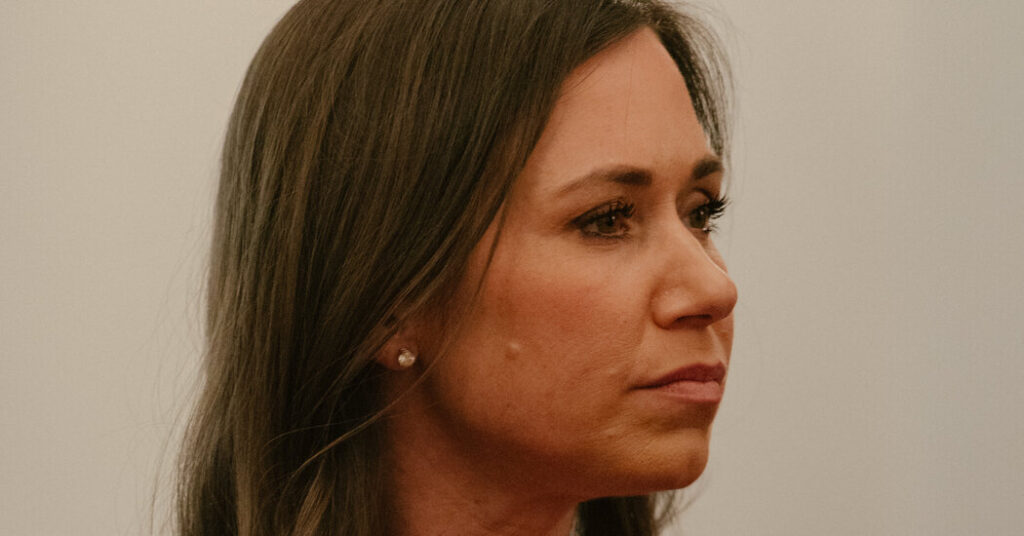
Her son had been at the orthodontist for 45 minutes when Katie Britt saw the picture of the boy in the bunny hat.
Waiting in her car for her son’s appointment to finish, the Republican senator from Alabama could not look away from the photo on her phone that had just gone viral: The agent’s hands on the boy’s Spider-Man backpack. The icy black vehicle. The flash of terror in those 5-year-old eyes.
“Can you look into this?” Ms. Britt texted her team from a Montgomery parking lot on a Thursday morning in late January, afraid to believe that this could happen in America. She had read reports that agents from Immigration and Customs Enforcement had used the boy as a “pawn,” sending him to knock on the door of his home in hopes of luring out others.
Ms. Britt’s 15-year-old son climbed into the car, his teeth checked and braces adjusted. He would sit for an A.P. World History test later that day, compete in a speech and debate tournament over the weekend.
The boy in the bunny hat would be sitting in an ICE detention facility over a thousand miles away from his home.
This was not the first time Ms. Britt had been disturbed by something she heard about the second Trump administration. She felt that way when Mr. Trump flirted with an invasion of Greenland. When his officials slashed funding for research into childhood cancers. When the Pentagon purged photos and videos of Alabama’s own Tuskegee Airmen from its training materials, erasing the contributions of the first Black military aviators to stamp out any hint of diversity, equity and inclusion.
The youngest Republican woman ever elected to the Senate, Ms. Britt, 44, largely receded from the national stage after delivering her party’s official State of the Union response from her kitchen two years ago — a speech mocked for its breathy intensity by critics across the aisle and seared into American culture by Scarlett Johansson on “Saturday Night Live.”
Now, Ms. Britt has emerged as a Republican uniquely positioned to reason with the Trump administration. While other establishment conservatives have typically selected one of two paths through the Trump years — go full MAGA or leave politics altogether — Ms. Britt has attempted to chart an alternate course. She stands fully behind Mr. Trump in public, but at times seeks to wield influence behind the scenes, guided by her personal values as a mother and a Christian.
Through a series of interviews and emotional moments observed in her Alabama home, Ms. Britt offered a rare look at how one Republican lawmaker is trying to navigate some of the most incendiary actions of the Trump administration. She seldom challenges Mr. Trump. When she does, she believes that, to be effective, any outrage must be felt quietly, any response conducted through back-channeled phone calls and peppered with words of admiration for the president.
But Ms. Britt’s strategy faces an acute test in the wake of the administration’s aggressive tactics in pursuing its deportation campaign in Minnesota.
Over the next week, in her role overseeing congressional funding for the Department of Homeland Security, she will help lead negotiations over whether to impose new guardrails on federal immigration agents. Ms. Britt has been fiercely supportive of Mr. Trump’s immigration crackdown, opposing Democratic demands for changes despite personal qualms about certain events. How she chooses to proceed will help illuminate whether Republicans troubled by recent violence in American cities will use their power to push for changes — or remain in lock step with the president.
Twenty minutes after she and her son arrived home from the orthodontist, Ms. Britt was off to a round-table event at a local day care center to highlight her recent child care legislation, which would be covered by members of the national media. Before she turned to the policy discussion, she knelt on the floor with a copy of “The Very Hungry Caterpillar.”
One little boy climbed into her lap.
“He was a big fat caterpillar!” the boy said, resting his head on her chest as she read the book aloud.
Ms. Britt was still thinking of the boy in the bunny hat, she said, who is right around the same age.
When it was time to talk to the cameras, she did not mention Minneapolis, reaching instead for a tagline she’d rattled off many times before.
“We are the party of parents, the party of families,” Ms. Britt said, bright lights in her eyes.
“President Trump has led the way on that.”
‘I’ll Be a Killer for You’
Ms. Britt opens her Bible every day when the house is quiet, just before 5 a.m.
She has had the same copy since she was 7 years old, its pages enthusiastically annotated with the pink and purple gel pens of a girl who always came home with straight A’s.
“Too often we don’t fall back on this,” she said, sitting in her sunroom armchair, her Bible open to a favorite passage on forgiveness. “And I think you have to.”
Ms. Britt lives in a stately brick home in Montgomery. Her front room could be the centerfold for Southern Living magazine, professionally designed with ruffled lampshades and soft florals. Everything smells like “white pine cashmere,” the scent of the candle burning in the hallway. All of the books on her bookshelf are different shades of white and blue.
Ms. Britt came to Washington fresh out of the University of Alabama, where she was president of her sorority, Chi Omega, and the student body. The 22-year-old started out as the deputy press secretary for Richard C. Shelby, an Alabama Democrat turned Republican who spent nearly four decades in the Senate; she ultimately served as his chief of staff.
When Mr. Shelby announced his retirement in 2021, he called Ms. Britt to encourage her to leave her job leading an Alabama lobbying group and enter the race herself. The front-runner in the Republican primary was Representative Mo Brooks, a conservative firebrand who quickly earned Mr. Trump’s endorsement after urging a sea of angry Trump supporters on Jan. 6, 2021, to “start taking down names and kicking ass”
“I knew that Alabama was better than some of the things he would do and say,” Ms. Britt’s husband, Wesley, a 6-foot-8 former football tackle for the New England Patriots, said of Mr. Brooks. “I knew she better represented the quality of people we have here.”
Ms. Britt hosts Christian youth group dinners at her house. She has a book of speeches by George W. Bush in her Washington office, next to an autobiography of Mother Teresa. She insists on her children writing handwritten thank-you notes on their own personalized stationery, not just for birthday and Christmas presents, but for small kindnesses year-round.
Senator John Fetterman, Democrat of Pennsylvania, said that when he checked himself into the hospital for depression, Ms. Britt was one of a handful of senators to visit him. Among all his colleagues in the Senate, he added, he considers Ms. Britt his best friend.
“How you treat people matters,” Ms. Britt writes in her 2023 autobiography, “God Calls Us to Do Hard Things.” “I want to work alongside people who treat the woman who cleans the restroom with the same respect they treat the principal or C.E.O.”
Ms. Britt knows how to make people like her. When she was trailing in the Republican primary polls, she made a last-ditch effort to charm Mr. Trump — showing up to a Trump rally for Mr. Brooks and maneuvering her way to the front of the photo line.
At the time, Ms. Britt was not a natural MAGA ally. She believed that those who broke the law on Jan. 6 “should be held accountable.” When she entered the race, Mr. Trump had referred to her as an “assistant” to “the RINO senator from Alabama,” using a derogatory acronym for “Republican in name only.” He added that she was “not in any way qualified.” But when Ms. Britt stepped up to greet the former president, she made her case.
“I’m going to win this election,” Ms. Britt told Mr. Trump, her husband recalled, as she looked him square in the eye. “And when I do, I’ll be a killer for you.”
She arrived in Washington in 2023 in a blaze of expectation, after beating Mr. Brooks by almost 30 points. Declared a “fearless America-first warrior” by Mr. Trump, who ultimately endorsed her, she seemed capable of holding down both the MAGA base and more traditional Republicans. A splashy magazine profile imagined her as a “face of the G.O.P.’s post-Trump future.”
Then Senator Mitch McConnell and House Speaker Mike Johnson asked her to deliver the Republican response to President Biden’s State of the Union address, an unenviable assignment that has become fodder for more than one “Saturday Night Live” sketch.
Ms. Britt’s staff members came up with the idea for her to speak from her kitchen, several people recalled. With her family a few rooms over, she stared into the camera with what Megyn Kelly, the conservative news host, called a “totally cringe” affect. Charlie Kirk said she looked as if she were “hosting a cooking show,” while her fellow Alabama senator, Tommy Tuberville, explained that she’d been picked to give the speech “as a housewife, not just a senator.”
For Ms. Britt, the backlash was unexpected and devastating. She called close friends and family members to make sure they were still proud of her. Eventually, she said, the episode became a lesson in how to “block out the noise” and stay focused on what matters: “being the hands and feet of our Lord and Savior, Jesus Christ.”
Right around the same time, Ms. Britt got on the phone with Mr. Trump, then the front-runner for the Republican nomination for president. The Alabama Supreme Court had just declared embryos to be children, a decision that halted in vitro fertilization procedures across the state.
When Ms. Britt called his cellphone amid the national uproar, Mr. Trump did not seem familiar with the subject. But as soon as Ms. Britt explained the stakes of protecting I.V.F., two people said, he drafted a Truth Social post with her still on the line, calling on Alabama lawmakers to act.
Two weeks later, the Alabama Legislature passed a law granting immunity to I.V.F. providers, allowing those clinics to reopen.
Ms. Britt had secured the ear of the future president, with instant results. If she needed to call again, she knew, she could.
A High-Stakes Phone Call
Back in Montgomery last month, after leaving the child care center, Ms. Britt sat at her kitchen table on the phone with her legislative director, trying to discern exactly what had happened with the boy in Minneapolis.
“What did JD say about it?” she asked.
Vice President Vance had defended ICE, the staff member explained, arguing that the agents had no choice but to detain the child after they arrested his father, whom Mr. Vance called an “illegal alien.”
Ms. Britt scribbled a few notes in her planner. She wanted to talk directly to the woman in charge.
As she prepared to call Kristi Noem, the Homeland Security secretary, Ms. Britt gamed out what the secretary might say, and how she should respond. If Ms. Noem told her that the child really had been used to lure others out of a home, Ms. Britt thought to herself, that would have to be a red line.
“Children should never be used as pawns,” she said in an interview that afternoon. “Ever. Period. The end.”
In Mr. Trump’s second term, Ms. Britt has voted in line with the president 100 percent of the time. Her disagreements emerge only in private, in conversations with top White House officials and cabinet secretaries, whose numbers are all saved in her phone.
Over the last year, Ms. Britt has occasionally convinced the Trump administration to reverse course, according to several people with knowledge of conversations between Ms. Britt and Trump officials, who spoke on the condition of anonymity to describe those interactions. A call to the Pentagon restored the training materials on the Black airmen from Alabama, the people said. A call to the White House got Mr. Trump on board with funding body-worn cameras for ICE agents. And a call to Mr. Trump directly restored billions of dollars for research last summer to the National Institutes of Health.
Democratic senators are well aware of Ms. Britt’s ability to make these calls, several of them said. They regularly rely on her to take their concerns to the White House in an era when the administration rarely reaches across the aisle.
Senator Chris Coons, Democrat of Delaware, said he called Ms. Britt during a recent delegation he led to Denmark to discuss Mr. Trump’s remarks on Greenland, and again last week about the Democrats’ decision to block the bill funding ICE and the Border Patrol.
“She does a kind of a temperature-taking as a go-between,” Mr. Coons said. “She’ll listen to several of us and then call Susie Wiles or then call the president.”
These conversations are handled delicately. Ms. Britt is well aware that “you can get a lot more with sugar,” said her mother, Debra Boyd — always careful not to say anything that might alienate those in charge.
Ms. Britt had taken a hard line on immigration enforcement before Mr. Trump returned to office, frequently calling for a more aggressive approach. She was the primary sponsor of a high-profile immigration law passed last year in response to the killing of Laken Riley, a 22-year-old student who was murdered in Georgia by an undocumented immigrant. But that legislation — which orders the detention of undocumented immigrants arrested in connection with a wide array of crimes — was aimed at cracking down on criminals. Not children.
In cases where undocumented parents are arrested, Ms. Britt said, she believes they should be given a choice of what happens to their children, permitted to either leave them with a trusted adult or keep them by their side in a detention facility — a position in line with official ICE protocols.
When she reached Ms. Noem on the phone, the secretary told Ms. Britt exactly what she was hoping to hear, Ms. Britt recounted later: The boy was never used as a pawn. ICE agents had cared for him after his father fled the scene. The agents followed proper procedures. And, as Ms. Noem has often said in response to public criticism, the media had contorted the story.
“Thank you so much,” Ms. Britt recalled saying to Ms. Noem. “This is so helpful to hear.”
Ms. Britt was already thinking through what she would say to people who asked about the incident: She would tell them that she had talked directly to the secretary and learned the facts.
But Ms. Noem’s facts did not match the accounts coming from local officials. Zena Stenvik, the superintendent of the boy’s school district, told reporters that masked agents had instructed the 5-year-old to knock on the door of his home to see if others were inside — “essentially using a 5-year-old as bait.”
Nonetheless, when asked if she believed Ms. Noem without a shadow of a doubt, Ms. Britt did not hesitate.
“Yes,” she said. “Absolutely.”
Less than 48 hours later, Ms. Noem would draw widespread attention for making false statements on another ICE-related controversy. She would claim at a news conference that Alex Pretti, a protester in Minneapolis, had “attacked” officers and brandished a gun before he was killed by federal agents — claims directly contradicted by video evidence.
Sitting in the same chair where she reads her Bible every morning, Ms. Britt explained how important it was to have these kinds of direct conversations with top administration leaders. To demand answers for the people of Alabama.
“I said I was going to run for the Senate to be a voice for the voiceless,” she said. “And I mean it.”
Ms. Britt had tears in her eyes.
“I’m sorry,” she said. “I just keep thinking about that child.”
A Court Ruling That Cites Scripture
One week after ICE detained the 5-year-old boy, Ms. Britt sat in a Washington auditorium to watch Mr. Trump introduce his investment account program for newborns. She listened to the president describe how he would give every child “a fair shot at the American dream.”
As Mr. Trump thanked a long line of senators and secretaries, he lingered on Ms. Britt.
“A friend of mine, a senator who has been unbelievable. She’s a tremendous woman,” he said. “She is one of our best senators, Senator Katie Britt.”
“Thank you, darling,” he added.
By that point, some Republicans had started to break ranks with the president over the immigration enforcement tactics being used in Minnesota. At least a half dozen G.O.P. senators had called for an independent investigation into the death of Mr. Pretti in the days immediately after the shooting. Senator Ted Cruz, Republican of Texas, criticized the Trump administration for “escalating the rhetoric” about events in Minneapolis. Senator Thom Tillis, Republican of North Carolina, said Ms. Noem should be “out of a job.”
While Ms. Britt eventually joined those calling for an investigation — as did Mr. Trump — her response was more measured, stressing her support for law enforcement officials and condemning what she referred to as “inflammatory rhetoric from the Left.”
“I really appreciate the way the president has handled this in the days following,” Ms. Britt said in an interview on Friday afternoon.
Mr. Trump had just pledged to press on at full force with ICE operations, calling Mr. Pretti an “agitator and, perhaps, insurrectionist” after a new video surfaced of Mr. Pretti kicking a federal agent’s vehicle.
Asked how she felt about Mr. Pretti’s killing, Ms. Britt struggled to select the right words.
She sighed. Ten seconds passed.
“I’m sad for our country,” she said. “I don’t think that the escalation that we’ve seen, particularly in Minnesota, I don’t think it is. … ”
She paused for another eight seconds. Mr. Trump and his supporters would most likely read these comments.
“Productive.”
Rather than pushing for any specific guardrails in the ICE funding negotiations, Ms. Britt has been playing a messenger role, several people said, shuttling various demands back and forth between Democrats and the White House. She recently put out a statement criticizing the Democrats’ proposal, which included requiring judicial warrants and federal immigration agents to show their faces — calling it “a ridiculous Christmas list of demands.”
Over the weekend, a Texas judge ordered the release of the 5-year-old now known across the country as Liam Conejo Ramos. His ruling cited the shortest verse in the Bible, alongside the photo of Liam in his bunny hat: “Jesus wept.”
Ms. Britt had been thinking about the boy all week. She’d asked her staff to keep her updated on his health and the status of his case, she said, aware that he and his father had been sent to a Texas detention center to await news of their future.
But when she delivered a speech on the Senate floor, Ms. Britt spoke instead of Ms. Riley, the student killed by an undocumented immigrant.
“The most dangerous thing that we have seen is the Biden administration letting countless numbers of individuals illegally enter our country,” she said. “We need more immigration enforcement.”
Asked if she was happy to learn that Liam had been released, Ms. Britt dodged the question, then challenged the notion that it should be an easy question to answer.
“It is and it isn’t,” she said.
“Look, I believe in the law,” she reiterated again and again. “I believe in the enforcement of the law.”
Caroline Kitchener is a Times reporter, writing about the American family.
The post The G.O.P. Senator Who Can’t Stop Thinking About the Boy ICE Detained appeared first on New York Times.