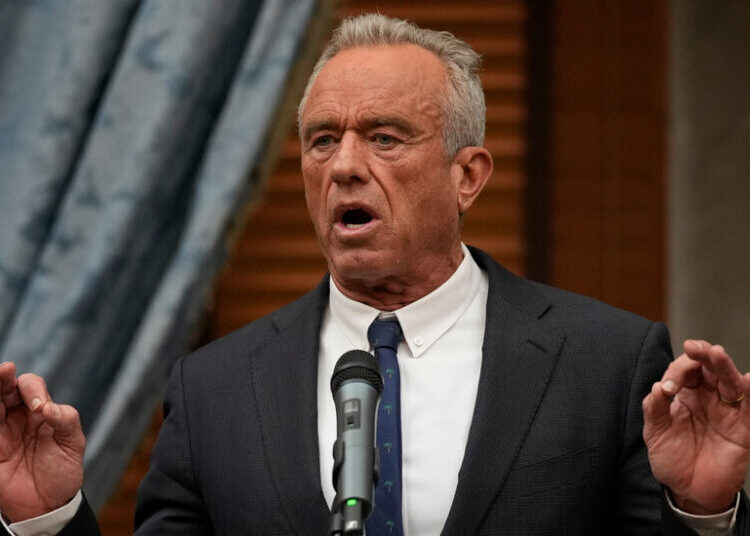
Richard Epstein is a professor of law at New York University School of Law and a senior lecturer at the University of Chicago. Max Raskin is a fellow and adjunct professor of law at New York University School of Law. He is a co-founder of Uris Acquisitions.
Billie Eilish brought the house down at the Grammy Awards on Sunday when she declared, “No one is illegal on stolen land.” While the first half of the statement was a fan favorite aimed at President Donald Trump and Immigration and Customs Enforcement, the second half was a throwback evoking popular land declarations this past decade that consider all land stolen if not derived from an original indigenous title. But it’s time to put Eilish’s theory of property out to pasture: Americans are not thieves who built on stolen land.
In 2022, Los Angeles County unanimously adopted a land acknowledgment proclaiming “that we occupy land originally and still inhabited and cared for by the Tongva, Tataviam, Serrano, Kizh, and Chumash Peoples.” Accepting generational guilt, the county further “acknowledge[s] that settler colonization resulted in land seizure, disease, subjugation, slavery, relocation, broken promises, genocide, and multigenerational trauma.” What the resolution fails to mention is that some of this mayhem was inflicted by one Native American tribe on another. Consider the fierce conquest of the southern Plains by the Comanche or the prevalence of Native American slavery before the European arrival. It also fails to mention that “we” — presumably White people — inflicted similar harms on one another across centuries of war, displacement and conquest.
Los Angeles inserts no time dimension into its denunciations, thus implying this principle applies identically to dispossessions that took place 1,000 or 10 years ago. Thankfully statements of apology, however sincere, don’t transfer title backward to the original owners, for if they did, civilization would collapse.
The land long ago taken from X, has in the interim centuries been conveyed to Y and Z, and countless others who then have built, torn down and built again homes, hospitals and schools for millions. The effort to undo the past would involve trillions of dollars in transfer payments and coerced title shifts that would unsettle every home mortgage, every mining and oil lease, and every graveyard in the United States.
To prevent this social catastrophe, every nation has always adopted a bifurcated view of property, poetically articulated in the Harvard Law Review by the influential California jurist Henry Ballantine in 1918. Principle No. 1 reads: “For true it is, that neither fraud nor might/Can make a title where there wanteth right.” From this it looks like all titles remain perpetually subject to challenge.
But every society also understands that people should be allowed to enjoy security in their purchases and not have to worry about what happened centuries ago. Thus, a second principle to protect these interests, as Ballantine writes, imposes strict limitations on when to sue, for “the great purpose is automatically to quiet all titles which are openly and consistently asserted, to provide proof of meritorious titles, and correct errors in conveyancing.”
All disputes must come to an orderly legal end because life, commerce, and even the Grammys must go on. Statutes of limitation and doctrines such as adverse possession clearly provide that you must sue by a certain date or your title is gone, no matter how maliciously acquired. So while “pure” theory has said since Roman times that “prior in time means higher in right,” in the real world of rough and tumble conflicts and imperfect records, matters of proof and reliance cut back on these theoretical rights. Put concretely: Do Anglo-Saxons take England back from the Normans? That would be civilizational suicide.
It is easy to call land stolen, but what about the innocent purchasers who acquired in good faith in the interim? Are they thieves? Is Eilish a thief because, as the Tongva tribe recently asserted, her $3 million mansion in Los Angeles sits on its ancestral homeland?
If Eilish meant that a random person could squat on land previously stolen from someone else, her assertion contradicts doctrines and common sense. The universal doctrine of jus tertii holds that if a random squatter, let’s call him Jerry Garcia, trespasses on the property of Charlie Parker, he cannot defend himself in court by saying that Frank Sinatra is the actual owner. In other words, Garcia cannot justify his trespass by saying that some third party who is not in court actually owns the land. Without this necessary rule, property — and even currency once stolen — could never again have secure ownership. Everyone’s home or wallet would be subject to lawsuit, a situation that only benefits lawyers, not society.
These ancient legal principles are the reason most land today is not stolen. Beyond the fact that much land was acquired by agreement — such as the island of Manhattan — establishing ownership does not require a time machine.
Fortunately, Eilish does not actually practice what she preaches, for otherwise anyone would be free to squat in her mansion, by asserting the property belongs to the Tongva, not her. But the same legal doctrines that protect her also protect Americans against sweeping claims that they live on stolen land. Performative politics usually ends when celebrities get off stage and become, however briefly, ordinary people.
The post No, Billie Eilish, Americans are not thieves on stolen land appeared first on Washington Post.