Russian troops fighting in Ukraine were reporting internet outages that hindered their fighting ability, Russia’s military bloggers said this week, after Elon Musk said he had moved to deactivate his Starlink satellite internet service for Moscow’s forces.
“Looks like the steps we took to stop the unauthorized use of Starlink by Russia have worked,” Mr. Musk wrote on X on Feb. 1. “Let us know if more needs to be done.”
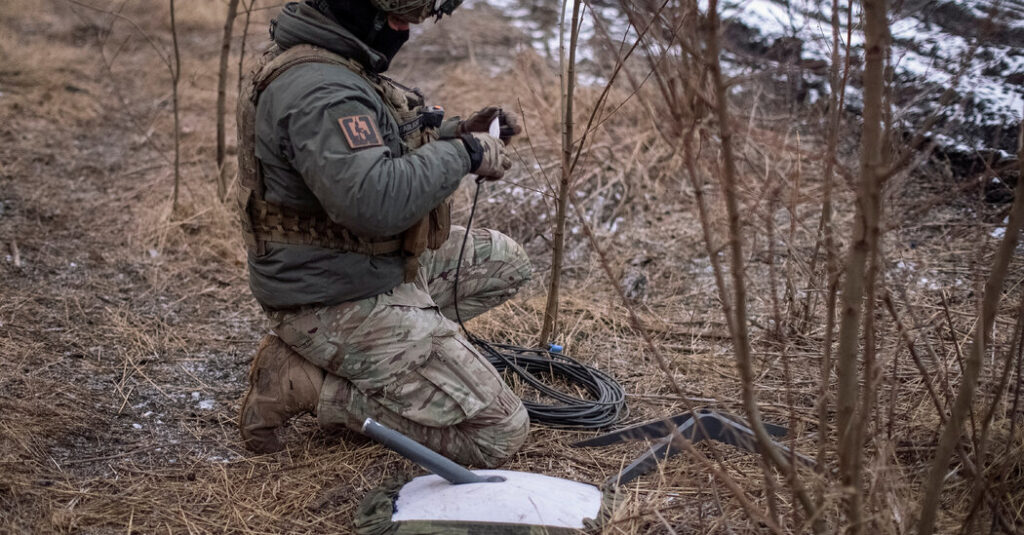
For years, while Ukrainian troops have had official access to Starlink, Russians have been evading export restrictions to smuggle the U.S. firm’s satellite internet devices into the country and send them to the front. Now, their use by Russian military units is under threat.
The Russian military began using Starlink installations this year to direct some of its attack drones against Ukraine, allowing the drones to hit moving targets far from the front line and evade Ukrainian jamming, according to the Ukrainian authorities.
The move prompted Ukraine’s defense minister, Mykhailo Fedorov, to contact SpaceX last month. As a result, the U.S. firm blocked access to Starlink in Ukraine except for registered and verified terminals.
Ukraine is keeping a “white list” of permitted terminals, essentially locking out contraband Russian devices used by Russian soldiers on the front. But the move also temporarily locked out many civilian and military users in Ukraine who still need to register and, in some cases, are awaiting approval.
Mr. Federov celebrated the Starlink move in a post on X on Thursday, noting that the new system was working and that Ukraine was continuing to verify and register terminals rapidly. He thanked the SpaceX chief and said the move was “delivering real results.”
“We are working very closely with your team on the next important steps,” Mr. Federov replied to Mr. Musk on X this month. “Thank you for standing with us. You are a true champion of freedom and a true friend of the Ukrainian people.”
Starlink’s parent company, SpaceX, did not respond to a request for comment.
The change in access to Starlink on the front comes as Russia continues a brutal campaign to take out the heat and electricity in Ukraine during one of the country’s coldest winters in years.
Moscow has launched the attacks as a form of pressure, analysts say, as negotiators from Russia and Ukraine continue to meet in Abu Dhabi for peace talks orchestrated by the United States. Those talks resulted in the announcement of a prisoner exchange on Thursday and an agreement between Russia and the United States to resume high-level military contacts.
Since the start of Russia’s full-scale invasion in 2022, Moscow’s military has struggled to put in place a secure and reliable system of battlefield communications. Units have, at times, relied on Starlink for coordination on the front line. Russia is racing to put up its own equivalent to Starlink, but so far it remains under development.
Apart from recently using Starlink to direct attack drones, Russian troops more broadly have been using the satellite network to get internet access and maintain communications at frontline posts.
“The enemy has not only a problem, the enemy has a catastrophe,” Serhiy Beskrestnov, an adviser to Mr. Fedorov, wrote on Thursday in a Facebook post. He said command and control of Russian troops had collapsed and assault operations had been stopped in many areas.
On the Ukrainian side, he said, there are problems with those who have not registered quickly enough for Starlink, noting that the processing was ongoing. Tetiana Chornovol, a commander of a drone unit, wrote in a Facebook post that two teams had been left without communication, adding, “Starlinks still not working, despite all data sent to the whitelist.”
Russia’s vocal cohort of pro-war military bloggers began detailing how the loss of Starlink was rattling Russian units on Wednesday, after Starlink suddenly required that they register for access. Initially, some bloggers said they thought the outage was temporary, but it soon became clear that it was a coordinated effort directed by Ukraine.
A Russian blogger writing anonymously under the name Military Informant in the Telegram messaging app said that both the Starlink connections on Russian drones and Starlink satellite internet communications for troops at the front had been disrupted. The blogger warned that the change could set the Russian force back “a couple of years” to oudated technologies like wired internet, Wi-Fi and radio communications.
The loss of Starlink for Russian units affects internet availability in the field, and there are no alternatives that work as well, Colonelcassad, a channel run by the pro-war blogger Boris Rozhin, posted on Thursday. There are ways to bypass Starlink’s blockage, a post in the channel noted, “but it will take some time,” as it will to bring high-speed internet to the front via other methods.
“The Starlink saga has created a serious breach in communications, which the enemy may attempt to exploit, something that should be kept in mind,” a separate post in the channel read.
In the face of the Starlink outage, Russian units have turned to traditional radio communications and other means of coordinating. And some had already installed fiber-optic cables to bring landline internet to the front line as a backup, Russia’s military bloggers reported.
Russia’s space agency, Roscosmos, has detailed plans to launch its own satellite internet operation in low-earth orbit as an alternative to Starlink. Production of the satellites is set to begin this year, with a launch planned for next year, Roscosmos’s general director, Dmitri V. Bakanov, told the state news agency Tass last month.
Aleksei A. Zhuravlev, the first deputy chairman of the defense committee in Russia’s lower house of Parliament, said that Russia must seek alternative forms of communication to Starlink. He suggested Russia should not become complacent because of the peace talks.
“It’s important to understand that relying on anything Western in the current situation is overly presumptuous,” Mr. Zhuravlev told the Russian news outlet Gazeta.ru. “Even though we’re currently in active negotiations with the U.S., that doesn’t stop them from becoming our adversary — and Musk’s actions clearly demonstrate this.”
Andrew E. Kramer contributed reporting from Kyiv, Ukraine.
Paul Sonne is an international correspondent, focusing on Russia and the varied impacts of President Vladimir V. Putin’s domestic and foreign policies, with a focus on the war against Ukraine.
The post Musk’s Starlink Blocks Russian Troops’ Internet Access, at Ukraine’s Request appeared first on New York Times.