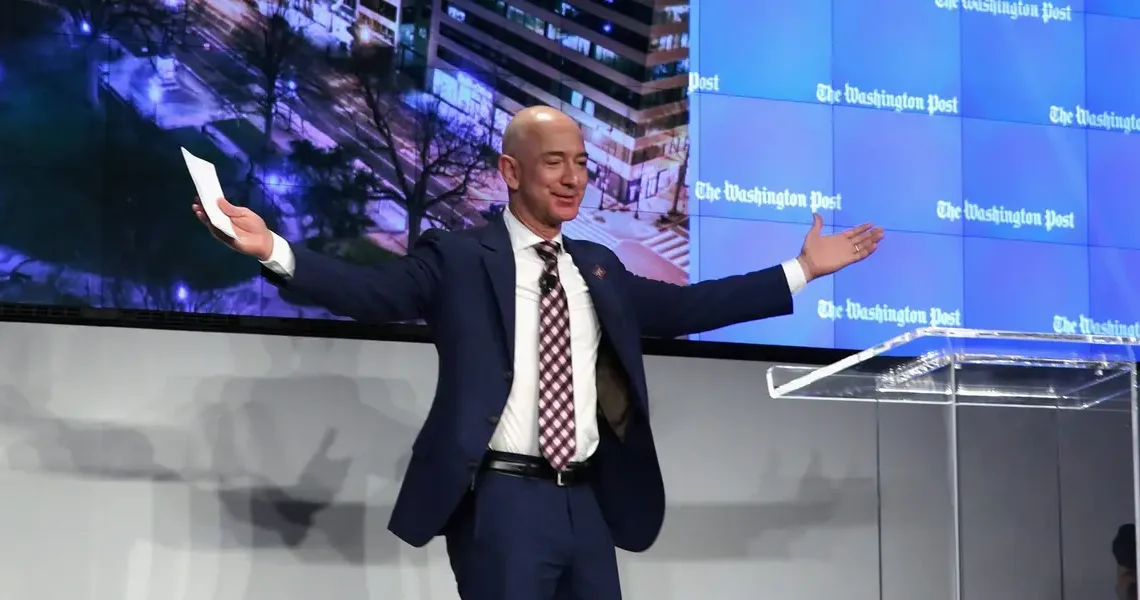
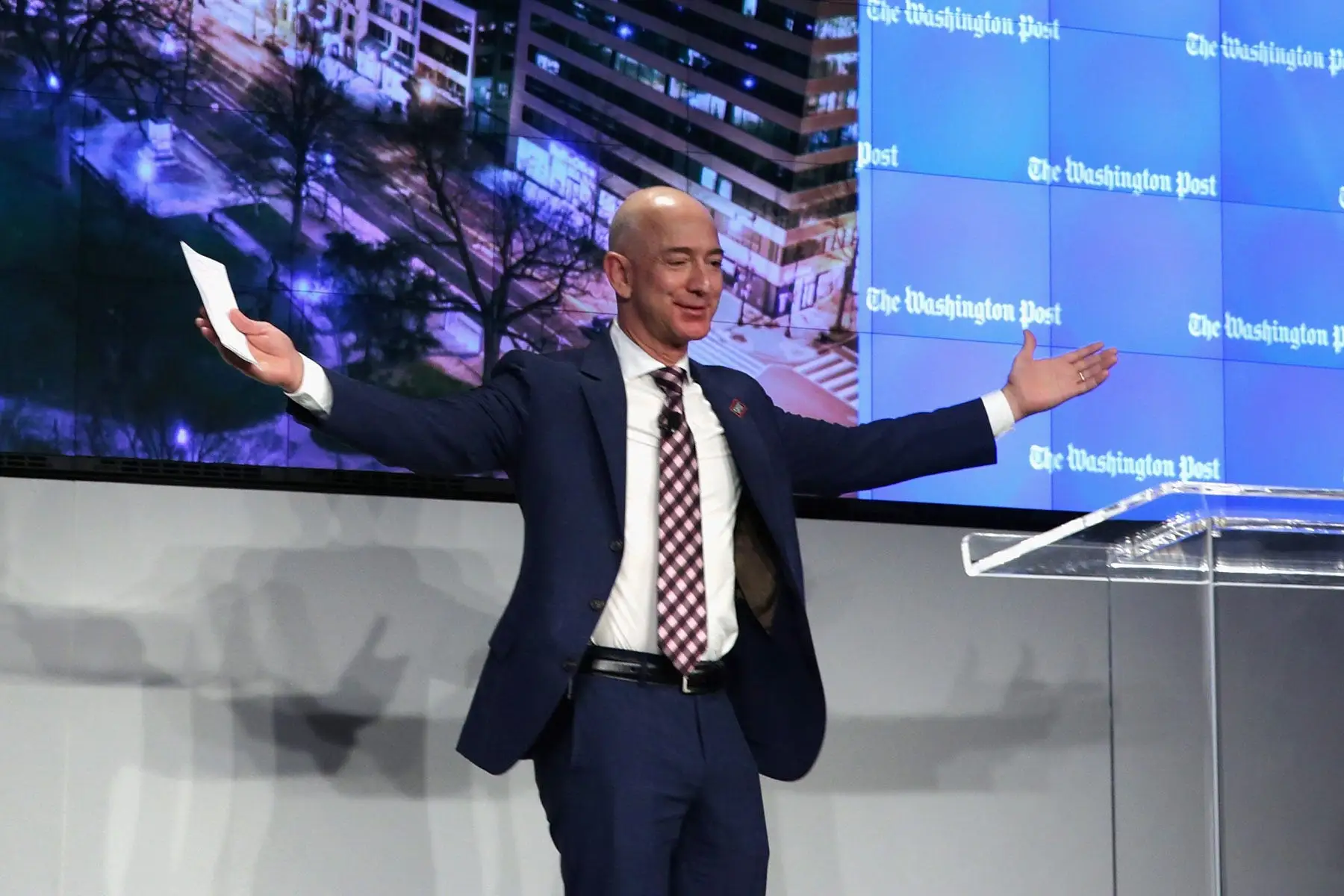
Lots of people are angry at Jeff Bezos because of the massive cuts he’s ordered at his Washington Post. But a decade ago, Bezos was widely celebrated for his ownership of the Post, which he had bought for $250 million in 2013.
Under Bezos’ ownership, the Post made huge investments in tech and staff. And readers loved the results — especially during the first Trump era, when the paper turned profitable.
Now things are very different: The Post says it has been losing gobs of money for the past few years, and Bezos has made a series of moves interpreted as a shift toward Trump — which spurred reader revolts, which made things even worse. And all of that led to this week’s cuts.
I talked to Erik Wemple, a New York Times media reporter who previously worked at the Post for 14 years, to try to reconcile the two eras of Bezos and the Post, and to get a sense of what might happen next. You can hear our entire chat on my Channels podcast; what follows is an edited excerpt from our conversation.
Peter Kafka: What shape was the Post in when Bezos bought it in 2013?
Erik Wemple: The Graham family, which had owned the Post forever, was an amazing steward for the paper. But they had to scale back their newsroom, because the internet had blown holes in classified ads. Classifieds used to be huge at The Washington Post.
At the time Bezos bought it in 2013, it was not dysfunctional. These were really good journalists, but the paper was in a bit of a funk. It wasn’t a reclamation project, but it had seen better days.
It was faded when he bought it.
Correct. And when Bezos came in 2013, he really wowed the staff. We all asked him questions. He answered those questions with tremendous enthusiasm and competence. He seemed really energized by this.
What did he think he was going to do?
When he came in, he was energetic, but deferential on the particulars of running the newspaper. He’s like, “You know what? I’m not in this business, but I do know how to organize discussions about the future of a business.” And that’s what he did. I was in one of them; it was really remarkable.
He had these things that he believed in. He was important in guiding conversations. And it was really remarkable because he backed it up with money. He invested in the newspaper. He invested in political coverage, big time. Investigative went up. International got a huge, huge boost. And the technology did too.
This is exactly what you want from your billionaire tech owner: Give us a bunch of money. Improve our tech. Also, stay away. Don’t tell us what to do.
That was exactly the sentiment. And one of the things you mentioned in there is really worth pausing on for a second, which is the lack of intervention, the lack of meddling. He just sort of looked on. And the newsroom really, really, really roared. Especially in the first Trump period.
So not only does this produce great journalism, it seems like it becomes a business success story — the paper becomes profitable again. Then, after Trump left the White House, there was a lot of hand-wringing about what happens after the Trump bump. People expected audiences to decline across lots of different publications, and that happened, so it makes sense that the Post would struggle a bit. But the numbers you hear about the reported losses — $77 million in 2023, $100 million in 2024 — are staggering. I still don’t understand how you can swing to losses like that just because your traffic goes down. What am I missing?
I share your knowledge gap.
One of the things that has been reported and pretty well substantiated is they may have over-indexed on staff growth. They vaulted up over a thousand in early 2021, up to 1,100. So I think they got ahead of themselves, and they had to pair that back. That’s one of the things.
Another consideration is that the digital advertising market sort of dried up, so that was a big deal.
It’s all somewhat of a mystery, but I don’t doubt that there are meaningful losses.
Can this just be as simple as the Post overhiring? Lots of companies have done that — the tech guys did during the pandemic.
No, I don’t think so. Especially if you look at the more recent past, when they tinkered with the opinion side and shot themselves in the foot.
In October 2024, the Post announced it would not be endorsing a candidate in the presidential election. And that happened after the Washington Post editorial board had drafted an editorial in favor of Kamala Harris. And hell broke loose — a subscription desertion of hundreds of thousands.
That’s an astonishing number. I remember thinking that it couldn’t be real.
The cause and effect could not have been more direct. People said, “No way. I’m not giving my money to this organization.”
The Post has continued to do lots of news reporting that is critical of the Trump administration. Which made me curious about this line in editor Matt Murray’s explanation of the cuts this week. He praises the work the paper has done, and then points out problems, and says “even as we produce much excellent work, we too often write from one perspective, for one slice of the audience.”
It almost sounds like what David Ellison and Bari Weiss say about remaking CBS News. Does that mean we should expect the Post’s news reporting to change in some sort of ideological way?
If Matt Murray or any of his top editors had actually edited that memo, they would’ve asked for specifics. And they would’ve put a big question mark alongside that and ask, “What the hell are you talking about here? Why are you speaking in such elliptical language? Why are you trying to whisper to the newsroom some message that you’re not willing to articulate?”
We need to ask him exactly what he’s saying. I think that that is coded language, and I think that could be political.
It’s a strange thing for the executive editor to be saying. It’s almost as if he’s asking for some force to adjust the newsroom cadence and its sensibility — when he has the power to do that.
(Editor’s note: Business Insider contacted the Post for comment, but didn’t hear back immediately.)
Why does Jeff Bezos own The Washington Post? It seems to be nothing but a headache for him the last few years. It doesn’t seem like it helps him curry favor with Donald Trump. It’s not like he’s using it to buy the “Melania” documentary for $75 million. What is the upside for him, and why does he continue to own it, do you think?
Erik Wemple: I have no idea. That is something all of us in the media trade have been trying to figure out. It is entirely a black box.
Many years ago, he seemed to be deriving a great deal of satisfaction from this. There was a close bond between The Washington Post Establishment and Bezos. I’m pretty sure it isn’t as strong as it once was.
So I think that the enjoyment he got from his association with his institution has probably faded.
But in 2024, he said, “We saved The Washington Post once, and we’re going to save it a second time.” So there’s another challenge, right? I guess that that would be something that he would derive some pleasure from. And I would imagine that if he wanted to get really involved and engaged, the way he was back in 2013-2015, the newsroom would welcome that.
A lot of the success stories we hear about in digital media these days are specifically publications that are focused largely or entirely on Washington, DC: Politico, Axios, Punchbowl, Semafor. Some of them have direct DNA from The Washington Post. Is there any chance of the Post reclaiming any of that, either through an acquisition or just by focusing on Washington and policy?
They have this Washington Post Intelligence thing now, which is sort of akin to that. But I don’t know if there are new streams of revenue opening up at the Post. And I think that that’s one of the reasons that the staff is so disaffected and so disappointed in the current management — they don’t see any sort of progress towards new business.
They’re just seeing cuts.
I think they’re seeing cuts. And also a fair amount of silence. I don’t think that they’re getting the feedback from management that they deserve.
Read the original article on Business Insider
The post Jeff Bezos used to be in love with The Washington Post. What happened? appeared first on Business Insider.