The November news photographs were startling: Jurassic-looking demolition cranes had just ripped up the East Wing of the White House.
Why did this happen? Because the current occupant of what has been sometimes referred to as “The People’s House” wanted to add a $400 million ballroom to the premises. And the site of the East Wing is where it will fit.
On Sunday, the administration announced that another cultural landmark, the John F. Kennedy Center, would close on July 4 for two years of “reconstruction,” to be remade into a “new and spectacular Entertainment Complex.”
These actions have raised alarms in cultural quarters in this city and across the country, where they are seen as a threat to the survival of a wide range of federally owned artistic and architectural treasures, including many dating from the progressive New Deal era.
One of these New Deal gems is a miraculously well-preserved set of murals produced, in the early 1940s, by two of America’s greatest political artists, Philip Guston and Ben Shahn, in a building relatively few tourists have seen or visited, and until recently may not have been aware of.
The paintings were commissioned for an architecturally distinguished setting, the 1940 Wilbur J. Cohen Federal Building, created as headquarters for — and a monument to — Franklin Delano Roosevelt’s Social Security Administration.
Anxiety now surrounds the survival of these treasures, however, because the Cohen building, with its wall-adhering art, has been earmarked by its current owners, the General Services Administration, for “accelerated disposition,” meaning made available for sale, and thereby vulnerable to destruction.
The sale was approved by Congress in a bill that came with notice of a condition under which that disposition could take place: The building has to be entirely empty of tenants. And the G.S.A., the government agency that manages the maintenance and disposal of federal properties, claims that a sale would include preservationist covenants. Yet after the East Wing debacle there’s a sense among concerned observers that any such formal guardrails could now be overridden or simply ignored.
Located two blocks from the United States Capitol and facing the National Mall, the million-square-foot granite-and-limestone structure has a mixed history of usage. It did not, in fact, initially serve as home to the Social Security Administration. Soon after it was ready for occupancy, World War II began and the U.S. federal War Department and National Defense Commission moved in. Long-term tenants since have included, until very recently, Voice of America, the nation’s largest international broadcaster.
Like many government buildings, since 9/11 the Cohen Federal Building has been closed to the general public, though beginning this month the G.S.A. will start offering a limited number of public tours. I recently took one arranged for the press with some G.S.A. representatives. Architecturally, the building is noteworthy for its melding of period styles: Art Deco, Stripped Classical, Egyptian Revival. But for historians of art and American culture — and in my opinion, what makes it beyond valuable — is the stellar collection of site-specific New Deal public art it holds, particularly the paintings by Guston, Shahn and the New York-born artist Seymour Fogel.
Together they have prompted a description of the premises as “a kind of Sistine Chapel of the New Deal” by the historian Gray Brechin, founder of the California-based advocacy group Living New Deal, which maps public art from the period and is now leading an urgent campaign to preserve the Cohen building and its contents. .
The murals I saw had been commissioned by the Treasury Department’s Section of Fine Arts, and painted in 1942 and 1943. They are works of visual power and grace. They are also primary historical documents of a nation still in recovery from the devastation of the Great Depression and attempting to forge a new democratic vision of itself.
Fogel’s Airbrushed Serenity
Of the three artists, Fogel, who had worked as an apprentice on Diego Rivera’s censored and obliterated 1933 Rockefeller Center mural, is the least familiar. And his two expertly done 1942 fresco panels flanking the building’s Independence Avenue-facing lobby entrance are the most straightforward in advertising the utopianism of Roosevelt’s welfare vision.
In one panel, titled “Wealth of the Nation,” the machinery of progress is smoothly running: a scientist sits at a microscope; an architect scans a blueprint; two factory workers hoist their tools and head off to work. In the second panel, “Security of the People,” the workday is done. A family settles down to what looks like an indoor-outdoor picnic to read, play and create art in a world that’s as flawlessly composed as a still life.
Guston’s Renaissance of the Family
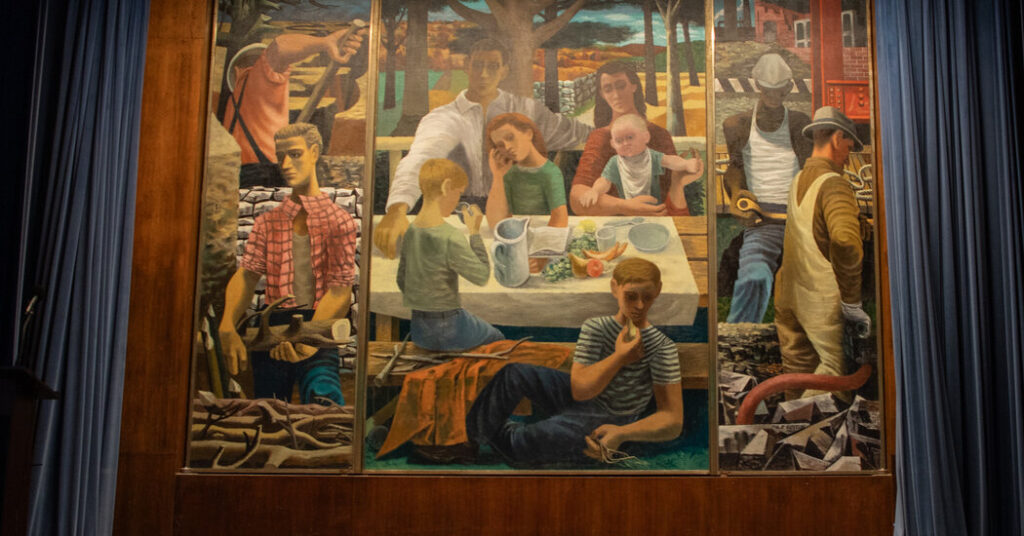
Philip Guston’s 1943 “Reconstruction and the Wellbeing of the Family,” installed in a lecture hall off the building’s lobby, adopts one of Fogel’s themes but in a different medium: oil paint on canvases glued to three detachable wood panels. The format is reminiscent of the Italian Renaissance religious triptychs that Guston loved. And the enigmatic tone of the work complicates Fogel’s airbrushed serenity.
The laborers in Guston’s picture, confined to narrow side panels, occupy crowded, cluttered environments. In the expansive central panel, an image reminiscent of a “Last Supper,” a family sits around a table under focused light that leaves some faces half in shadow. This theatrical effect makes sense: The painting was made to be installed on the auditorium’s stage. But the effect is to make a scene of “well-being” feel moody, somber. The family members look pensive, none more so than the adolescent boy half-reclining in the foreground who could be dreaming the scene.
Shahn’s Low-Color World
The paired Shahn murals, together called “The Meaning of Social Security,” spread organically over facing lobby walls. Like Fogel’s, they combine two traditional fresco techniques, with paint applied to both wet and dry plaster. And, like Rivera’s ill-fated Rockefeller Center mural — on which Shahn also worked — they mark an interesting departure from the forward-march ideal of social justice that much New Deal art was designed to promote. Broad-stroked in texture, half-abstract in style, and monumental in scale, they’re divided into images of America before and after the 1935 arrival of Social Security. The lobby’s east wall follows a template adhered to by Guston and Fogel, with images of family, sports and construction, the latter with workers, dressed in pristine white overalls, building fantastic celestial cities from gold-colored planks and beams.
The west wall features a vision quite different — one of America before the progressive politics of the New Deal had arrived. Unemployment, poverty, illness and age are the themes here. We’re in a bleak, low-color, politically critical Rivera-esque world. Out-of-work men sit idle. A father and son wander disconsolately down a railroad track carrying their possessions in a sack. Children sleep on city streets. The only support a juvenile mine worker and an elderly Black woman seem to have in this world are their crutches.
After completing the two-part painting, Shahn said: “I think the Social Security mural is the best work I’ve done.” Not everyone has agreed. Over the decades, as living memory of New Deal optimism began to fade, some of the Cohen building’s tenants had a problem with the west wall images, finding them off-puttingly grim, maybe too reflective of social realities that are still very much with us. In response, the offending wall was temporarily hidden behind a curtain.
But it now seems possible that, at some point in the future, no such curtain would be necessary, because the murals, along with building itself, could disappear. For some years, the G.S.A., with an eye to curtailing government spending, has compiled lists of what it deemed revenue-wasting real estate. And for some time now the Cohen building has been on that list.
It moved toward the top of it during the first Trump term when the V.O.A. incurred the president’s displeasure. He began to refer to it as “the voice of radical America” and slashed its funding. Hard up for cash, it had trouble paying its rent, and the G.S.A. said it would have to leave by 2028.
Pressure on the building seemed to have lightened somewhat during the Biden years. There was even talk of an upgrade, though nothing was done. Then in 2024, in the very last days of the Biden term, a Republican senator from Iowa, Joni Ernst, a budget-reduction activist, tucked a clause demanding the sale of the Cohen building into a bill about water resources. Her bill was signed by President Biden, with a stipulation added that a sale must occur within two years of the premises being empty.
A 2024 report found an average of only 72 people using the giant building (the G.S.A. said Wednesday that it doesn’t have a count of current tenants but that it’s probably fewer). And since the building’s listing in May 2025 for “accelerated disposition,” there’s reason to fear that a private buyer, with an eye on development, might decide the only value of the deteriorated property lies in the land it stands on.
The idea of transferring the murals to another location is a gamble. While feasible for the free-standing Guston paintings, it could pose grave risks to the wall-adhering Fogel and Shahn murals.
The G.S.A. speaks of including, in a sales contract, preservationist covenants stipulating that the agency would retain oversight of artworks once they passed into other hands. But the ability of the agency, with its Art and Architecture Division drastically downsized during the second Trump term, to exercise such oversight is a question.
Petitions to preserve the building and its murals are circulating. One, drawn up by Living New Deal, calls for the Cohen building — “a living testament to America’s shared values, social progress, and the power of public art to uplift us all” — to be preserved intact, with any potential transfer of ownership made subject to public approval.
Another, an open letter written by three artists (Elise Engler, Joyce Kozloff, and Martha Rosler) and signed by hundreds of art world figures, addressed to the Jewish Museum in New York City, specifically urges that museum to lead an institutional charge to save the landmark paintings of Fogel, Guston and Shahn, who were all Jewish artists. (The museum recently mounted a stirring Shahn retrospective, and in 2024 held a show pairing Guston with the contemporary artist Trenton Doyle Hancock.)
At this point, it’s crucial for culture institutions across the nation to present a united front against the historical erasure ongoing under the Trump administration, of which the potential loss of the Cohen building murals would be another example. The president very clearly understands the political utility of public art. It can be no coincidence that the monuments-to-self proposals he has recently initiated — the ballroom, the renamed and redesigned Kennedy Center, the new triumphal arch — are appearing, like victory gestures, ahead of the country’s crucial midterm elections.
So what better time, strategically speaking, for our art institutions to unite in promoting the survival of another, different example of public art — an art for the people that celebrates the dignity of labor, the heroism of sharing, and the morality of kindness as the Cohen building murals do? Surely Americans of every stripe still find such values deeply relatable.
And if you want to put this to the test, head to Washington (now). And see for yourself what could be lost.
Holland Cotter is the co-chief art critic and a senior writer for the Culture section of The Times, where he has been on staff since 1998.
The post It’s Been Called the ‘Sistine Chapel of the New Deal.’ Don’t Destroy It. appeared first on New York Times.