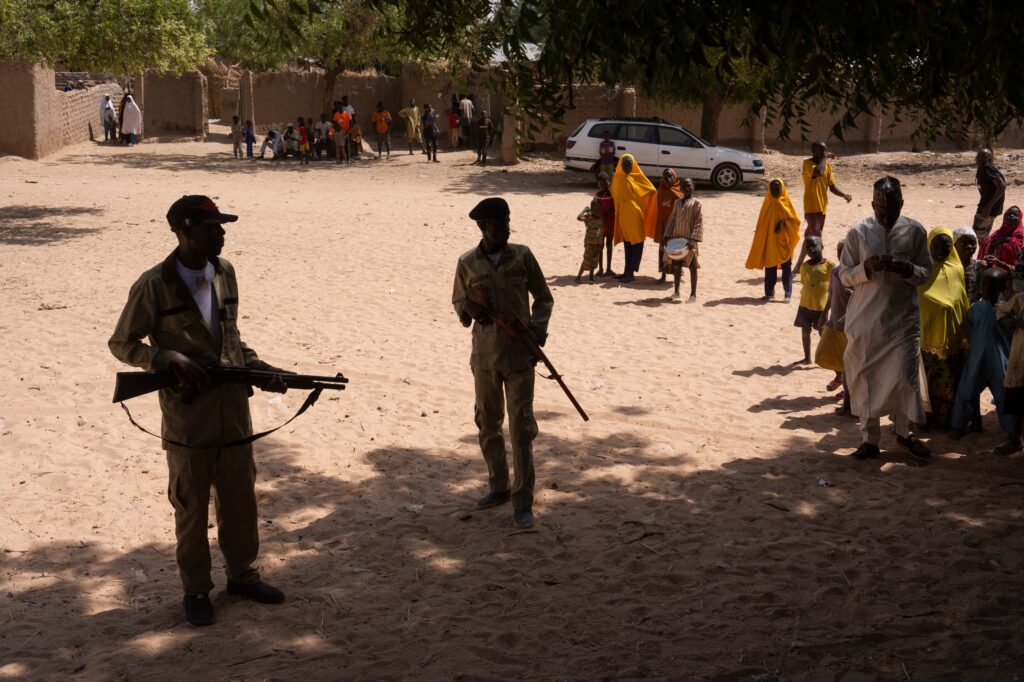
BAIDI, Nigeria — There are still bloodstains and bullet holes in the mud-brick alcove where villagers took shelter last month after militants overran their community, opening fire on residents who had gathered to drink tea in the town square.
Six people, ages 18 to 60, were killed in Baidi that night, locals said, gunned down without warning by men whose faces were obscured by the darkness. The attack was the latest in Nigeria’s northwestern Sokoto state, carried out by what Nigerian and U.S. officials believe is the newest African affiliate of the Islamic State.
On Christmas night, President Donald Trump announced that United States had launched airstrikes against the group, known here as Lakurawa, part of what the White House and its allies have described as a campaign to put a stop to the “slaughter of Christians” in Nigeria. But the U.S. strikes were largely ineffective, Nigerian officials, analysts and residents said, and there are very few Christians in Sokoto to protect. The state, once part of a 19th-century caliphate, remains overwhelmingly Islamic, and it is Muslims in villages like this one who have borne most of the violence in Sokoto.
Yet no one here denies there is a real and growing security crisis. Islamist militants from several different groups have wrought havoc in Mali, Burkina Faso and Niger in recent years while quietly extending their reach into northern Nigeria. Most researchers see Lakurawa as an extension of the Islamic State Sahel Province (ISSP), which is strongest along the borderlands between Mali and Niger but has shown the ability to strike high-profile targets. Its fighters kidnapped an American missionary in central Niamey, Niger’s capital, late last year and, just last week, executed a large-scale attack on Niger’s international airport.
Now, according to five Nigerian and U.S. officials, ISSP is sharing intelligence and coordinating logistics with the more established Islamic State West Africa Province (ISWAP), which is based hundreds of miles to the east on the islands of Lake Chad. Together, officials fear, the two groups could destabilize vast stretches of northern Nigeria, home to an estimated 130 million people, where authorities have long struggled to contain insurgent violence.
“This is not just a Nigeria problem,” said one of the Nigerian security officials, speaking like others in this story on the condition of anonymity to discuss sensitive and ongoing operations. “It affects the entire region.”
The U.S. has ramped up cooperation with Nigeria’s military in recent months, according to four of the officials, running daily surveillance flights over northern Nigeria with drones launched from Ghana. Officials said the flights have provided actionable intelligence used in additional strikes by the Nigerian military.
What, if anything, the U.S. and Nigerian strikes have achieved against militants in the northwest remains difficult to discern. Both nations are playing catch-up on a threat that analysts say has been building for years and is still poorly understood. Attacks by Lakurawa have not been officially claimed by the Islamic State, and researchers and officials have competing theories about the group’s origins and allegiances.
What was clear over the course of more than 20 interviews across Sokoto state is that the militants are on the offensive. Residents in multiple front line villages say armed men are increasingly imposing an extreme version of Islamic law on their communities, demanding they pay taxes known as zakat and punishing those who refuse.
Fighters often announce their arrival by barging into mosques and dictating the rules communities must live by. Most of the villages around Baidi, residents said, have already fallen under Lakurawa’s control. Western schools, already rare in this impoverished region, have been shuttered. Music, cigarettes and traditional celebrations, including weddings and naming ceremonies, have been banned. Drinking and drugs are forbidden and strict dress codes are enforced.
A few weeks before the attack in Baidi, residents said, militants approached members of a local vigilante group that had formed to defend the community, demanding they urge local leaders to submit to their rule. The leaders refused.
“We understood there would be retaliation,” said Musa Sani, 47, one of the vigilantes. “But we did not want to live under a terrorist regime.”
‘Under the radar’
In November, U.N. Secretary General António Guterres told the U.N. Security Councilthat Africa’s Sahel region, spanning the breadth of the continent from the Atlantic Ocean to the Red Sea, now accounts for more than half of all terrorism deaths worldwide and warned of a “disastrous domino effect across the entire region.”
A dizzying array of armed groups thrive across a succession of weak states with porous borders. JNIM, a powerful al-Qaeda affiliate, and ISSP compete for influence in Mali, Burkina Faso and Niger (JNIM also claimed its first attack in Nigeria in late October). ISWAP and the remnants of the Boko Haram jihadist movement are dominant in northeast Nigeria and around Lake Chad.
Boko Haram’s rampage in northeast Nigeria captured the world’s attention more than a decade ago when fighters kidnapped nearly 300 schoolgirls from their dormitories in Chibok. But the arrival of Sahelian militants in the northwest a few years later flew largely under the radar and has been a source of growing alarm for Nigerian officials.
In early November, when Trump suddenly threatened to go “guns-a-blazing” into Nigeria to protect embattled Christmas, officials here were surprised and angry. Nigeria’s population of 230 million is roughly split between Christians and Muslims, and people of both faiths have been targeted by extremists.
But Nigeria’s military was watching the militant violence, especially in the northwest, with growing concern, acknowledged Daniel Bwala, a senior adviser to President Bola Tinubu. “We had always viewed the United States as a senior brother,” said Bwala. “We needed to find a way to work with [them].”
Bwala and a delegation of top officials made the rounds in Washington, appealing for help in addressing a security crisis they said impacted all Nigerians. Their efforts paid off: When the U.S. launched strikes on Dec. 25, it was against Lakurawa targets provided by Nigerian officials.
Although Trump and other U.S. officials have publicly claimed the strikes were a success, they have provided no evidence to support their claims. At least four of the 16 Tomahawk missiles failed to explode, The Washington Post found, landing in open fields and a residential area far from where the militants are known to operate. Nigeria’s government has said three dozen suspected militants were arrested while attempting to flee Sokoto state following the strikes. Mohammed Idris, the country’s information minister, told The Post that a “comprehensive evaluation” was still underway.
A senior Nigerian intelligence official who deployed a team to the sites where missiles reached their targets told The Post that while Lakurawa camps were destroyed, there was no indication that militants were killed. Three other Nigerian officials conceded that the sheer number of armed groups operating in the northwest, and shifting alliances among them, have made it difficult to obtain accurate intelligence.
That lack of clarity presents “a real operational challenge vis-à-vis targeting,” said James Barnett, a Nigeria specialist based between Lagos and Britain. “Intelligence has to be precise and fresh for it to be effective.”
Barnett also cautioned that Lakurawa may not be a single coherent group, but rather a catchall term for Sahelian Islamist militants. Allied criminal bandits, he added, may be exploiting the confusion and operating under its name.
As officials try to make sense of the situation, fighters loyal to ISSP have “entrenched themselves in the Niger-Nigeria borderland and are advancing toward Benin,” said Héni Nsaibia, the senior West Africa analyst for the Armed Conflict Location & Event Data project.
“They have decided to run their operations covertly,” he said, “to try to stay under the radar.”
Rule of the gun
Driving north from the bustling city of Sokoto, the regional capital, toward the border with Niger, the roads are largely devoid of traffic. Rolling brushland is interrupted only by the occasional farm.
It is in these remote, ungoverned spaces that Lakurawa established a foothold, officials say, and is now expanding.
Residents in four towns and villages described armed men arriving here more than five years ago from Mali and Niger, traveling on motorbikes and speaking languages they didn’t understand.
At first, they presented themselves as peacemakers — mediating disputes between herders and farmers, which sometimes turned violent, and protecting communities from roving bandits. But it was not long before they showed their true colors, residents said, issuing draconian decrees at gunpoint.
Over the last year, according to experts, residents and officials, the militants have widened their reach, bringing more villages under their control and using violence against those who resist.
Residents in Dankale recalled being crowded into the village meeting place last year by 10 men with AK-47s, their faces mostly hidden by turbans. Through an interpreter, the Islamists demanded that locals disarm and adhere to their rules, said Awal, one of the men present that day.
“We knew that if we spoke,” he said, “we would be killed.”
In nearby Karadal, imam Sirajo Lawal said that virtually everyone in his village tries to live by the Quran. But the Islam that he preaches, and that his father preached before him, gives people the freedom to choose their own path, he said.
With the militants, however‚ “they say, ‘You must do this, otherwise, hellfire,’” said Lawal, 55. “This is the point of difference.”
He spoke to The Post at a school in Tangaza, about six miles from his village, now solidly under the control of Lakurawa. Interviewing him there would have been too dangerous. Men in the community who listen to music or refuse to grow beards are beaten or fined by the militants, he said. Gunmen have also burst into traditional ceremonies, which are no longer permitted, and fired into the air.
In Karadal, and dozens of communities like it, the group rules by extortion: forcing locals to pay taxes in exchange for safety. Lawal said he had put aside eight bags of grain for his next payment to the group.
Kingsley L. Madueke, the Nigeria research coordinator for the Global Initiative Against Transnational Organized Crime, said much of Lakurawa’s funding is believed to come from tax collection, though the group also carries out kidnappings for ransom and steals cattle from herders. Often, he added, they cooperate with local bandits who know the terrain.
Most analysts believe Lakurawa is part of, or affiliated with, the Islamic State Sahel Province, which first emerged in 2015, killed four U.S. soldiers in an ambush in rural Niger in 2017 and was officially recognized as a “province” by the Islamic State in 2022.How much support Lakurawa receives from the Islamic State’s hub in northern Somalia is unclear — one of many things researchers are still trying to pin down.
Lawal said the militants came straight to him when they wanted to enter his village. He acquiesced to their demands, he said, knowing the Nigerian government would not protect them.
“We are not comfortable at all, but we cannot do otherwise,” he said. “They could kill us at any time.”
In the wake of U.S. strikes, Lakurawa have apparently moved their camps, Madueke said, but their attacks have continued. Dislodging them from the northwest would require a clear strategy and sustained commitment from an administration that has not prioritized Africa, said retired U.S. Air Force Maj. Gen. Kenneth Ekman.
“A dozen cruise missiles does not a counterterrorism mission make,” he said. “We’ve learned time and again that success requires consistent presence with sufficient capability and will alongside our partners.”
Sani, the vigilante in Baidi, was initially hopeful the U.S. strikes would wipe out so many militants that they would abandon the area. He knew he was mistaken when he heard the gunfire in the town square.
He found his grandfather among the dead, his stomach perforated with bullets. Through his tears, he tried to help two men with critical injuries, he said, but neither made it. He expects more violence is coming.
“We’re more scared than ever before,” he said. “It feels like they’ve dispersed and are everywhere.”
Murtala Ahmed Rufa’i contributed to this report.
The post In northwest Nigeria, U.S. confronts a growing terrorist threat appeared first on Washington Post.