On Sunday, millions of Americans will watch the Super Bowl grazing on typical game-day fare like chicken wings, nachos and pizza.
So, how about adding Raisin Bran to the mix?
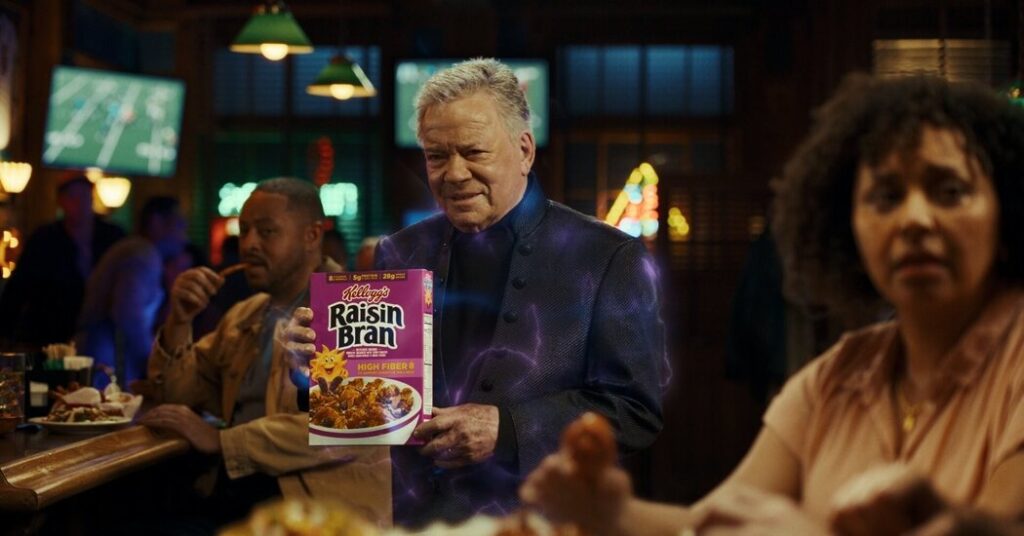
In its first Super Bowl ad for Raisin Bran, WK Kellogg is pitching the cereal as a way to get over “gut regret” the morning after indulging in not-so-healthy foods.
In the cheeky spot, “Will Shat,” also known as William Shatner of “Star Trek” fame, beams from a spacecraft to various venues, tossing boxes of Raisin Bran to unsuspecting revelers. This year, commercials during the Super Bowl airing on NBC are going for as much as $10 million.
“Duty calls,” Will Shat says before transporting to a bar. “Will Shat?” a patron at the bar asks. “Every darn day,” he responds. When he beams into a house party, he points to a dog, asking, “Is that a Shih Tzu?”
Sales of breakfast cereals have been declining steadily for years as consumers have increasingly turned to grab-and-go bars and shakes in the morning. But the ad also allows WK Kellogg, which the Italian candy maker Ferrero acquired last year, to tap into a resurgent health and wellness trend: fiber.
In recent years, protein has been the hot “it” nutrient for consumers, promoted across social media as a wonder food source that builds muscle and promotes weight loss by making consumers feel fuller for longer after a meal.
Food companies have gone full throttle on the protein boom by adding the molecules to anything and everything. Protein chips. Protein sodas. Even protein ice cream.
The result? Americans are eating more than enough protein. Maybe even too much, some experts warn.
Now, fiber is stepping into the spotlight.
“Honestly, I’m glad the conversation is switching from protein to fiber,” said Bonnie Jortberg, an associate professor at the University of Colorado Anschutz School of Medicine. “What we know is that 90 percent of Americans don’t get enough fiber in their diet.”
Most adults in the United States aren’t consuming the recommended 25 grams a day for women and 38 grams for men. Dr. Jortberg said she typically started her morning with a bowl of oatmeal, with some granola thrown in and some berries, all fiber-rich foods that get her close to half the recommended daily target in one meal.
Nutritionists say the emphasis on protein in diets came at the expense of fiber, a less sexy but still critical nutrient. Most Americans get their fiber from foods like bread or pasta, carbohydrates that have been belittled or even vilified by some fad diets.
But health professionals say getting adequate fiber can reduce the risk of chronic health conditions like cardiovascular disease, Type 2 diabetes and some types of cancer.
“Fiber is really important to gut health,” said Joanne Slavin, a professor in the department of food science and nutrition at the University of Minnesota. “I’m happy fiber is getting to be a little more front and center these days.”
Of course, the focus on consuming fiber isn’t a new thing. In the 1970s and into the ’80s, for instance, the F-Plan diet was a fad that featured lots of fiber.
These days, as in any good health craze, some on social media are taking the fiber trend to the extreme, advocating “fibermaxxing.” They provide tips on how to load meals up with fiber by adding beans or mixing chia seeds into shakes or puddings. In some cases, they suggest eating two times the recommended daily amount, or even more.
“If you’re eating 50 to 75 grams of fiber a day, you might end up with a lot of bloating, gas or even pretty significant gastrointestinal issues,” Dr. Jortberg warned.
In response to emailed questions, WK Kellogg said the Super Bowl “is a cultural moment where eating habits are front and center — and fiber usually isn’t.”
Consultants say consumers are likely to start seeing fiber added to various products or highlighted in marketing in the coming months as food companies try to ride the wave.
“I think fiber will be the next protein,” Ramon Laguarta, the chief executive of PepsiCo, said on an earnings call with Wall Street analysts and investors in October, noting the company’s plans to launch high-fiber products, like popcorn.
“Fiber is having a moment right now,” said Stephanie Mattucci, a strategist at Mintel, a market research firm. “It’s benefiting from the same cultural shifts that are making sourdough, knitting, canning, all of those things that seemed old-fashioned, relevant again.”
She added: “My grandfather carried his bran cereal and Metamucil around for his regularity. But now, with the broad cultural shift, brands have permission to make fiber fun.”
Julie Creswell is a business reporter covering the food industry for The Times, writing about all aspects of food, including farming, food inflation, supply-chain disruptions and climate change.
The post If a Fiber Campaign Costs Millions, It Has to Be a Super Bowel Ad appeared first on New York Times.