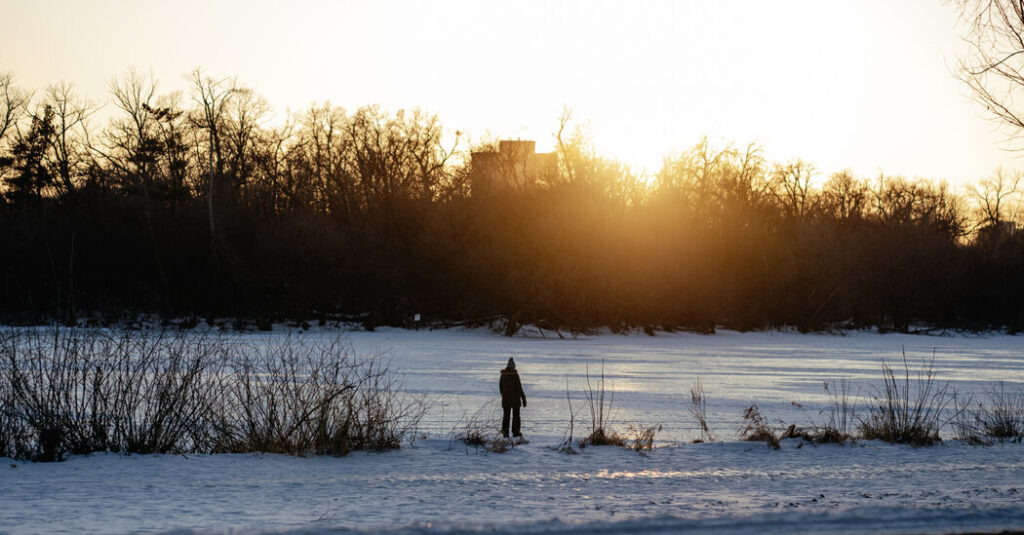
Two rescues and three deaths last week in the United States underscore the dangers of walking on thin ice.
Though temperatures are below freezing in many parts of the country, the water in ponds, lakes and rivers has to turn into an ice block four inches thick before most people can safely walk across, according to scientists.
The general rule of thumb is at least four consecutive days and nights of subfreezing temperatures are needed to form ice that is safe to walk on. At least five inches are needed for an A.T.V., and six for a snowmobile.
Bystanders rescued a 13-year-old boy in Colorado Springs from a pond on Friday, and an 11-year-old boy was saved on Saturday in a pond in Holly Springs, N.C.
But also last week, three boys died in Texas after falling through an ice-covered pond.
It is also illegal in many places to walk or skate on frozen bodies of water. On Sunday, the police in Philadelphia reminded residents that “river ice is not as thick as it looks — moving water underneath weakens it and conditions can change fast.”
Clear blue ice is a sign of high-density ice, and the strongest signal of safety. White ice, which forms when snow melts and refreezes, or when water floods the surface, is full of air bubbles and is more risky. Slushy gray ice is a sign of melting and is not safe.
If you plunge through the ice, the cardinal rule for victims and bystanders is not to panic, experts say.
Though it may seem paradoxical, time is on your side.
“A lot people think that you become hypothermic in minutes, and most people understand you can die of hypothermia,” said Dr. Gordon Giesbrecht, an expert on cold weather physiology and hypothermia, and a senior scholar at the University of Manitoba. “So that leads people to erroneously think that they’re going to die of hyperthermia quickly” and “make bad decisions.”
Here are the best ways to stay alive after plunging through ice, according to Dr. Giesbrecht, who has repeatedly fallen through ice for science.
What You Should Do as a Victim
Remember the “1-10-1” principle.
The “1-10-1” principle is the best strategy for staying alive, Dr. Giesbrecht said.
You have one minute to get your breathing under control; 10 minutes before the cold water thwarts your ability to effectively use your arms and legs; and one hour before losing consciousness.
Relax and take deep breaths.
“You might be hyperventilating,” he said. “That’s the cold, sharp response that often happens.”
Force yourself to take slow deep breaths to get yourself under control.
Try to get your arms on the ice shelf.
Once your arms are on the shelf, stretch them out.
“Hopefully they’ll freeze to the ice before you become unconscious, and then you won’t slip under the ice and drown,” Dr. Giesbrecht said.
Having your arms frozen to the ice shelf “widens the window of opportunity for rescue,” Dr. Giesbrecht said. “It’s the difference between going under the ice after four minutes, rather than maybe somebody finding you up to an hour or so later, and still being able to save you.”
Keep in mind that you weigh more now because water has soaked your clothing.
Determine the best direction to get out.
“Often it’s the way you just came,” he said. Remember that broken ice is weaker than it was before.
Try the kick-and-pull method.
Don’t try to get out as you would a swimming pool. Once your arms are stretched out on the ice, kick your feet, and then your body will come up horizontal near the surface of the water.
“Kick like crazy and pull yourself along the ice,” he said. “So you’re going horizontal as opposed to trying to get up.”
Try multiple times, if needed.
Don’t stand up.
Shimmy forward on your arms until you feel you’ve reached stronger ice.
Don’t overexert yourself.
“Resting won’t make you any stronger because you’re getting colder,” Dr. Giesbrecht said. “After you give it four or five shots, that’s about enough, and then you need to stop” because the situation will worsen with exhaustion.
What to Do as a Rescuer
Don’t run to the hole.
Remember that the broken ice is now weaker.
“There are lots of stories of people who run up to try and help someone broken through and become victims themselves,” he said.
Dr. Giesbrecht acknowledged that telling would-be rescuers not to run onto the ice is very difficult advice to follow.
“If it’s your kid, you’re probably going to go anyway,” he said. “If it’s your pet, you’ll probably go anyway, but you shouldn’t.”
A person who runs after a dog that has fallen through the ice will weigh more, and will be immersed, too.
Talk to the victim.
Speaking to the victim in a calm tone can play an important role in the rescue, Dr. Giesbrecht said.
“Tell them to face you, put their arms on the ice, tell them to kick and pull,” he said. “And coax them to get toward you.”
Throw a rescue line to the victim.
Find a rope, an outdoor extension cord, a hose or anything that’s long. If that does not work, then you might have to get closer to reach them with something like a tree branch.
“A lot of these plunges happen in residential areas, in a pond, or near a house on a river, or some thing like a farmhouse pond,” Dr. Giesbrecht said. “So there might be some useful objects around.”
If desperation grows, call for help.
If these steps don’t work, experts believe that the best course of action is not to try to effect a rescue, as bystanders most likely lack the proper equipment, such as flotation devices and thermal protection, or training.
The best thing a bystander can do is to immediately call for help.
It’s paramount to remember that victims have an hour or more before they’ll die of hypothermia.
That’s time to have trained professionals come and rescue them.
“Don’t become a victim yourself,” he said. “There are too many stories of that.”
Adeel Hassan, a New York-based reporter for The Times, covers breaking news and other topics.
The post How to Survive a Fall Through the Ice appeared first on New York Times.