There are two things I can say about myself with certainty: I dislike being cold, and I’m terrible at stepping out of my comfort zone. So it may seem odd that I decided to take up figure skating.
But every four years, during the Winter Olympics, I’m captivated by it. As I watch impossibly fit athletes glide across the ice and spin in the air, I think, from my couch: I want to try that.
It’s a common response. Adult enrollment in figure skating lessons tends to spike during the Winter Olympics, said Elise Preston, the senior director of membership at U.S. Figure Skating, the national governing body for the sport.
“People can really start at any age,” she said, adding that she regularly sees adults in their 60s and older registering for lessons. Some want to get back into their childhood hobby, while others are fulfilling a dream they didn’t have the time or freedom to pursue before.
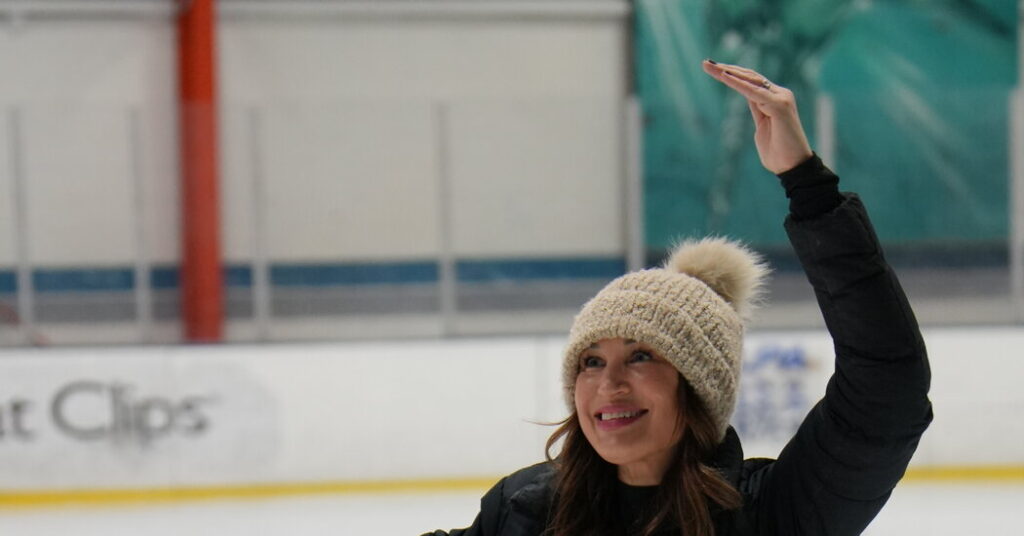
So I booked some lessons at the Oakland Ice Center, a rink in the Bay Area where weekend warriors train on the same ice as Olympians like Kristi Yamaguchi and Alysa Liu.
My goals were to learn some fundamental moves, feel confident on the ice and get some exercise. And if possible, I really wanted to do a spin.
Lesson 1: Stroking, swizzles and crossovers
At the rink, I met my coach, Vadim Shebeco, a former member of the Soviet Union figure skating team. Affable and debonair, he is someone you could picture as Prince Charming in the Ice Capades — a role he actually played in the ’90s.
We started with stroking, a foundational technique in which you push off the ice and extend your leg backward. Then we practiced swizzles, where you keep both skates on the ice, drawing a football shape as you move. Crucially, we also worked on stopping — knees bent, toes turned in and heels pushing out (far more effective than my old method of crashing into the sides).
Finally, we tried crossovers, where you bring your outside skate over your inside one to gain speed along a curve. I could get my right skate rather inelegantly over my left, but not the reverse. “Totally normal,” said Mr. Shebeco, who regularly coaches adults. “Most people are stronger on one side.”
Figure skating is challenging partly because you’re trying to control your body over a narrow base of support, said Deborah King, a professor of exercise science at Ithaca College who studies the biomechanics of the sport.
Because you’re engaging your lower body almost constantly — as well as your core, back and arms for stability — it’s also a great workout.
“It helps build core and leg strength, it’s good for working on balance and posture and it’s mostly low impact,” said Patricia St. Peter, an International Skating Union Council member and a former coach.
Low impact, that is, until you fall. At the end of the lesson, my quads, hamstrings and calves burned, and I had broken a light sweat. But I hadn’t wiped out.
Lesson 2: The first spin
As we warmed up with a few laps around the rink, Mr. Shebeco encouraged me to lift each skate off the ice for a few seconds at a time. “Your mind is going to fight you,” he cautioned. He was right: The idea of being even less stable was terrifying.
Adult beginners often feel particularly vulnerable, Dr. King said, because they know they aren’t invincible. And “it’s so easy to fall in every direction,” she added.
Before my lesson, I’d practiced the footwork for crossovers in my living room. On the ice, Mr. Shebeco had me do crossover after crossover, praising me when I managed a fluid step instead of an unwieldy stomp.
“It’s hard for it to come naturally,” he said. “Because it’s not a move you make in everyday life.”
By the end of the lesson, I felt confident enough to try a two-foot spin. Mr. Shebeco showed me how: Plant the ridge at the front of one skate — called the toe pick — and use the other foot to pivot around it. When you have enough momentum, he explained, lower the heel, draw your legs together and bring your arms in.
Is it scary, I asked? “It’s a little bit of a thrill,” he shrugged, with the nonchalance of a man who could do it in his sleep. But every time I tried, I couldn’t pivot fast enough to build momentum. I would draw my legs and arms in, only to feel my body stop.
“It’s not working!” I told Mr. Shebeco.
“Yes,” he deadpanned. “Because you are going very slow.” Even so, I reassured myself: I didn’t fall.
Lesson 3: Falling
The only way to get better at skating is to become comfortable with falling, Corinne Keller, a figure skating coach and a member of the intercollegiate team at the University of California, Berkeley, told me. A few minutes into my next lesson, I caught my toe pick on a crossover and went down hard.
“First one!” cried Mr. Shebeco, raising his fist jubilantly, as I clambered awkwardly to my feet.
It wasn’t a graceful fall, and I instinctively put my hands out, which is a reliable way to break a wrist. But it wasn’t as bad as I’d feared.
After that, it was like a switch had flipped. I felt vastly more confident. Falling had made me stop worrying about falling. Buoyed by my newfound fearlessness, I took another stab at the two-foot spin.
This time, after a few tries, I managed to work up enough speed as I pivoted that when I pulled in my arms and legs, I actually spun for several rotations. The cool air whipped against my face as Mr. Shebeco whooped.
Then I kept on doing it. It wasn’t perfect, and it wasn’t pretty, but it was more than a little bit of a thrill. For a few seconds, I felt like an Olympian.
How to get started
Many rinks offer multiweek programs for adults — Learn to Skate is a useful resource — as well as drop-in public sessions for practice. Choose a class specifically for adults, Ms. St. Peter said, as you’ll be able to cover more ground.
Ms. Preston advised wearing warm, fitted, athletic layers and thin, calf-length socks to prevent blisters and chafing. And as soon as you’re serious about the sport, it’s worth buying your own skates.
Like many people who take up skating in midlife, I’ve swiftly become enamored. The reward for embracing a little physical and mental discomfort has been huge, and it feels good to get better at something.
“Those who work hard and excel, they make it look easy,” Ms. St. Peter said. “But I can tell you, nobody comes to the rink looking like that.”
Holly Burns is a writer in the San Francisco Bay Area.
The post How I Learned to Ice Skate in Middle Age appeared first on New York Times.