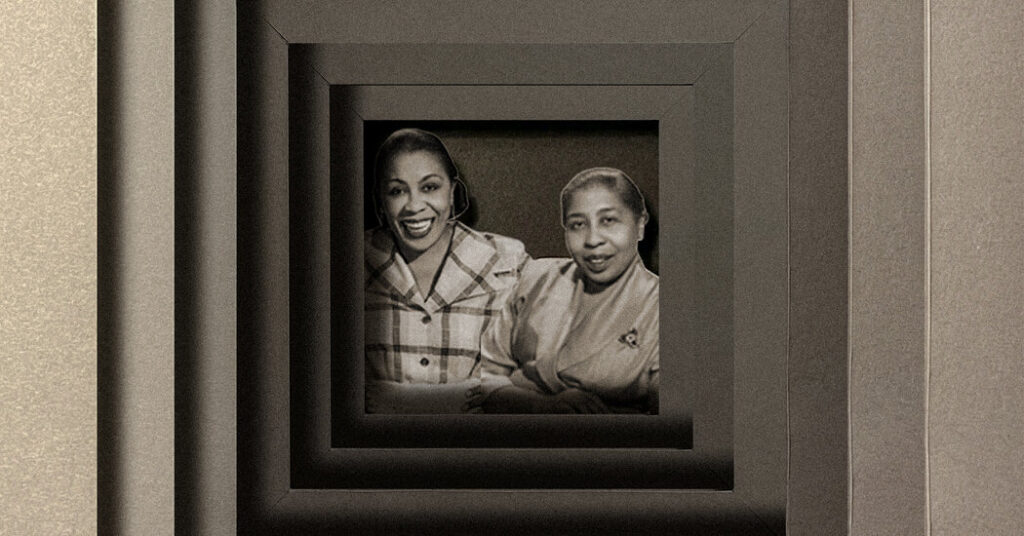
It may not have made it onto many critics’ top 10 lists, but the release of the Blu-ray edition of all 114 theatrical “Tom and Jerry” cartoons was one of my cultural highlights of 2025. Old cartoons are among the things I love most, and I’m a completist. All of “Tom and Jerry”? Turn me loose!
One delightful surprise in that collection was “Lady of the House: The Story of Mammy Two-Shoes,” a short documentary about one of the series’ less prominent characters. Mammy Two-Shoes was voiced by Lillian Randolph, an actress I’ve long been in awe of. Amanda Randolph, her sister, was an actress, too, as well as a musician, and I’m just as much in awe of her.
Black women making their way long before the civil rights era navigated career prospects much narrower than those of today’s Black stars, but the Randolphs shone through all the same. Maybe it’s because it’s Black History Month, or maybe it’s because I enjoyed the cartoons so much, but these two impressive talents struck me as stories for our time.
The Randolph sisters were born in Southern states in the last few years of the 19th century. Poor as their family was, their father, a Methodist preacher, arranged for music lessons for Amanda, who then taught Lillian. By the time she was a teenager, Amanda was picking up work as a piano player and an organist. As for Lillian, she got her break in radio as a singer, and then moved to Hollywood in the late 1930s. She established herself by playing maids, and kept at it for the next 20 years.
After World War II, the N.A.A.C.P. began deriding such roles as demeaning (Walter White, the organization’s leader, described the roles as “mugging and playing the clown before the camera”) and criticizing Black actresses for taking them. Hattie McDaniel, who played Scarlett O’Hara’s enslaved maid in “Gone With the Wind,” reportedly retorted that she would rather make $700 a week playing a maid than $7 a week being one. The sad truth, as Lillian noted, was that in that era, if Black actresses didn’t play maids, they wouldn’t play anyone at all.
The mainstay of Lillian’s career was playing Birdie, the maid on “The Great Gildersleeve,” a series about a bachelor raising his niece and nephew in a small town called Summerfield. It’s my favorite old radio show. A kind, witty portrait of Middle America, it ran on NBC from 1941 to 1957, inspiring a season-long expansion to television in 1955 as well as four spinoff movies. Lillian was the only member of the cast who was there for the whole run. Amid the cackling broadness typical of so much old radio comedy, her measured, realistic delivery sounded distinctly modern. She brought listeners in.
To be sure, the character was a product of the times. In the first season, Birdie is depicted as pretty dumb. Over the radio show’s 16-year run, we learn next to nothing about her life. And throughout, she does a little too much guffawing.
Despite all that, Randolph’s warmth — laced with irony — always shone through. The show allowed her to go places all but unknown on other radio commentaries. She could show some attitude, as when she says, about a testy houseguest, “One nice thing about her, she don’t know nothing about cooking. That’ll save a lot of wear and tear on my personality,” coloring the last few words with a tinge of agitated pride. And when Gildersleeve asks, with concern, whether Birdie is satisfied with her life, she replies quietly: “Mr. Gildersleeve, do you know anybody that’s satisfied?” Gentle, genuine — even deep. Birdie also sang occasionally, allowing Lillian to show off her lovely lullaby contralto, which could lower into a baritone.
And she did so much more. Fans of the film “It’s a Wonderful Life” may remember Lillian as the maid Annie, who near the end runs in with a donation for George Bailey, saying, “I been savin’ this money for a divorce if ever I get a husband!” As the civil rights era slowly opened more opportunities for Black actors, she got to expand her reach to new kinds of roles, including Bill Cosby’s mother on his short-lived, puckish sitcom “The Bill Cosby Show,” which ran from 1969 to 1971.
At the beginning of the Covid-19 pandemic, I set myself two cultural goals. One was to finally read “War and Peace.” The other was to watch all 253 episodes of “The Jeffersons” — for the sake of nostalgia, as a Black person of what used to be called a certain age who grew up watching the show. One of my favorite episodes was about a reunion between George Jefferson’s mother and his aunt. It takes a while before the aunt appears onscreen. Given the age the aunt would have to be, the year in which the episode was made, what her skin tone and speech would be like to make her resemble her sister, as I watched, I started to think Lillian Randolph would be the perfect actor for the role. So perfect, in fact, that I would be almost annoyed if anyone else had been given the part. Then a door opened, and there she was on my television.
Lillian did the scene beautifully; despite all the contrivance of sitcom convention, any viewer would have believed it really was the reunion of two sisters. It was one of the best performances of her career.
“The Black Network,” a 1936 short about a fictional Black radio station, had a young woman at the mic singing “Something Must Be Wrong With Me,” a self-deprecating number about her troubles catching a man. That was Amanda Randolph, Lillian’s big sister. Funny and irresistible, the performance is a glimpse at the talent that had already made her a big deal.
Her career started in Cincinnati, where she made some recordings as a singer and was the only Black woman known to have recorded piano rolls. Moving to New York in the early 1920s, she sang in Harlem nightclubs and even in some Broadway shows, becoming enough of a phenom that Langston Hughes name-checked her in his memoir “The Big Sea”: “When Harlem was in vogue, Amanda Randolph was at the Alhambra, Jimmy Walker was mayor of New York and Louise sang at the old New World.” In the late 1940s she was both the first Black regular in a television series, playing the maid on the primordial sitcom “The Laytons,” and then soon afterward the first Black woman with her own daily show, a musical spot called “Amanda.”
Unfortunately, few recordings of her work in New York survive, but when Amanda moved to Los Angeles in 1949, she began much of the work that we can still experience today. She shone especially as the mother-in-law on the “Amos ’n’ Andy” radio show, which she carried over into the television version in the early 1950s. Her almost Falstaffian delivery as the classic battle-ax mother-in-law was a “delirious scream,” as Donald Bogle, the author of “Primetime Blues: African Americans on Network Television,” described it. In one memorable episode she refers to her lazy son-in-law in escalating degrees of abuse: “That no good … stupid … idiotic … birdbrained, jugheaded, big-mouthed, LAZY LOAFIN’ HUSBAND of yours!”
Despite her tremendous presence, however, Amanda generally had to accept the same limited options her sister did.
When one of my daughters was a toddler, I thought she might relate to “Little Audrey,” a cartoon series of the late 1940s and 1950s I’d heard of but never watched. It turned out that “Little Audrey,” too, had a maid character. The first time my daughter saw her, she asked, “Why is there a bear?” There was no bear, just “Petunia,” drawn in such an exaggerated minstrel caricature that to a 3-year-old she barely looked human. We quickly switched to the Pink Panther, but the Petunia voice was Amanda’s. I noticed in later solo viewings that she was a gifted comic artist.
This served her especially well when she was cast as the title character on the hit radio show “Beulah” — another maid, of course. Hattie McDaniel had played the part for years but withdrew, owing to illness. Amanda gave the role a sly spin of her own, more skeptical and weary than McDaniel’s sassy take.
She was cast as a maid again in the 1950 Sidney Poitier film “No Way Out,” but this was another thing entirely. This crime drama was a serious film of the kind then called a “problem picture,” meaning it addressed racism and plumbed subtleties of human interaction. With subtle aspects of facial expression and intonation, Amanda conveyed something unspoken about the dynamic between her character and her white and seemingly unmarried employer: By taking care of him, anticipating his needs, lending him a sympathetic ear, she had become a kind of substitute wife.
The television role that made Amanda most nationally familiar was as yet another maid, the sardonic Louise on “Make Room for Daddy,” a hit sitcom that ran for most of the 1950s and into the 1960s. The protagonist was the singer and comedian Danny Thomas, and now and then Amanda got to sing a number herself. My favorite instance is in a 1957 episode when Amanda sits down and sings “I Can’t Give You Anything but Love,” accompanying herself on piano, and suddenly the family home is like a nightclub she would have played in the 1930s.
I have long found the Randolph sisters to be two of the most relatable and consistently excellent performers of their era. Their work never got to be front and center, as it deserved to be, and with old radio and antique television all but unknown these days beyond an ever shrinking hobbyist set and old movies always a minority taste, it never will be. Yet it — they — should not be forgotten.
Black people are sometimes described as underrepresented in American arts and entertainment. In addition to delighting us with their performances, the Randolph sisters teach us how obsolete that formulation has become. With Black people now regularly cast as characters who historically would have been white — such as Golda Rosheuvel in “Bridgerton” or Lupita Nyong’o as Helen of Troy in the upcoming film “The Odyssey” — we are far past the limitations Lillian and Amanda Randolph had to settle for. When Amanda appeared in “Make Room for Daddy,” every time Thomas or one of the other cast members gave Amanda a kiss on the cheek or put a hand on her shoulder, the show would get mail from angry viewers. “When I want to see a white man petting a gorilla,” one letter declared, “I’ll go to the zoo.” Those sentiments are hardly unknown today, but no longer put nearly as much of a check on Black actors’ careers.
The Randolph sisters should remind us of something else, too: how lucky we are today to have easily available means to record performances of all kinds. The early stages of both sisters’ careers — especially Amanda’s — are lost to us because of how expensive and cumbersome cameras and recording equipment were. In part as a result of that scarcity, we see the Randolph sisters’ work as occurring in a distant and perhaps peculiar past. But they didn’t feel it that way, and when we can get a peek at what they were doing, it can be fascinating to imagine ourselves in the lives they led. As the protagonist of “The Waterworks” by E.L. Doctorow tells readers, speaking from 1871: “You may think you are living in modern times, here and now, but that is the necessary illusion of every age. We did not conduct ourselves as if we were preparatory to your time. There was nothing quaint or colorful about us.”
The post Hollywood Viewed Them as Maids. The Randolph Sisters’ Talent Shone Through. appeared first on New York Times.