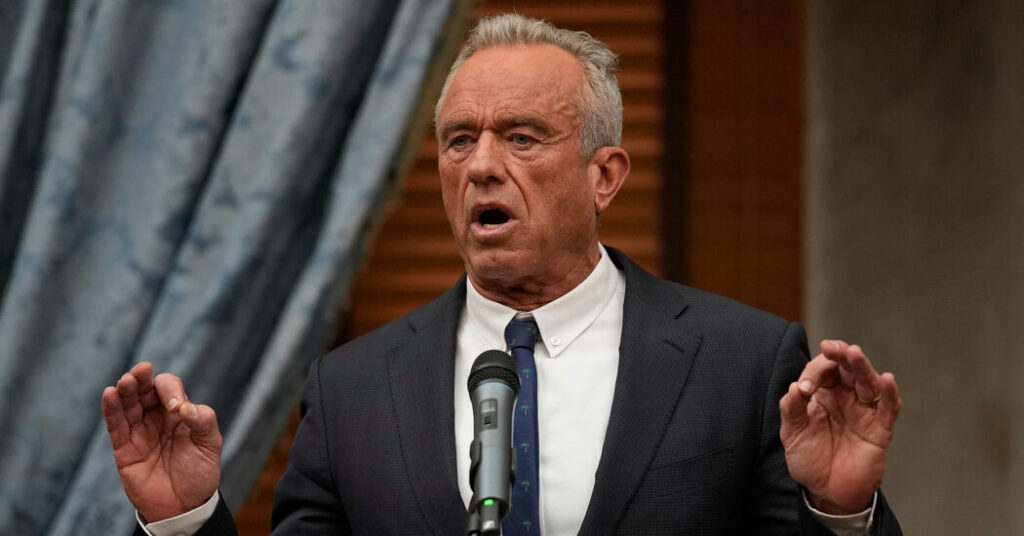
Health Secretary Robert F. Kennedy Jr., who is on a mission to change the way Americans eat, took steps on Thursday to fulfill that goal by making it easier for food makers to claim that they are not using artificial dyes in their products.
The Food and Drug Administration currently bars food makers from advertising that products contain “no artificial colors” unless they have no added dyes of any kind. But Mr. Kennedy and F.D.A. officials announced that the agency would no longer enforce that rule, so long as companies are not using petroleum-based dyes.
The agency also approved beetroot red, a new color option, as well as the expanded use of spirulina extract, an existing color additive derived from a type of algae. Those approvals bring to six the number of natural dyes that the agency has authorized since President Trump and Mr. Kennedy took office.
“We are making it easier for companies to move away from petroleum-based synthetic colors and adopt safer, naturally derived alternatives.” Mr. Kennedy said in a statement.
The F.D.A.’s announcement comes as Mr. Kennedy travels the nation encouraging Americans to “eat real food.” On Thursday, he is scheduled to deliver a “fireside chat” at a cattle industry convention in Tennessee — an appearance that dovetails with his call for Americans to eat more proteins like steak, cheese and whole milk, while limiting carbohydrates.
“We’re asking people now, ‘Eat real food,’” Mr. Kennedy said Wednesday at the Tennessee State Capitol. “Eat protein.”
Mr. Kennedy made clear when he took office last year that changing the American diet was high on his priority list. He announced what he called a ban on artificial food dyes and said he had “an understanding” with major food manufacturers to remove petroleum-based food colorings from their products by 2026.
But the secretary has been unwilling to use the standard tools of government — regulation and legislation — to achieve that goal. Instead, he has relied on voluntary cooperation from food manufacturers. His peer-pressure approach has produced some results; big food makers including Nestlé and Conagra have signed on to the plan, though candy makers, who rely heavily on artificial dyes, have resisted his entreaties.
Sheryl Gay Stolberg covers health policy for The Times from Washington. A former congressional and White House correspondent, she focuses on the intersection of health policy and politics.
The post F.D.A. Relaxes Labeling Rules on Food Dyes as Kennedy Pushes Protein appeared first on New York Times.