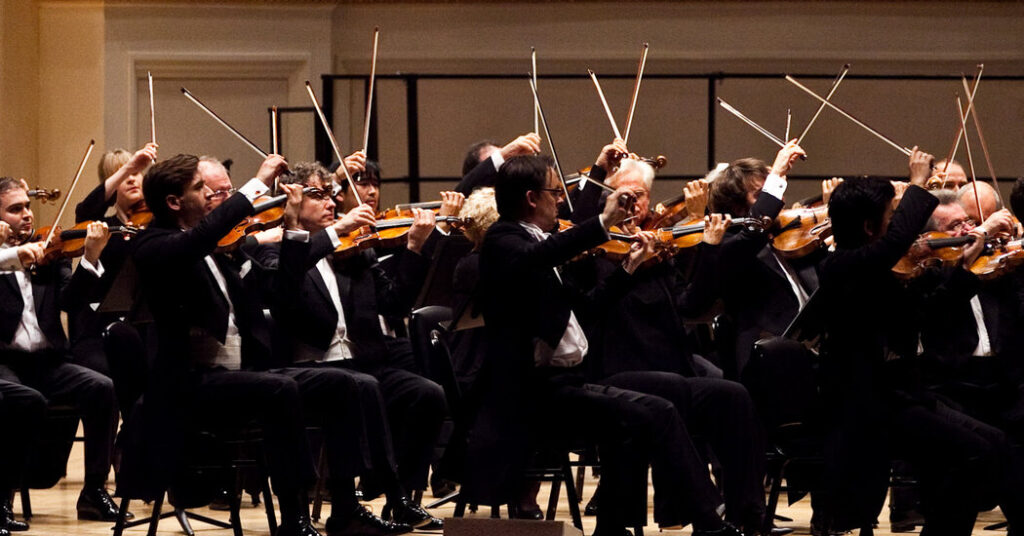
Carnegie Hall announced on Thursday that it will present Wagner’s entire, four-opera “Ring” in concert next March as part of its 2026-27 schedule, the first time in the hall’s history that it has staged the whole 15-hour epic.
The announcement came as Carnegie unveiled its coming season. The “Ring,” which will be performed over six nights, is an import from the Orchestra of the Zurich Opera House, conducted by its general music director, Gianandrea Noseda. “He is a fantastic Wagnerian conductor,” Clive Gillinson, Carnegie’s executive and artistic director, said in an interview.
Noseda is also the music director of the embattled National Symphony Orchestra, and has been at the center of the turmoil roiling the John F. Kennedy Center for the Performing Arts in Washington. The ensemble had planned to premiere Philip Glass’s new symphony there this season, but the composer withdrew it. Now that work, commissioned to honor Abraham Lincoln, will be performed at Carnegie Hall in January 2027 by the Orchestra of St. Luke’s, conducted by Dennis Russell Davies.
Among other highlights is a cycle of Mahler symphonies, led by Yannick Nézet-Séguin and performed by the Met Orchestra, the Philadelphia Orchestra and the Vienna Philharmonic. The Eighth Symphony, written for a large orchestra and multiple choruses, is too big for Carnegie and will instead be performed at the Metropolitan Opera House.
Yunchan Lim, a South Korean pianist and the youngest winner of the Van Cliburn International Piano Competition, will perform all of Mozart’s piano sonatas and fantasies. Igor Levit will do something similar with Beethoven’s piano sonatas in April 2027, as part of Carnegie’s programming for the 200th anniversary of the composer’s death.
“It’s the last time we’ll have a major Beethoven year,” Gillinson said. “We wanted to look at the extraordinary breadth of what he contributed as a composer. Beyond the symphonies.”
Below, critics for The New York Times pick performances they are looking forward to.
— Adam Nagourney
Berlin Philharmonic, Oct. 8-11
It can be easy to talk yourself out of buying certain concert tickets. But when considering the Berlin Philharmonic, the smart move is to get out your wallet and just go. That was the case when this orchestra and its chief conductor, Kirill Petrenko, performed at Carnegie in 2024. And it should prove wise again when they bring in their verismo-highlight show for the hall’s opening gala, along with concerts of works by Strauss, Tchaikovsky and more.
— Seth Colter Walls
Yunchan Lim and Igor Levit, starting Oct. 21
Yunchan Lim, a pianist of astounding technique and well-honed style, dedicates four concerts to Mozart’s keyboard works, and the formidable Igor Levit hosts a marathon of his own: 18 of Beethoven’s 32 piano sonatas, performed over four consecutive days next April. Some of the biggies don’t make the cut — there’s no “Moonlight” or “Hammerklavier” — but there are ample opportunities for Levit’s rigorous sense of architecture to shine.
— Oussama Zahr
Steve Reich at 90, Oct. 22
Steve Reich, one of the reigning American composers, turns 90 on Oct. 3, and Carnegie Hall will throw him a belated birthday party with a starry group of artists, including Nico Muhly and Bryce Dessner. “Two Pianos,” which was supposed to premiere in a 2024 concert at Town Hall that was canceled, will finally be heard in New York, as will “In All Your Ways,” fresh off its world premiere earlier in the month.
— Joshua Barone
Jean Rondeau, Nov. 6
Set aside your preconceptions about what a harpsichord can do when this rising star takes the stage. Known for his emotional candor and ability to coax unexpected sonic richness from period keyboard instruments, Rondeau offers a program of Rameau, Royer, and Louis and François Couperin — composers whose music reveals the French Baroque at its most rhapsodic, stormy and brilliantly intricate.
— Corinna da Fonseca-Wollheim
Aigul Akhmetshina, Nov. 11
When the mezzo-soprano Aigul Akhmetshina spoke with The Times in January, she broke into song while discussing the role of Carmen, weaving Nina Simone and Foreigner into the conversation. Operagoers who only know the velvety-toned singer as Bizet’s femme fatale will see more facets of her personality in a program of standards (“Misty”), musical theater (“West Side Story” and “Funny Girl”) and art songs by Britten, Satie and Rachmaninoff.
— Oussama Zahr
Jupiter Ensemble, Nov. 17
Performances by the Jupiter Ensemble all but guarantee two things: surprising, endlessly beautiful repertoire, and ensemble playing in its purest form. There is an electric dynamic between the lutenist Thomas Dunford and the mezzo-soprano Lea Desandre, partners in music and life, but the closeness of vision and artistry extends throughout the group, which brings passionate devotion and daring improvisation to early and Baroque works, and even some scores of today.
— Joshua Barone
Rihab Chaieb, Nov. 18
On opera stages, this Tunisian-born, Montreal-raised mezzo-soprano is celebrated for her searching portrayals of complex heroines, notably Carmen. In recital, Chaieb joins Ammiel Bushakevitz, one of today’s most compelling collaborative pianists, in a program exploring lived and imagined visions of the Orient. French songs by Saint-Saëns and Aubert meet Judeo-Spanish selections by Osvaldo Golijov and Arabic classics, including Fairuz’s haunting “Li Beirut,” a plea for peace amid war.
— Corinna da Fonseca-Wollheim
Lukas Sternath, Jan. 27
This young Austrian pianist, a rising star in Europe, brings a mature vision to his performances, with a gift for letting lyrical passages sing as if they were being played by a string quartet. He is, in other words, something of a poet, which should suit the program he is bringing to Weill Recital Hall: Schubert’s “Wanderer Fantasy,” the second set of Liszt’s “Années de Pèlerinage” (“Years of Pilgrimage”) and Liszt arrangements of Schubert songs.
— Joshua Barone
Vikingur Olafsson, March 2
The elegantly expressive pianist Vikingur Olafsson has programmed statement pieces like Bach’s “Goldberg” Variations for Carnegie Hall’s main auditorium. There’s something to be said, though, for small pleasures. Next season he dips into his recording catalog for briefer material by Debussy, Rameau and Philip Glass. Part of Olafsson’s magic is the way he can make a disparate collection of colorful, exquisite and driving selections hang together as a cogent whole.
— Oussama Zahr
Jlin and Third Coast Percussion, March 6
The electronic music composer Jlin has a strong relationship with the quartet Third Coast Percussion, which issued her Pulitzer Prize finalist “Perspective” in 2022. Yet before and after that release, Jlin put out her own interpretations — revealing a certain fluidity of creative practice. So when these acts team up for a show at Zankel Hall, there’s a possibility that we’ll hear a new, collaborative iteration.
— Seth Colter Walls
Quatuor Ébène, March 23
Years of unorthodox programming and cross-genre collaborations have sharpened this ensemble’s sense of adventure. Next season, Quatuor Ébène brings its responsiveness, wit and lucidly elegant sound to the entirety of Beethoven’s string quartets. Each program places early and late works side by side, setting the melodic freshness of Op. 18 against the inward, searching chromaticism of pieces from the composer’s final years.
— Corinna da Fonseca-Wollheim
Maxim Vengerov and Martha Argerich, April 23-25
As a veteran virtuoso, the pianist Martha Argerich can now pull a standing ovation just by striding onto the stage. When she arrives with Vengerov to play all of Beethoven’s violin sonatas across three evenings, it will have been nearly a decade since her previous, thrilling Carnegie visit. For a sense of these musicians’ rapport, listen to their recording of Shostakovich’s Piano Trio No. 2 with the cellist Gautier Capuçon. Excitement is justified.
— Seth Colter Walls
The post Carnegie Hall’s New Season: What We Want to Hear appeared first on New York Times.