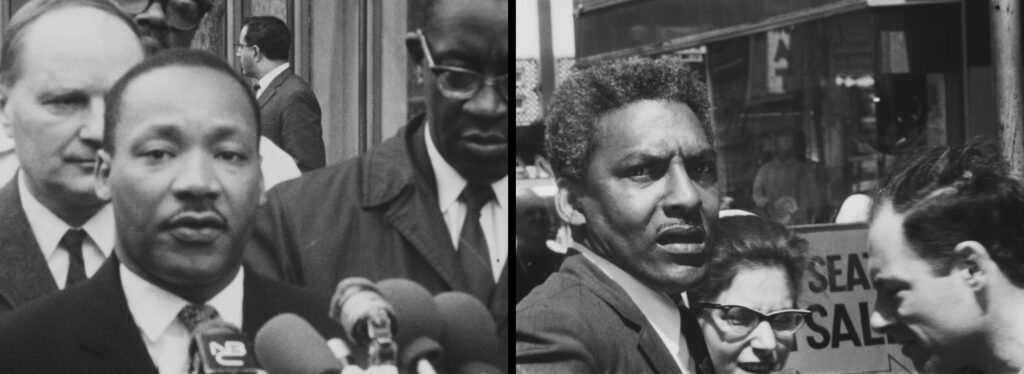
The most striking moments in Kameron Neal’s 2023 video installation “Down the Barrel (of a Lens)” are freeze-frame shots of people on the street, protesting war, racial inequality and abuses of state power. Culled from thousands of New York City police surveillancefilms made in the 1960s and ’70s, Neal’s portrait of America occasionally stops time, arresting the historic 16mm footage to pick out a face and humanize a lone, anonymous actor in this country’s ongoing struggle for equality, fairness and decency.
The video, seen on two screens facing each other in a darkened room, won the 2025 Outwin Boochever Portrait Competition, a triennial contest administered by the Smithsonian’s National Portrait Gallery. Along with other winners and finalists from the Outwin competition, which began in 2006 after a gift from Virginia Outwin Boochever, Neal’s work is on view at the Portrait Gallery through the end of August. But if you want to see it, go now. The Trump administration has been threatening the Smithsonian’s independence, and it isn’t inconceivable that it might try to pressure the museum into removing it. This powerful work of art doesn’t just recall history, it indicts our present moment of state power once again acting with impunity.
Neal’s prizewinning work isn’t a portrait in the limited sense that many people may use the word. It isn’t focused on a single person, and it isn’t a traditional representation, such as a painting, photograph or sculpture. But his use of freeze-frame makes strangers from a half-century ago suddenly feel familiar and deeply human, isolating and humanizing them for a few fleeting seconds like traditional portraiture, which gives this work an uncanny and disturbing relevance to our current, spiraling moment of protest and repression. It is a collective portrait, punctuated by moments that single out individuals, much as events in Minneapolis have made individual victims of federal officers and agents suddenly and tragically famous.
The faces that emerge challenge the viewer like one of the most famous freeze-frames in cinema, the last few seconds of Francois Truffaut’s 1959 film “The 400 Blows.” Truffaut uses the device to implicate his audience in the suffering and vulnerability of the film’s central character, Antoine Doinel, a troubled 14-year-old boy who is spiraling into a life of petty crime and delinquency. For a brief, harrowing moment, Doinel stares directly at the viewer with the imploring gaze of a needy child. Have we seen enough of this boy’s life to have empathy for him?
This heartrending moment helps clarify the power of photography, and the particular power of the photographic portrait. Cinema has the dynamism and messiness of life, while photographs, especially photographs of the face, can distill, clarify and pose fundamental questions. Among them is a question millions of American are asking after seeing images of citizens killed by federal agents in Minneapolis: Who is human?
That question pops up throughout the almost half-hour length of “Down the Barrel (of a Lens),” the title of which plays on the analogy between guns and cameras as tools and weapons, which can be used both to enforce and resist raw power. Neal, who is based in Brooklyn, made his portrait based on material he discovered as an artist in residence in New York City’s Department of Records from 2021 to 2022.
“When I think about what is protest designed to do, in many ways, its function is to stop and slow down time,” says Neal, in an interview with The Post. Protesters go into the street to call a timeout from some intolerable state of affairs. “The freeze-frame is a good device for that.”
From the 1960s to the 1980s, police made thousands of films of people at marches, protests and public gatherings, until the blanket surveillance technique was ruled unconstitutional. The archive, now digitized, includes people milling about, giving the finger, holding signs and often directly engaging the police who are filming them.
The 1960s and 1970s were a period of increasing public anger directed at police in New York. A commission set up to investigate corruption in the department found it so rampant that it divided the bad cops into “grass eaters” and “meat eaters,” the former engaged in widespread, everyday demands for bribes and small payoffs, the latter focused on more aggressive, organized and lucrative shakedowns, graft and peculation. The Knapp Commission, which inspired films like Sidney Lumet’s 1973 crime drama “Serpico,” starring Al Pacino, found not just corruption, but a culture of corruption, in which officers felt peer pressure to be on the take as a condition of social inclusion within the force.
So, Neal’s portrait isn’t just a portrait of protesters, or a prescient reminder that if no one is watching the watchmen, the watchmen will go rogue. It is a portrait of entrenched distrust between the people and their supposed protectors, a distrust that persists unabated in communities of color, which suffer disproportionately from a culture of violence still deeply rooted in too many police forces around the country.
Neal’s work also shows the police occasionally filming themselves, capturing casual, sometimes loutish behavior. Cultures of corruption create cultures of impunity, which have a habit of leaving detailed records of their crimes. When people feel beyond accountability, they are free to behave in ways that undermine their own humanity. They smirk, scoff, curse and mock, degrading themselves beneath the baseline of common human decency. We see it in Neal’s portrait and with shocking frequency in videos of ICE and other federal officers acting like thugs, now a staple of social media.
A half-century later, the cameras are again collecting evidence of Americans appalled by the abuses of those who supposedly serve them. But there is a striking difference between the films Neal culled for his black-and-white picture of America and the cellphone images emerging today. In video circulating now, the protesters have faces, while the federal agents wear masks.
Trump administration officials, including ICE’s acting director Todd M. Lyons, have defended face covering as a defense against doxing and harassment. But being faceless isn’t just about anonymity. It stokes fundamental and primal fears about what it means to be human.
It’s curious that when the Knapp Commission wanted to classify corruption, it turned to zoological analogies: grass eaters and meat eaters. The reference to animals was probably unintentional. But faces humanize, which is why we are so reflexively drawn to portraiture. And right now, faces and portraiture have extraordinary power. Renée Good and Alex Pretti — American citizens shot at point-blank range by federal agents — are no longer just two faces among some 340 million other Americans. They are forcing us to think about our collective portrait.
Portraits help us classify living beings. They can discover the humanity in animals, and the animality in humans. As Americans use their cellphones to make a new, collective self-portrait, the question is: Who will show their face and rise above the bestial?
The post An award-winning portrait asks Americans, ‘Who is human?’ appeared first on Washington Post.