If only this were a game of musical chairs.
But in the competition for curbside parking after a blizzard, the rules aren’t as clearly defined, occasionally leading those who are left circling the block without a space to retaliate against the “winners.”
After the sprawling snowstorm last month, a brawl over a parking spot left a Philadelphia man in critical condition; another argument, this time in Pittsburgh, led to a police response and a car was buried in snow; and in Boston, a man was accused of stabbing two people over a disputed space.
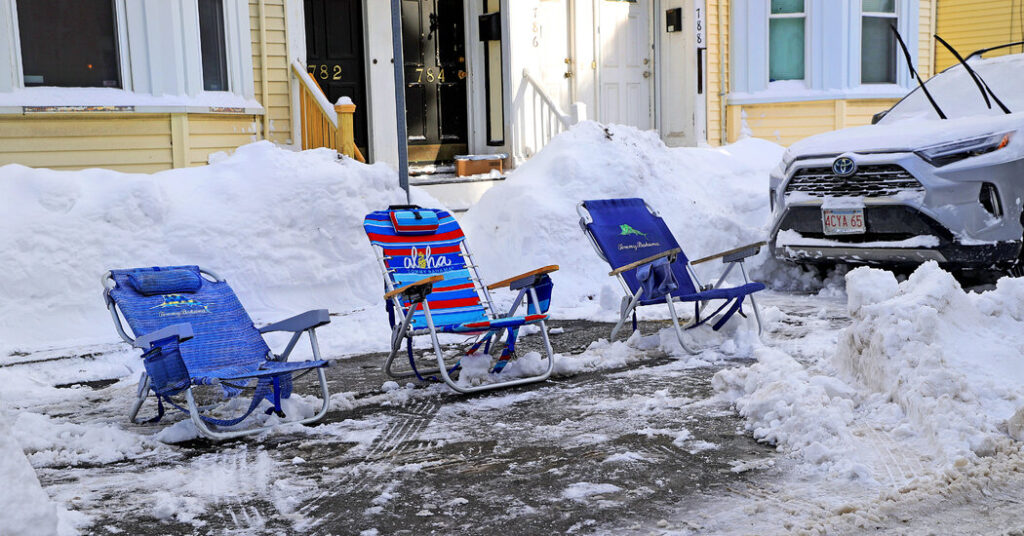
Whether you call it “dibs” or “savesies,” many cities in the northern United States have unwritten rules after snowstorms: The parking space belongs to the shoveler. Those spots are often saved with household items — chairs, tables, garbage bins, mattresses, and sometimes more elaborate displays.
All over TikTok, videos of the snow parking wars and perceived violations had viewers commenting with gleeful schadenfreude as spot-stealers got their cars covered in snow or water that would soon ice over. Millions tuned in, including some from warm-weather states such as California and Texas and as far as Greece and Nigeria.
In Boston, space savers can remain in a shoveled spot for up to 48 hours after a city-declared snow emergency. In Chicago, personal property isn’t allowed on “public ways,” but “dibs” are a longstanding tradition there.
The practice is similarly prohibited in Baltimore, New York, Philadelphia and Pittsburgh, as public streets are government property. Philadelphia police officers began a “NoSavesies” campaign a decade ago, to mixed success. In Pittsburgh, the “parking chair” seems to reign supreme.
Sanitation crews are often called upon to remove the space savers, and “dibs” won’t get a car owner far in a court of law.
“Don’t do it,” Mayor Brandon Scott of Baltimore said in late January after the monster snowstorm. “If I see your chair, it’s coming with me and going into the trash.”
But tradition leaves unwritten neighborhood etiquette often clashing with city codes.
After the storm, Torrie Kim, a pharmacist in Baltimore, said she shoveled out her car to be ready the next morning. When she left for her job at a hospital, she didn’t save the space.
“I don’t feel entitled to that spot just because we shoveled it out,” Ms. Kim said. “The whole neighborhood is first-come, first-serve. People come and go all the time.”
When she returned that night, she circled the block until finding a spot with a trash can. One of her passengers removed it, and she drove in. She woke the next morning to find feces smeared across the windshield of her white Mazda crossover S.U.V. It was also scooped and stuffed in her door handle.
“I wasn’t trying to be malicious and take their spot and discredit all their hard work,” she said, “but I think smearing dog feces on someone’s car felt very extreme and unsettling.”
Ms. Kim posted the video of her car on TikTok.
“I just don’t think that using a chair or a trash can on a public street guarantees a spot hours later,” she said. “I didn’t expect my spot to be open when I got back.”
For drivers unsure what to do, etiquette experts recommend following tradition.
“If you are new to the neighborhood and a snowstorm is coming, ask your neighbors what they do to prepare,” said Lizzie Post, the great-great-granddaughter of Emily Post, and the co-president of the Emily Post Institute, an etiquette firm in Waterbury, Vt., run by descendants of the 20th-century doyenne of manners.
Ms. Post suggested adding a personal touch to help ward off any potentially combustible situation, like a sign that grants someone else permission to remove the space saver, and says when you’ll return.
“It could allow them to have more options with the situation,” she said, “where they end up not impeding on what you’re hoping to achieve, but still getting to use the space themselves.”
That’s precisely what Aeriel Burtley did in Midtown Manhattan, of all places. Ms. Burtley, who works at a nonprofit, woke up early to shovel out her spot, which was occupied when she returned home from work that night.
When she needed a spot the next day, she took another well-shoveled spot. It was not saved, but she left a note on her car.
“Nothing elaborate, just a quick acknowledgment that I saw their work, an apology for taking their spot, and a promise to be out by 5:30 p.m.,” Ms. Burtley said. “It was the kind of gesture I wish I’d received when my spot was taken.”
She moved her unharmed car well before 5:30.
“It was such a small thing, a few sentences scribbled on paper, but in a city where winter parking can bring out the worst in neighbors, it felt like it mattered,” she said. “Sometimes, a little acknowledgment of someone else’s effort goes a long way.”
Adeel Hassan, a New York-based reporter for The Times, covers breaking news and other topics.
The post All’s Fair in the Snow Parking Wars appeared first on New York Times.