The deepest Jessie Diggins ever descended into the pain cave was on Feb. 20, 2022, the final day of the Beijing Winter Olympics, when she raced in the women’s 30-kilometer freestyle cross-country skiing event. The conditions at the National Cross-Country Skiing Center in Zhangjiakou were brutal. The trails in northern China were nestled in the valleys of a dry mountainous landscape. Siberian winds whipped in from the Lake Baikal basin and the Mongolian steppe, blowing snow across the course. The day before, the minus-21 wind chill and the 30-mile-an-hour gusts forced Olympic organizers to cut the men’s 50-kilometer race nearly in half.
But the conditions for Diggins, who had covered her nose, cheeks and earlobes with kinesiology tape to protect against frostbite, were even worse than they were for her 62 competitors. About 30 hours before the start, she became violently ill from what she believes was food poisoning. She couldn’t keep down food or liquid. The morning before the race, she couldn’t complete a 10-minute jog and instead climbed back into bed and cried. She called her parents: “This isn’t how it’s supposed to be,” she told them.
There were expectations now. Four years earlier, Diggins and her teammate Kikkan Randall had put the cross-country world on notice by winning an Olympic gold medal, America’s first ever in cross-country, in the freestyle team sprint event. And Diggins, who is now 34 and the best cross-country skier in American history — in a sport that might feature mankind’s fittest competitors — had shown that while her skiing technique may lack the traditional excellence of the world’s top skiers, no one was better at enduring the pain her sport demands. Competitors who hoped to win a medal knew they would have to battle Diggins for it.
Her body slowly came back to life that evening — she ate bananas and peanut butter and oatmeal; she sipped electrolyte-heavy sports drinks; she rode a spin bike — and the next morning she decided she had to race. On the bus to the course, Diggins opened an email from her mother. “You don’t have to do this,” Diggins recalls her mother writing. “You don’t owe anyone anything. If you go out there and decide to start, do it with a full heart. Because you love what you do.”
Her mom’s email had a calming effect. Racing that day wasn’t about fulfilling outside expectations; it was only about trying to satisfy her own. “In my head, I’m like, Pressure’s off!” Diggins says she thought at the starting line. “The fact I’m standing here is an absolute miracle.”
Less than half a kilometer into the race, which consisted of four loops around a 7.5-kilometer course, another skier cut her off and she crashed. A bad start, but she managed to push herself toward the front. Feeling no obligation to finish, she felt freed.
‘This is the healthiest sport in the whole world — except at the very top of the sport. The way we do it is maybe not that good for us.’
Diggins closely tracked the leader, the Norwegian star Therese Johaug, but at a feed zone less than halfway through the race, where coaches handed out fluids and high-calorie gels to the racers, Diggins made a mistake. As Johaug sped through the feed zone, Diggins turned away while grabbing a high-carbohydrate drink. By the time Diggins looked up, Johaug was out of reach.
This was a problem: On such a windy day, drafting behind another skier could make a huge difference. The slipstream created by closely following another skier would allow Diggins to conserve energy while maintaining speed. “Do not ski alone!” Diggins’s coaches shouted at her. But there she was, exposed, by herself in second place, 48 seconds ahead of the next skier.
Around that time, Diggins felt a twinge on the inside of her knees, the first sign of cramping. Slowly the rest of her body cramped — legs, hips. As she passed her coaches, she was so disoriented she had to ask one of them what lap she was on. “That’s not a good sign,” Diggins says. By the fourth and final lap, coaches from the U.S. and other national teams cheered encouragement: They could see that Diggins’s body was failing.
Her vision turned pink. Sound was muffled. Sports scientists describe this as a body in crisis. “It’s all overwhelmingly trying to stop her from moving forward any longer,” says Rui Li, an associate clinical professor of exercise science at Northeastern University in Boston. Her muscles were depleted. Most likely she was experiencing dehydration, and possibly hypoglycemia.
“My best races, there’s no noise,” says Liz Stephen, a former Olympic skier and a mentor to Diggins. “A lot of people lose sound. They lose their sensory experience. Taste, smell, sound, those things go away. Even vision. It’s just what you’re focused on, kick and glide. My world becomes very bubbled.”
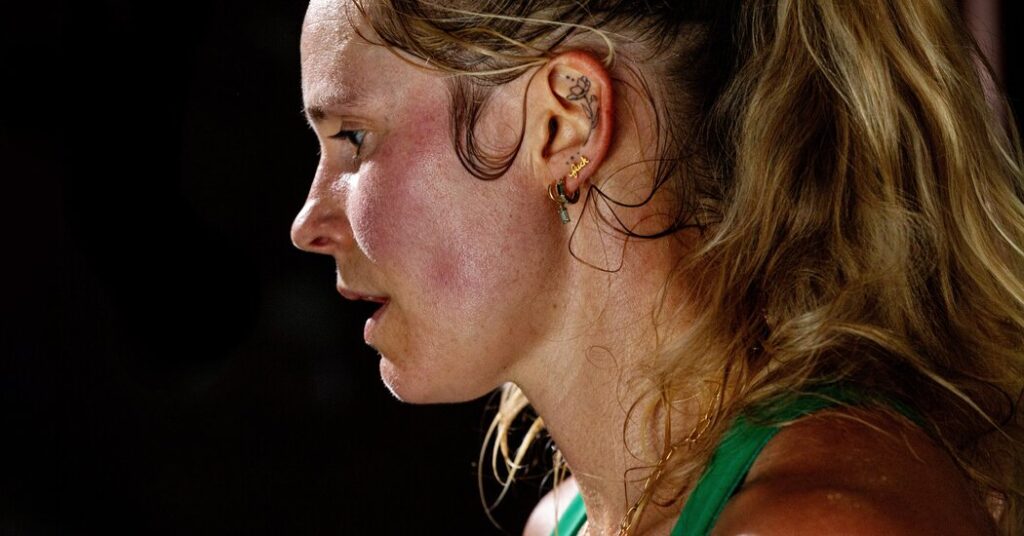
When Diggins crossed the finish line in 1 hour 26 minutes 37.3 seconds — nearly a minute ahead of the bronze medalist, which made her the first non-European to medal in that event — she collapsed, skis split akimbo, face in the snow, a marionette whose strings had been cut. Her eyes were open, contacts frozen to her eyeballs, but she couldn’t see. Her breathing was a shallow panting. At first she didn’t know where the sound was coming from. “Then I realized, Oh, my God, that’s me,” she says.
When she tried to stand, she collapsed again. Two minutes after she had finished her race, she was carried to a warming hut and gently laid next to a space heater. She now says she probably should have been taken to the hospital. Instead, she managed to climb the podium to receive her silver medal.
But she was not well. “I was falling apart, in bed 15 hours a day,” Diggins says. “I finally went home and rested for two weeks to feel like myself in my body again. You only have so many of those races in the tank.” That was four years ago, at her last Olympic race. Now, as she heads into this month’s Winter Games in Italy, Diggins thinks back to that race as the moment that made her question how far is too far. “I’m glad I know I can dig that deep,” she says. “But I should not.”
Sports scientists agree that few sports test the human body more than cross-country skiing. A research paper from 2017 on the physiological capacity of the best cross-country skiers, one of whose authors is the sports director at the Norwegian School of Elite Sports, is subtitled “Approaching the Upper Limits of Human Endurance.” Clay Diggins, Jessie’s father, has another way of putting it: “If you had the 100 most-fit people on the planet in one room,” he says, “Jessie would be in that room.”
There are two principal reasons for the superior conditioning of cross-country skiers, according to Laura Richardson, a clinical exercise physiologist at the University of Michigan School of Kinesiology. First, theirs is a quadrupedal sport, with arms and legs working hard at the same time, along with core and back muscles. Because the body’s cardiovascular system is not accustomed to serving those large muscle groups simultaneously at high rates of exertion, they all compete for the available blood. Over time, the body adapts by increasing blood volume, so the heart pumps more blood with each heartbeat. This sends more hemoglobin with oxygen throughout the body. As a result, most elite cross-country skiers like Diggins have an especially powerful heart muscle and an especially large and strong left ventricle to pump out more blood per minute. The mitochondria in muscle tissues — the powerhouses of the cell — in turn grow in size and in numbers to handle the rise in oxygen.
All these changes improve aerobic capacity as measured by the maximum volume of oxygen, or VO2 max, that the body can use during intense exercise. A higher VO2 max means a greater capacity to use oxygen to produce energy, which enhances endurance.
‘She’s one of the best at getting exhausted, and one of the best at continuing after she’s exhausted.’
There are other quadrupedal endurance sports, like swimming and rowing. But swimmers and rowers don’t have to race up and down hills, and because swimmers are buoyed in water and rowers sit upright, in neither sport does body weight have the same impact as it does in skiing. A skier’s body also has to work harder in the cold.
The second reason for the superior conditioning of elite cross-country skiers is that their sport by its nature is interval training. High-intensity bursts of activity are interspersed with lesser-intensity recovery periods; this increases aerobic capacity. Going up hills typically takes up a third of the average course’s length but half of a skier’s time on the course; that’s where the body works the hardest. During a race, cross-country skiers have to be able to perform steadily at a near-peak of aerobic exertion throughout the entire course while also surging to peak anaerobic power on the hills.
“That’s their challenge: Their body has to constantly have the energy to shift between the relative contribution of these energy pathways,” Rui Li says. “It demands remarkable stamina and endurance. Then on the other hand, you have to be able to handle the repeated supermaximal muscle-power output on the climbs. You have to excel at both aerobic and anaerobic extremes.”
In addition to requiring a strong physiological engine, cross-country skiing demands technical mastery. The sport has two main disciplines: classic, which includes diagonal striding in parallel groomed tracks that’s similar to running; and skate, a faster, more dynamic movement in which skiers bob in a U-shaped motion similar to that in ice skating. In skate skiing, the main techniques are V1 technique, a low gear for uphill in which the skier plants one ski and both poles simultaneously then follows with a single-leg push-off, and the elegant but complicated V2 technique, used on flatter terrain, which incorporates double-pole pushes while the body shifts from balancing on one gliding ski to the other. Diggins, who has finished first or second overall the past five World Cup seasons, is strongest in skate skiing, but last season, after more than 300 World Cup events, she finally won a classic race.
While Diggins lacks the brute strength of some of her Olympic peers and does not always make the best tactical choices, her ability to tolerate pain is her greatest asset. “She’s one of the best at getting exhausted, and one of the best at continuing after she’s exhausted,” says Thomas Losnegard, a skiing professor at the Norwegian School of Sport Sciences and head of the Department of Endurance at the Norwegian Olympic Training Center. “We think it’s fascinating that someone from the United States could actually beat a Norwegian.”
Sports science can tell you a lot. You can measure heart rates, VO2 max and lactate levels (which at high levels indicate a lack of oxygen), but it can’t tell you much about the root of Diggins’s stature in the sport. “Because,” says Oyvind Sandbakk, the sports director at the Norwegian School of Elite Sports, “you cannot measure mental capacity.”
Diggins discovered this superpower at 15, when as a freshman she was anchoring the final leg of a high school relay. Her teammates told her that she had to beat a particular skier from a rival high school who would be wearing a green race suit. But the rival team had more than 100 skiers, with multiple relay teams in each race, and Diggins was overwhelmed at seeing some 20 skiers wearing the same green race suit. She couldn’t figure out who she needed to pass, or even which green suits were on the third leg and which were on the final leg. Pushing herself in a way she had never done before, she passed all 20 skiers from the rival team, then collapsed at the finish thinking she was going to die.
“Then, 30 seconds later, it was, Oh — I’m not going to die,” Diggins recalls. “It was a huge lightbulb. This whole next level had been there the whole time, and I can access it if I am willing to push that hard. All it is is pain. It’s not permanent damage. I want to know what my true potential is. I never want to wonder, What if I had just been a little tougher mentally?”
But Diggins’s greatest strength can be her greatest weakness. The mental toughness that allows her to go deep into her pain cave also pushed her toward her darkest moments.
“Jessie’s gift, and her Achilles’ heel, is that her body is able to withstand so much,” says Julia Kern, her teammate and close friend. “Jessie’s ability to recover is so quick that her mind doesn’t give her a sign to stop.”
‘I want to know what my true potential is. I never want to wonder, What if I had just been a little tougher mentally?’
Growing up outside St. Paul, Minn., her mentality was “all gas, no brakes.” She was a fiercely independent child: “Now let me do it!” she would tell her parents. Diggins was a 4.0 student, a competitive swimmer, a virtuoso violinist; her parents had to force her to rest. In her bedroom, her only cross-country skiing poster was of a man skiing on a sandy beach, and she aspired to be that man: Bill Koch, the first American to win an Olympic medal in cross-country skiing, in 1976, and the only one until Diggins and Randall won gold in 2018.
“There’s people who are like, ‘A little bit is good, but a lot is probably better,’ and there’s a degree of that in her,” says Jason Cork, her longtime coach. “She’s someone who doesn’t go halfway.” Diggins acknowledges as much, saying of cross-country: “This is the healthiest sport in the whole world — except at the very top of the sport. The way we do it is maybe not that good for us.”
Even as a professional skier, Diggins challenges herself each year to do what she calls “the Big Stupid,” an extreme physical feat outside skiing. Last June, less than eight months before this year’s Olympics, she competed in the Broken Arrow Skyrace near Lake Tahoe, in California. She ran three races in three days, comprising more than 40 miles of trail running and three miles of elevation gain. Taking the three races together, she finished fifth among women.
Diggins is a naturally positive person. Her energy, as well as the race-day glitter she has long daubed on her face, inspired her teammate-given nickname, Sparkle Chipmunk. When in Norway, she organizes Bob Ross painting nights after picking up supplies at a favorite art-supply shop in Lillehammer; she encourages team sledding nights in Davos, Switzerland. Only through therapy did she learn that it’s OK to be upset, that it’s OK to not feel motivated some days.
Not long after turning down a scholarship at Northern Michigan University to pursue skiing full time, she sought treatment for an eating disorder. She suffered from bulimia, which she says was brought on by the thought she had to be tiny to be a great skier, but it soon morphed into an effort to find control in a life dominated by things she couldn’t control, from weather to opponents.
She entered the Emily Program, an eating-disorder treatment center in Minnesota. Her hardest moment came when she had to eat a quarter-pound hamburger and a handful of fries. She told her dietitian she couldn’t. Her dietitian said this was her exact caloric requirement. Diggins burst into tears. The others in the program finished their meals and encouraged her as Diggins sobbed for an hour. They left for their next session as the dietitian reminded Diggins that she couldn’t leave until she ate. After two hours, she finally ate the gross, soggy, cold burger, and she recognized her world hadn’t ended. When she walked into group therapy, the room burst into applause.
That experience made her a better skier. “People ask, How are you so gritty in a race?” Diggins says. “No matter how much pain I felt in a race, none of that compares to the pain I felt when I was struggling with my eating disorder. The way I talked to myself, that cruelty from my eating-disorder voice to me, I would never talk to another person that way. So just dealing with some physical pain in a race that has a defined finish line and end point, that’s not a big deal in comparison. When you’re really sick with an eating disorder, you don’t see a finish line. And you’re in some kind of emotional pain all the time. In comparison to that? Ski racing is not hard. It’s a privilege.”
A few years ago Diggins experienced a relapse. She had been winning races and living her childhood dream, but winning wasn’t providing fulfillment. Her response was to severely restrict her calories. She had always defined her eating disorder as bulimia, and because she wasn’t exhibiting bulimic symptoms, she says it didn’t occur to her that her eating disorder had returned: She looked in the mirror and saw someone healthy and strong where others saw someone who looked sick. Eventually the impact of her eating disorder on her body forced her to stop and take a break.
“Just because I’m very good at being in pain doesn’t mean I should be in pain,” she says. “In sport, with guidelines and a medical team and a defined finish line, that’s great. But in life, you can’t just push yourself through pain indefinitely. There’s a big difference between challenging your body and pushing hard because you want to and you’re excited to see what’s at the bottom of the well and at the back of the pain cave — that is different than punishing yourself.”
Diggins knows it would be easy to assume she races that way because she’s driven by demons. “No,” she says. “Because I’m free. Because I’m happy and joyous in my everyday life, I can put myself through all that pain. But if you’re already in pain, you can’t do that.”
‘No matter how much pain I felt in a race, none of that compares to the pain I felt when I was struggling with my eating disorder.’
The relapse, she believes, has better prepared her mentally for the 2026 Games. She doesn’t tie her self-worth to where she finishes in the standings. Surrendering to what was out of her control strengthened her, like a statement of faith. Now, instead of fearing race-day pain, she says she greets it.
“Like, thank you,” she says. “This is a sign that I know I’m giving this everything I have. Instead of pushing aside the pain, trying to ignore it, trying to pretend it isn’t happening, it’s like, Of course this is happening. I wanted this to happen. Because this is how I know I’m getting everything out of my body. And so when my vision tints pink, if my legs are going numb, if my lungs are burning, my muscles feel like I’m on fire, I will never live with regret.”
This weekend, when Diggins pushes off from the starting line at the Tesero Cross-Country Skiing Stadium in Northern Italy, this final Olympics for her (she announced late last year that she plans to retire after this season) will be the crest of what she and her coach call her “superpeak.” Diggins and Cork, her coach, meticulously planned her year of training leading up to the Games. Diggins is a Type A planner; last year’s list of life and training goals stretched to four single-spaced pages, detailing how she would improve her strength in double-poling, how she would maintain good recovery practices for her eating disorder and how she would integrate volunteer work into her schedule.
Her plans also included how to make the most out of the months when there’s no snow on the ground near her New England home. As they like to say in cross-country skiing, the best skiers are made in summer. Pushing then helps Diggins survive her grueling winters. While she lives out of a suitcase in Europe through the winter ski season, her offseason is mostly spent in a condo in southern Vermont, a great place for roller-skiing, with little traffic on the winding mountain roads.
But on one August morning last year, as she prepared for a training run on roller-skis, fine particulate from Canadian wildfire smoke filled the air; the occasional cars that passed had their headlights on at 8:30 a.m. “I don’t know how much of this air I should be breathing,” she said as she strapped on her roller-skis behind her Toyota RAV4. “This stresses me out a little.”
Diggins, her freckles pronounced from a summer in the sun, took off into the haze, bobbing in a U shape, her poles’ metal tips clicking against the pavement. But the day’s plan — roller-ski intervals in the morning, strength training in the afternoon — had to change. The air was too bad. Her lungs are her job, and like most elite cross-country skiers who have to work out in subzero temperatures, Diggins has sports-induced asthma. After a brief run up and down a hill, she took off her custom-made sparkly framed Oakley sunglasses, drove to Stratton Mountain School’s gym and hopped on a treadmill.
She ran five 10-minute intervals with two-minute rests between. She clicked the treadmill up to a 12 percent incline at five miles per hour, then sped up to nine miles per hour at a 1.5 percent incline. During rest periods, Cork pricked her finger to test her blood lactate levels. They wanted her to push hard, but not too hard: a Level 3 interval session out of five possible levels. Her lactate level came in lower than her coach wanted, but he trusted that Diggins knew her body. After three hard weeks, this was an easy week — “normal hard,” she said, nowhere close to the pain cave.
When the final interval ended, sweat poured off her, but her breathing quickly slowed; teammates are astounded by Diggins’s ability to recover quickly, whether from a bad cold or after a demanding hill. “She’s a unicorn,” Kern says. In six days, Diggins would fly to New Zealand with Kern for a few weeks on southern hemisphere snow.
After lunch and a nap, she returned for strength training. A big bruise was visible on her left shin, a vestige from a recent run in the woods when she and some teammates went bushwhacking off the trail and Diggins smashed her shin against a tree. For Diggins, these are all badges of pride: the bruise inside her legs from slamming against a metal plate during weighted pull-ups; a blackened big toe from the Broken Arrow Skyrace; a roughed-up upper-right leg from a roller-skiing fall; a crescent on her right knee from a collision with a rock while running down a grassy slope in Alaska during training camp.
As she warmed up on a spin bike, she talked about these Games and her post-Olympic plans: a few more World Cup events in Europe followed by her final World Cup race in Lake Placid, N.Y., in March. After that, there are plenty of things she wants to do in retirement: tend a garden, get a dog with her husband, run an ultramarathon. She wants to be home for Thanksgiving; she hasn’t done that since she was 16. She yearns for mundane things, like being able to wash her clothes when they’re dirty. When she’s on the road for four months straight during World Cup seasons, more often than not she does her laundry in the sink, then rolls her clothes in a towel to dry them.
“You know the book ‘The Giving Tree,’ by Shel Silverstein?” she said. “Horrible book. The tree just keeps giving and giving. If it had only given apples, it could have given apples forever. But the kid keeps coming back and saying, ‘Can I have a branch?’ ‘Can I have a limb?’ ‘Can I have all of you?’ And what is left is a stump. And essentially I had become a stump, because I hadn’t set limits. I just kept trying to say yes and give too much. This skiing world has given me everything, and I felt like I owed it to say yes to everything and be everywhere. I had to learn to just give apples. Now I feel my cup is full because I’m giving apples and I’m able to sustain that and I’m in balance.”
Even if the snowpack was light the following week at the Snow Farm near Lake Wanaka, in New Zealand, as her coach feared, no matter: one more thing out of her control.
She started her strength workout. Four sets of weighted pull-ups. Fifteen reps of back extension plate drops. Ten throws of a huge medicine ball.
She walked over to a set of stairs for a lateral stair hop, one-footed jumps whose combination of explosiveness and coordination are especially important for cross-country skiing. She bounded up the stairs and felt the pain: a grimace, then a smile.
The post ‘All It Is Is Pain’: The Olympian Testing the Limits of Endurance appeared first on New York Times.