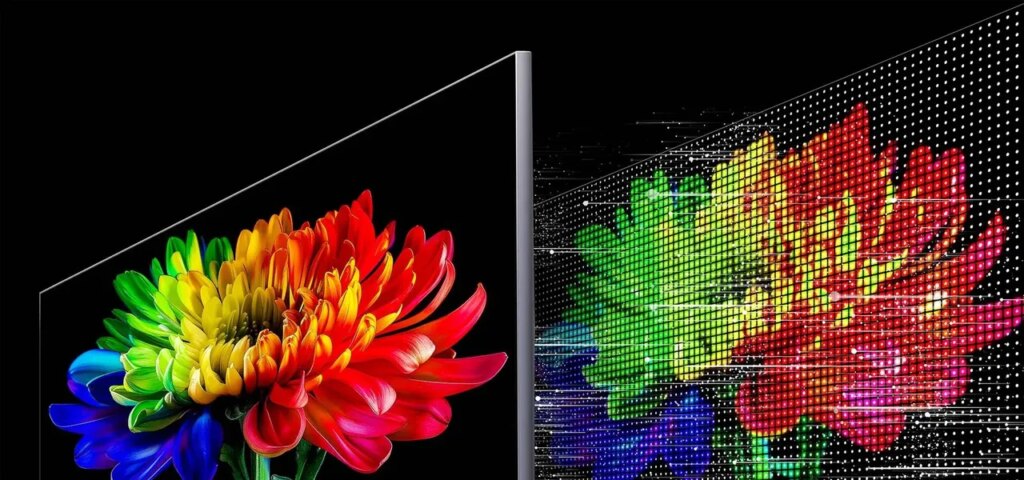
Not So long ago, TV display tech seemed to have almost stagnated. Now it’s moving so fast, even professional analysts can barely keep up. From quantum dots—tiny nano particles that enhance brightness and colors—to multi-stacked OLED panels that ramp up the power of self-emitting screens, today’s TVs are brighter, more colorful, and more capable than ever.
Now, a new TV technology has entered the fray, poised to change the paradigm once more. It’s a new kind of LED lighting system called RGB LED, and the secret behind its brilliance is in the colors. Last year I flew to Japan to investigate the early stages of the tech at Sony, and with this year’s surge of consumer-facing screens, I’ll help you understand a bit more about the tech and where you can look for it in 2026.
Updated February 2026: We’ve updated this post with the latest information about RGB display tech and the new models set for availability in 2026.
What Is RGB LED?
It’s all about the backlighting. Traditional LED TVs use white or blue LED backlights that shine through substrates like color filters and an LCD panel to create bright and colorful images. The best LED TVs use quantum dots for enhanced colors, multiple dimming zones (called local dimming), and thousands of increasingly small LEDs, called mini-LEDs, to increase brightness and combat light spillage. They still produce noticeable light bleed, which leads to contrast that’s less striking and nuanced than emissive light sources with a totally black backdrop, like OLED, where each of a screen’s millions of pixels is self-lit.
RGB LED panels are similar in concept to LED TVs, but instead of traditional white or blue LEDs, they use thousands of red, green, and blue LED backlight modules to produce “pure colors directly at the source,” according to Hisense, one of the first brands to unveil an RGB LED TV. This ability to produce colors at the light source in concert with color filters allows RGB TVs to produce a much wider color gamut (i.e. more expansive colors) than traditional LED, alongside enhanced backlight control and reduced light bleed for improved contrast. Hisense refers to this technique as “RGB local dimming,” as opposed to traditional LED-based local dimming.
The new breed of RGB LED TVs from Hisense, Samsung, and LG claim to provide color accuracy at an astonishing 95-100 percent of the next-gen BT.2020 color gamut spec. Sony’s RGB LED prototype, which I saw in its Tokyo labs last year, claims a similarly impressive 90 percent of the BT.2020 spectrum. In contrast, most of the traditional LED and OLED TVs we test top out at around 80-85 percent of this color space, and many fall way below that number. That may not be as important in the current TV landscape, where real-world content mastered for this color space is limited, but that will no doubt change in the near future.
In the brief time I’ve spent with these new panels at the Consumer Electronics Show (CES) and Sony’s labs, RGB’s advantages over traditional LED TVs in contrast, blooming control, off-axis performance, and color saturation were impressive. While it still can’t match the deep blacks or nuanced contrast of emissive screens like OLED, RGB tech has another powerful weapon that could be just as integral to its success: searing brightness.
RGB vs OLED and QLED: The Brightness Wars
It’s hard to beat OLED TVs for sheer picture performance right now. OLED’s blend of perfect black levels, near-infinite contrast, excellent off-axis viewing, and expansive colors powers the best TVs you can buy. Yet for all its advantages, OLED has limitations—namely, brightness levels that can’t match the most potent LED TVs, let alone the new era of RGB displays.
That might sound dismissive, considering that the best OLED TVs are already fantastically bright in a vacuum. The latest OLED panels in 2026 flagships from Samsung Display and LG Display claim to get as bright as 4,500 nits in very small windows. Like last year’s “4,000-nit” panels, this will likely translate to much lower peak brightness for real-world content, with the top OLEDs from 2025 topping out closer to 2,000-2,200 nits in regular testing, but that’s still a lot of pop.
Traditional mini-LED TVs with quantum dots, or QLED TVs, maintain a notable brightness advantage, with accessible models regularly hitting 4,000-5,000 nits peak brightness in real-world content, and some high-end QLED models claiming even higher brightness specs.
The RGB LED TVs we’ve seen so far take things even further, with current models claiming a stunning 8,000-10,000 nits peak brightness. Like their color gamut specs, this is overkill for our current TV pipeline, with most content currently mastered at a maximum 1,000 nits peak brightness for streaming, and top Blu-rays at a max 4,000 nits. Even as the content catches up, I’m not sure 10,000 nits will ever be necessary (or watchable) in anything but the tiniest of highlights, but higher peak brightness usually equates to higher full-screen brightness, or APL (Average Picture Level), which still has some room to grow.
RGB LED’s potency also likely contributes to its color accuracy, in concert with their ability to produce colors directly at the light source. As Sony engineer Hugo Gaggioni put it, brightness when properly controlled “becomes a new color accuracy weapon.” That’s a big reason we’re seeing an explosion in TV panel innovation across the industry.
Sony goes beyond brightness in comparing RGB to OLED, boasting its next-level color gradation control. As Sony puts it, “The [RGB LED] system can achieve what is challenging for existing OLED panels: the expression of colors with moderate brightness and saturation.” In other words, colors can look more accurate, even in low-lit scenes. In the few scenes I saw at Sony’s RGB LED demo, the panel clearly outclassed the previous Sony OLED flagship, the A95L, in color saturation. The OLED display still held the advantage in black levels and image focus, but it was an impressive demonstration of RGB LED’s skills.
Brightness and color accuracy aside, RGB LED may also be a good alternative for those worried about OLED burn-in. OLED’s makeup of organic compounds can more easily degrade at different rates over time, leading to potential variations in brightness and color. Burn-in is increasingly less common in modern OLEDs, so it’s not something we worry about for most viewers, but it remains a concern over the life of an OLED display, especially for high-volume gamers where static images are consistently onscreen.
Micro RGB vs Mini-LED RGB
Until recently, the word “micro” has been almost exclusively used by display makers like Samsung and Hisense to describe the self-emissive display technology aimed at taking on (or even displacing) OLED called Micro LED. Like OLED, Micro LED displays can achieve perfect black levels thanks to their ability to control each of their millions of pixels independently, but they’re incredibly difficult to produce, and you’ll currently pay a king’s ransom to get one.
In the new RGB landscape, Samsung uses “micro” to describe its non-emissive RGB backlight system, “Micro RGB,” which sits behind a liquid crystal display like other RGB TVs. (Yeah, it’s confusing.) The key difference is that Samsung’s tri-colored light clusters appear to be smaller than their RGB counterparts that use mini-LEDs. Samsung claims a measurement of less than 100 μm (microns) for its RGB backlight modules, which is less than the width of a human hair. LG also uses the term Micro RGB for its new RGB TVs announced ahead of CES 2026. LG says its Micro RGB evo TV uses “countless micro RGB lights, smaller than MiniLEDs.”
Just how much smaller Micro RGB backlighting is than mini-LED RGB modules from other brands may vary depending on which RGB TVs you compare.
After seeing Samsung’s first Micro RGB TV at CES 2025, I reached out to the brand for more info about its new tech. “Unlike conventional LED TVs that rely on white backlighting, this product uses micro-sized RGB (red, blue, and green) LEDs to control each color independently,” said Lydia Cho, head of product for home entertainment at Samsung Electronics America. “This results in sharper, deeper, and more vibrant colors than ever before. This breakthrough technology marks the future of display technology, specifically showcasing the potential for even more color accuracy and vibrancy.”
Again, as wonky as these naming conventions are, these Micro RGB displays are not self-emissive, meaning they can’t achieve the same perfect black levels or granular contrast as displays like traditional Micro LED and OLED.
Micro RGB TVs should still offer better contrast than their mini-LED rivals, as their smaller size can theoretically offer more dimming zones for better overall black levels. They may also more readily provide naturalistic and granular color shifts, though we won’t know just how much better or different they are until we’ve spent more time with each variety. Samsung’s 2025 prototype was impressive in the short time I spent with it, with fantastic colors, clarity, and brightness. You can currently buy Samsung’s first Micro RGB TV in a 115-inch size for a cool $30,000, but 2026 will see more accessible sizes and (presumably) pricing.
What Is RGBY LED?
Just as we’re all getting our heads around this new era of RGB LED backlighting, Hisense moved the needle once again. After pushing RGB LED backlighting into the spotlight at CES 2025, the company used CES 2026 to reveal its new 116UXS RGB mini-LED TV that adds a new color substructure to RGB’s red, green, and blue modules with the introduction of cyan. (This is not to be confused with Hisense’s new emissive Micro LED TV, which also uses cyan in its color architecture.)
“Cyan sits in the part of the spectrum where human vision is most sensitive to subtle changes and its addition allows the 116UXS to render gradients, tones and transitions with a level of nuance that feels more natural and lifelike,” said Hisense in its press release. The TV is claimed to go above and beyond current RGB LED tech with a stunning 110 percent coverage of the BT.2020 color spec, as well as audio extras like a Devialet Opéra de Paris 6.2.2-channel audio system. We don’t know much more about it or its backlight tech right now, but expect it to come with a very high price tag if and when it becomes available.
What About SQD LED?
TCL was one of the few major panel makers that did not showcase an RGB LED TV at CES 2026. Instead, the company touted another new display technology that advances today’s many quantum-dot-enabled (or QLED) displays, called Super Quantum Dot mini-LED. Debuting with TCL’s new 85-inch X11L SQD mini-LED TV, the new tech blends traditional blue mini-LED backlighting with “newly formulated” Super Quantum Dots, and a new UltraColor Filter.
The TV offers similarly stunning specs to top RGB LED TVs, including up to a claimed 10,000 nits peak brightness and 100 percent of the BT.2020 color spectrum—though the brand also notes the latter is based on “typical performance of tested units” and that “actual results may vary.” TCL goes on to say its new display tech minimizes color artifacts when compared to RGB LED TVs, and that the X11L’s WHVA 2.0 panel is designed to provide a “wide color viewing angle” and enhanced contrast for deep black levels to better compete against OLED displays.
While I haven’t seen the X11L in person yet, it made a big splash at the show, promising to be an exciting new competitor to RGB LED in this rapidly evolving market. The X11L SQD TV is available now in 75-, 85-, and 98-inch sizes starting at $7,000.
RGB TVs You Can Buy in 2026
One of the most exciting things about RGB LED is that it’s already here. In fact, Hisense began selling its first model, the UX Series RGB mini-LED TV, in 2025, albeit in gigantic sizes with similarly gigantic price tags. That’s changing this year, with multiple RGB LED TV models set to be available in more modest sizes, hopefully with more attainable price tags. That’s why we declared 2026 the year of the RGB LED TV. Here are the RGB LED TV models we know about so far:
RGB LED TVs Available NowSamsung 1st-gen 115-inch Micro RGB TV ($30,000)
Samsung’s original Micro RGB backlit TV claims to offer a backlight system that is “the smallest available in any RGB LED TV” and 100 percent of the BT.2020 color spectrum, Samsung’s glare-free coating, and is powered by Samsung’s Micro RGB AI engine. The short time I spent with this TV’s prototype offered impressive spectacle, with fantastically bright colors. At CES 2026, Samsung also debuted a 130-inch RGB LED TV in a unique form factor the brand calls “the peak of our picture quality innovation,” but it’s unclear when or if this TV will be commercially available.
Hisense 116UX Series RGB Mini-LED ($20,000)
Hisense’s mini-LED RGB TV was similarly spectacular at CES 2025. It reaches 95 percent of the BT.2020 color gamut from over 20,000 “color control units, and claims up to 8,000 nits of blasting brightness.
RGB LED TVs Coming SoonSamsung 2nd-gen Micro RGB TVs
Samsung’s latest Micro RGB TV lineup will include 55-, 65-, 75-, 85-, 100-, and 115-inch model sizes, which should mean much more attainable pricing. Along with more accessible screen sizes, highlights include Samsung’s next-gen Micro RGB AI Engine Pro chipset and an upgraded Micro RGB light source with “enhanced” RGB color dimming for improved precision. All the TVs will incorporate Samsung’s glare-free matte screen tech.
LG MRGB95B Micro RGB Evo TV (75-100 inches)
Called the “most advanced LCD TV,” LG’s Micro RGB evo will incorporate an upgraded processor and is claimed to achieve 100 percent coverage of BT.2020, the more widely used DCI-P3, and Adobe RGB color gamuts.
Hisense UR8 and UR9 RGB Mini-LED TVs (55-100 inches)
With an aim at making RGB LED backlighting tech available to “more homes, more screen sizes, and more price points,” the UR9 and UR8 models will likely be the most accessible of the RGB LED TVs we’ve seen thus far. Calling the new models proof of “what’s scalable,” we’re hoping these TVs may wind up being somewhere in the premium range of current OLED and QLED tech, though pricing is still up in the air. While specs are limited so far, Hisense says these models will provide “dramatically expanded color range with richer saturation and more accurate tonal reproduction than standard premium TVs on the market.” I can’t wait to see if they deliver.
It’s still early days for RGB displays, and way too soon to count out other new display technologies or OLED, which continues to evolve further than we ever expected. We’ll find out a lot more this year, but what’s clear is that the future of TV is brighter, cheaper, and better-looking than ever.
The post What Is RGB LED TV? Everything You Need to Know About This Next-Gen TV Tech In 2026 appeared first on Wired.