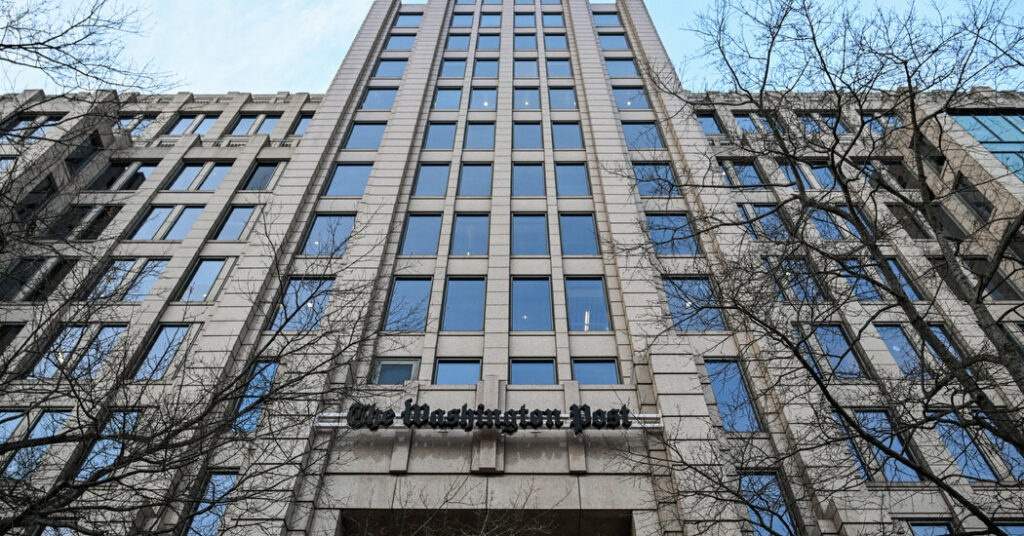
The Washington Post told employees on Wednesday that it was beginning a widespread round of layoffs that are expected to decimate the organization’s sports, local news and international coverage.
The company is laying off about 30 percent of all its employees, according to two people with knowledge of the decision. That includes people on the business side and more than 300 of the roughly 800 journalists in the newsroom, the people said.
The cuts are a sign that Jeff Bezos, who became one of the world’s richest people by selling things on the internet, has not yet figured out how to build and maintain a profitable publication on the internet. The paper expanded during the first several years of his ownership, but the company has sputtered more recently.
Matt Murray, The Post’s executive editor, said on a call Wednesday morning with newsroom employees that the company had lost too much money for too long and had not been meeting readers’ needs. He said that all sections would be affected in some way, and that the end result would be a publication focused even more on national news and politics, as well as business and health, and far less on other areas.
“If anything, today is about positioning ourselves to become more essential to people’s lives in what is becoming more crowded, competitive and complicated media landscape,” Mr. Murray said. “And after some years when, candidly, The Post has had struggles.”
Mr. Murray said the sports section would close, though some of its reporters would stay on and move to the features department to cover the culture of sports. The Post’s metro section will shrink, and the books section will close, as will the “Post Reports” daily news podcast.
He said that while The Post’s international coverage also would be reduced, reporters would remain in nearly a dozen locations.
“I know that every one of us believes deeply in this place,” he said, “and we all want to save it.” He added that The Post needed to “become nimbler, and to find new ways of working and innovating to understand what our customers want more of and what they want less of.”
As emails notifying employees that they were laid off began landing in inboxes, journalists at The Post began notifying their colleagues that their positions had been cut. “Eliminated,” “Eliminated,” “Eliminated,” their messages read to one another.
Mr. Bezos hired Will Lewis as publisher in late 2023 to find a path to profitability for The Post, which had been suffering from declining audiences and sagging subscriptions. Mr. Lewis has experimented with several changes to transform the organization, notably embracing artificial intelligence to power comments, podcasts and news aggregation.
At the end of 2024, Mr. Bezos described the struggle in an interview at a conference hosted by The New York Times: “We saved The Washington Post once, and we’re going to save it a second time.”
In a staff meeting in 2024, Mr. Lewis warned that The Post was in trouble. “We are losing large amounts of money,” he said. “Your audience has halved in recent years. People are not reading your stuff.”
The Post is far from alone among publishers in its struggles to achieve profitability. For many outlets, print circulation has continued to nosedive, digital traffic has been hampered by generative A.I. and audiences have splintered to various social media platforms. Publishers have had to experiment with different revenue streams, such as events and premium memberships, to offset losses.
“This is a tragic day for American journalism, the city of Washington and the country as a whole,” said Jeff Stein, The Post’s chief economic correspondent, who was not among those laid off on Wednesday.
“I’m grieving for reporters I love and whose work upheld the truest and most noble callings of the profession,” he said in a statement to The New York Times. “They are being punished for mistakes they did not cause.”
Don Graham, whose family owned The Post for more than a half century and oversaw its expansion into a first-rate newspaper that cracked Watergate, said in a post on Facebook that he would “have to learn a new way to read the paper, since I have started with the sports page since the late 1940s.”
Marty Baron, The Post’s former executive editor, said in a statement that Wednesday ”ranks among the darkest days in the history of one of the world’s greatest news organizations.”
“The Washington Post’s ambitions will be sharply diminished, its talented and brave staff will be further depleted and the public will be denied the ground-level, fact-based reporting in our communities and around the world that is needed more than ever,” Mr. Baron wrote.
Benjamin Mullin reports for The Times on the major companies behind news and entertainment. Contact him securely on Signal at +1 530-961-3223 or at [email protected].
The post Washington Post Begins Laying Off More Than 300 Journalists appeared first on New York Times.