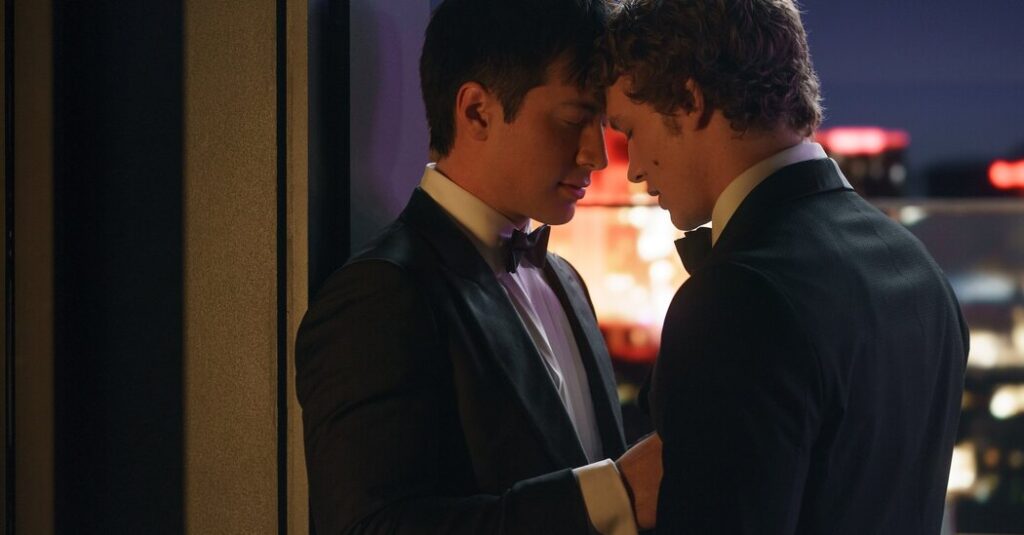
For Zach Sullivan, watching the television series “Heated Rivalry” brought up vivid memories of hiding.
“Before I came out, I was probably one of the most homophobic people in the room and that was just a case of, ‘If I’m being homophobic, people won’t think I’m bisexual,” he said.
Sullivan, 31, plays professional hockey for the Manchester Storm of the Elite Ice Hockey League in Britain. In 2020, he came out as bisexual, making him one of the few openly queer male professional athletes in the world. Before that, Sullivan recalled, he would lie awake at night in fear that a teammate might find out about his sexuality.
That was before “Heated Rivalry,” the HBO Max series about a yearslong secret romance between two professional hockey players, became a surprise word-of-mouth sensation. But the show’s popularity, and the experience of athletes like Sullivan, has underscored how little has changed in the locker room culture of men’s professional sports, one of the last bastions of contemporary society where being openly gay does not guarantee acceptance.
But few male players openly identify as gay, and most who do, came out after they retired. None have been stars. Currently, there are no openly gay active players in any of the four major men’s professional sports leagues in the United States.
“Things have not changed. The culture is still the same, and people are very apprehensive,” said Bill Kennedy, a longtime N.B.A. referee who in 2015 became the league’s first openly gay male official. Kennedy said he was so moved by the finale of “Heated Rivalry” that he cried for “at least 20 minutes and couldn’t go to sleep.”
Sullivan, who has described hockey as “a hypermasculine and overtly homophobic sport,” said his prevailing feeling in the locker room was fear: fear of not being accepted and fear of being seen as weak and feminine.
“You always see in the media how all the winning teams all have this really tight-knit, close bond,” he said. “It’s because they all like the same things. They all do the same things. They hang out together.” Even now, he added, “There are aspects of my relationships past and present that I don’t feel comfortable talking about because it’s something that might cause one of my teammates to be uncomfortable.”
This stands in stark contrast to women’s professional sports, where there are dozens of openly gay players in the W.N.B.A. alone, including stars like Brittney Griner and Chelsea Gray.
Lindsey Darvin, an assistant professor at Syracuse University who has studied gender in sports, said one reason gay male athletes feel compelled to remain closeted is the relationship between athletics and “hegemonic masculinity,” a sociological term referring to the maintenance of male dominance in society.
Sports “reward a very narrow ideal of what a male athlete should represent: being straight, dominant, and emotionally-controlled,” Darvin said. “Being perceived as gay, more feminine or not fitting that full ideal is treated as a status threat.”
For women in sports, it’s generally more accepted to align with a more masculine identity, Darvin said. And just by playing a sport, she said, some women find it less risky to be more open because they are already going against “stereotypical femininity.”
Women also have had a longer runway with prominent out athletes. The tennis star Billie Jean King was outed as a result of a 198l lawsuit. Soon after, another elite player, Martina Navratilova, came out as gay — a decision that she said cost her millions in sponsorships.
As the gay rights movement has advanced, the public reaction in the rare cases where male professional athletes have come out has been broadly positive. After Ryan O’Callaghan, who played in the N.F.L. from 2006 to 2010, came out in 2017, he said in an interview he “ didn’t have one negative experience” with his former teammates.
In 2021, Carl Nassib of the Las Vegas Raiders became the first and, so far, the only active N.F.L. player to come out. He retired in 2023.
There have been other signs of progress. In 2021, the L.G.B.T.Q. sports news website OutSports published the results of a survey of 1,000 high school and college athletes in the United States and Canada who identify as L.G.B.T.Q. The survey found that 95 percent described the response from their teammates after they came out as “neutral” to “perfect.”
“We keep being told that men’s sports: ‘Oh, it’s homophobic. They’re going to be rejected by their teammates.’ But that’s not sports,” Cyd Zeigler, a founder of OutSports, said in an interview. “We’ve said for years that athletes will be accepted when they come out, and they are.”
Charlie McAvoy, a defenseman for the Boston Bruins of the N.H.L., appeared to signal that kind of response, telling reporters last month that while he hadn’t seen “Heated Rivalry,” it had been “growing the game a lot and in support of that community, so that stuff’s all awesome.”
Men’s leagues have made efforts to portray themselves as allies of the gay community, but the atmosphere has not been uniformly friendly. In 2021 and 2022, the N.B.A. fined two stars, Kevin Durant and Anthony Edwards, for using anti-gay slurs. Around the same time, five players for the Tampa Bay Rays declined to wear rainbow patches for the team’s Pride Night promotion. In 2023, the Philadelphia Flyers defenseman Ivan Provorov refused to wear a rainbow jersey for a Pride Night game. In both cases, the players cited their religious beliefs.
The fact remains that players like Michael Sam, who in 2014 became the first openly gay player to be drafted by an N.F.L. team, and Jason Collins, who that same year became the first openly gay N.B.A. player, opened a door that few other men have walked through.
For Kennedy, coming out wasn’t as bad as he thought it was going to be. “We look back and we laugh. But the needle hasn’t moved. The needle hasn’t moved because nobody else has done it,” he said, referring to the N.B.A.
Zeigler, of OutSports, has a theory: The average professional career lasts only a few seasons, so gay players figure they can wait until after they retire to come out — a prospect that the protagonists of “Heated Rivalry” discuss in the season finale.
There are signs that “Heated Rivalry” is having some impact because of its broad appeal. The show, which was produced by the Canadian network Crave, has made stars out of its leads, Hudson Williams and Connor Storrie, who served as Olympic torchbearers in Italy. It was name-checked by Mayor Zohran Mamdani of New York. It was spoofed on “Saturday Night Live.”
Inspired by the show, 10 new players signed up in the last month to compete in Boston Pride Hockey, a league for L.G.B.T.Q. players, according to a spokesman, Kevin Corsino, who said he has heard about a similar response in other leagues across the country.
“What’s been most striking is that the show hasn’t so much created interest as it has unlocked it,” Corsino said. “For many queer players, simply seeing themselves reflected in the sport — emotionally and culturally — has helped them imagine a version of hockey where they belong.”
Sullivan, the Manchester Storm player, was skeptical that “Heated Rivalry” would lead to a major shift in the current professional environment. (There is one openly gay man playing for an N.H.L. affiliate: Luke Prokop.)
“I think there’s still quite a few more steps to take,” Sullivan said. “Professional athletes currently struggling with their sexuality, I think it’s going to help them,” he added. “I think it will hopefully start these kinds of conversations and pave the way for the future generations.”
Sopan Deb is a Times reporter covering breaking news and culture.
The post ‘Things Have Not Changed’: What ‘Heated Rivalry’ Gets Right About Men’s Sports appeared first on New York Times.