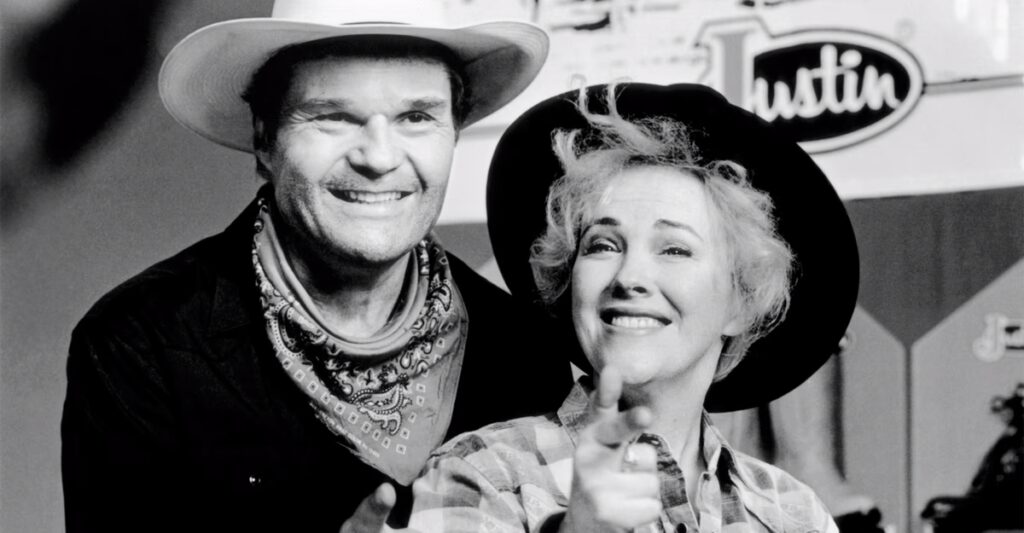
In the mid-1990s, when Catherine O’Hara flew into Lockhart, Texas, to begin shooting the indie mockumentary Waiting for Guffman, she felt spooked. The film’s director and lead actor, Christopher Guest, had shown her scenes of their co-stars already seeming comfortable in their heavily improvised roles. As a gifted sketch comedian and a co-founder of the Toronto-based comedy show Second City Television, or SCTV, O’Hara knew her way around a “yes, and” prompt. But seeing how her fellow actors alchemized Guest’s loose script, about community-theater members preparing a musical for their tiny Missouri hometown’s sesquicentennial, into fully realized characters intimidated her.
Then Guest gave O’Hara some unexpected advice: “Don’t worry about being funny,” she recalled later in an interview with The New Yorker. “Just be in the scene.” When the film came out, O’Hara’s portrayal of Sheila Albertson, a goofy travel agent who’s sharper than she lets on, stood out even amid a sparkling cast of actors playing memorable weirdos. Her wacky asides, undergirded by a subtle poignancy, both gave Guffman a zany edge and helped transform the mockumentary genre itself.
A comedy giant, O’Hara, who died last week at 71, was known for lending an eccentricity to her characters: a worried mom in the box-office juggernaut Home Alone; the dippy Moira Rose in the sitcom Schitt’s Creek; a salty therapist in the dystopian The Last of Us; a shrewd former movie executive in the Hollywood send-up The Studio. But the four mockumentaries that O’Hara made with Guest over the course of a decade—Guffman, Best in Show, A Mighty Wind, and For Your Consideration—are the most transcendent examples of her comedic prowess.
[Read: ‘She works on levels that people don’t even know’]
In each of these roles, O’Hara grounded these high-strung personas while deftly winking at the audience and letting them in on the joke, particularly in the films’ mock-interview segments. Her indelible character work played a key part in mockumentary’s evolution from a parodic favorite of indie entertainers to a popular device used on network-TV shows such as The Office; in the crude ambush comedy of Borat; and even in The Moment, the newly released Charli XCX film satirizing pop stardom.
The mockumentary’s origins go back further than O’Hara’s shimmering collaborations with Guest and his regular stable of skilled actors, including Eugene Levy, Parker Posey, and Jennifer Coolidge. In an article for the journal Cinéaste, the film historian Thomas Doherty argued that Orson Welles’s The War of the Worlds and Citizen Kane were among the first American examples of a fake documentary, deploying a “sleight of hand” that was “prophetic and pathbreaking: not simply parody, but cinematic mimesis” with a fresh “look via staged interviews, faux library stock, and unsteady peek-a-boo shots.” Later, cinema verité–style filmmaking became the jockey vehicle for Guest and the late Rob Reiner’s 1984 film, This Is Spinal Tap, a mockumentary following a washed-up metal band trying to regain its former renown.
As Doherty notes, O’Hara’s comedic work on Guest’s ensuing mockumentaries in the ’90s and 2000s, for which actors developed their characters through improvisation, proved “indispensible” to these kinds of stories that often trace how ordinary people’s egos and fears get the better of them in the lead-up to a big event.
Cookie Fleck, O’Hara’s character in Best in Show, is an outstanding example of her comedic sensibility—a meld of physical comedy, deadpan affect, and delirious self-confidence—whose influence is all over the mock-interview segments of, say, Parks and Recreation. The film tracks Fleck and her husband, Gerry (played by Levy), driving from their home in Florida to compete in a prestigious Philadelphia dog show. O’Hara’s Cookie is a recovering bon vivant who, in her first scene, corrects her husband’s assertion that she had “dozens of boyfriends” in a past life. “Hundreds,” she quips, her delivery gut-busting. (A recurring gag involves Cookie continually running into men she was formerly romantically entangled with.)
O’Hara once noted that she loved playing “insecure delusional” characters, “people who have no real sense of the impression they’re making on anyone else.” Cookie epitomized this persona, a woman whose daffy reactions to her former paramours pained her husband and yet who earnestly tried to fit in among her more well-heeled competitors at the dog show. But in the staged-interview portions of Best in Show, O’Hara gave her character an additional layer of depth, as someone who’s constantly underestimated—not unlike Parks’ Leslie Knope. This facet of her personality made the Flecks’ eventual victory—their terrier’s clinching of the best-in-show title—all the more satisfying, and shocking.
[Read: The bombastic matriarch of Schitt’s Creek]
The clearest successors to O’Hara’s knowing mockumentary style are, undoubtedly, the denizens of NBC’s The Office. Steve Carell’s take on Michael Scott, the bafflingly self-assured, albeit insecure, boss of Dunder Mifflin, is indebted to O’Hara’s Marilyn Hack in For Your Consideration—an actor who can’t accept not being nominated for an Academy Award. Sheila Albertson, in her sincerity and penchant for theatricality, walked so the un-self-aware oddball Dwight Schrute (known for injecting melodrama into every facet of his 9-to-5) could sprint; Dunder Mifflin’s receptionist Pam Beesly, meanwhile, is on a similar wavelength as Mickey Crabbe, the reluctant folk singer whom O’Hara portrayed in A Mighty Wind with understated aplomb. That 2003 film traced a group of Greenwich Village–era ’60s folk musicians reuniting for a high-stakes concert decades later; O’Hara was one-half of the folk duo Mitch & Mickey. But instead of going an obviously kooky route, O’Hara played Mickey as a subdued figure conflicted about revisiting her broken relationship with Mitch. It’s not a stretch to read Mickey as a precursor to Pam, who hides a deep sweetness, and sadness, behind an aloof front.
In each of Guest’s faux documentaries, O’Hara gave her characters a distinctive loopiness: They drunkenly ramble about circumcisions at nice restaurants, sing ditties about terriers’ “cute little derrieres,” and unravel after reading online rumors speculating about their potential Oscar nod. Yet by simultaneously gesturing toward the audience, O’Hara also underscored the importance of bringing viewers into the fold. She helped show us people who were, like the rest of us, trying to work through everyday fears—and she did so by staying in the scene as much as possible.
The post The Queen of Mockumentaries appeared first on The Atlantic.