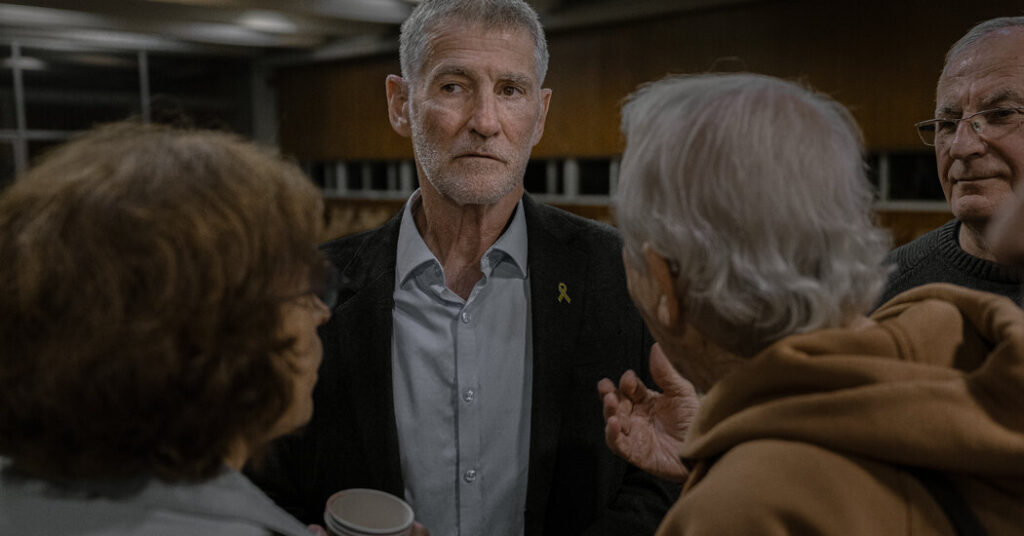
On a sweltering day last August, the Israeli politician Yair Golan hopped onto a makeshift stage perched on a van outside the Knesset building in Jerusalem. Golan, 63, is a slim man with cropped hair that has recently turned white and deep-set eyes that constantly dart around. He has the straight-armed, straight-backed gait of a former general, which he is. Around him, hundreds of red-faced protesters had assembled in the heat, shouting slogans that displayed the various demands of the Israeli opposition: “Enough killing!” “Democracy!” “Hostages above everything!” Golan appeared to be the only person who had not broken a sweat.
Being coldblooded has served him well. As the leader of a newly formed left-wing party alliance called the Democrats, Golan is the only Jewish party leader trying to keep the idea of the two-state solution alive. His support for a future Palestinian state is borne of pure pragmatism, he says, a “cruel truth” learned through four decades of military experience: that “peace is the ultimate security.”
Golan believes that after Oct. 7, 2023, when Hamas-led attackers killed roughly 1,200 Israelis and took some 250 hostages to Gaza, Israel was seized by a “national psychosis” for revenge. The war Israel started in response has now killed around 70,000 Palestinians, according to the Gaza health ministry. Of those identified, more than half are women, children or seniors. Last year, in a radio interview, Golan said that “a sane country does not fight against civilians, does not kill babies as a hobby” — a comment that seemed to unite the bitterly polarized Israeli population against him. He later clarified that his criticism was pointed at the policies of Prime Minister Benjamin Netanyahu’s government, not soldiers. But the fallout was swift. Government ministers accused him of “blood libel” and called for a criminal investigation into him.
That afternoon in August, the Israeli government was set to vote on a measure to oust the country’s attorney general. Netanyahu has been on trial for corruption since 2020, over charges he denies, and critics saw the move against the attorney general as his attempt to fire his chief prosecutor. “This government meeting is not about releasing the hostages,” Golan shouted to the protesters. “It’s not about ending the war, or building an alternative rule to Hamas’s rule in Gaza. The only thing that concerns the government is itself!”
A taxi driver pulled up behind a police barricade and yelled at Golan: “You’re scum!” A young woman drew near. “Traitor!” she screamed and dumped a water bottle on the protesters standing next to her. Several more people approached the other side of the barricade and began to curse at Golan, full-lunged and furious. Golan, seemingly unfazed, only spoke louder into the microphone.
“Israeli society is torn apart and exhausted,” he called out. “Israel is becoming the leper country of the world.”
“We won’t stop this war!” a man in a skullcap yelled.
For Golan, the war in Gaza could have ended with a hostage-release deal as early as February 2024, “when we defeated Hamas’s military force,” he told me later. The lives of thousands of Palestinians and hundreds of Israeli soldiers could have been spared. Though a cease-fire went into effect last October, more than 500 Palestinians have been killed since then, according to the Gaza health ministry, which does not differentiate between combatants and civilians. Gaza today is barely recognizable to its own residents; 80 percent of its buildings have been damaged or destroyed, according to the United Nations.
Israeli politics, meanwhile, has lurched to the right. Young Israelis tend to be more politically hawkish than their parents, so much so that ultra-Orthodox lawmakers recently floated a bill that would lower the voting age to 17. In the West Bank, Jewish settlers have been emboldened to launch regular attacks on Palestinian villages. Public support for a two-state solution has been steadily falling for years, and after Oct. 7 it became widely accepted that to recognize a Palestinian state would be a “huge reward to terrorism,” in the words of Netanyahu. Even the current leader of the Israeli opposition, Yair Lapid, when asked whether he supported a Palestinian state in the next decade, responded, “No, no, of course not.”
Today one-quarter of Israelis back a two-state solution, according to a 2025 poll by Gallup. That’s less than half the number that favored it in 2012, but it remains a solid faction in a divided country. Golan appeals to this electorate, many of whom have grown weary of politicians from the center-left barely differentiating their agenda from Netanyahu’s. According to a 2025 report by the Israel Democracy Institute, Israelis who say they will vote for Golan’s Democrats tend to exhibit “critical Zionism”: high levels of support for the rule of law and the Israel Defense Forces (I.D.F.) leadership on one hand, and on the other a deep criticism of the government, a belief in a political settlement with the Palestinians over “military solutions” and even doubts “about their own future in Israel.”
‘I spent my entire adult life surrounded by danger.’
Yair Golan
An Israeli election — the first since the war in Gaza began — is scheduled for October. It will take place sooner if the government fails to meet a budget deadline in March. Even if Netanyahu’s Likud party secures the most votes, he will struggle to recreate the government he has in place today, which represents narrow far-right and ultra-Orthodox interests. Over the past several months, polls have shown Golan’s Democrats emerging as the third-largest party — no small feat for a seemingly vanishing left wing that currently holds only four of 120 seats in the Knesset. If Golan can win double-digit seats and serve in a governing coalition, the Israeli left will be part of the political conversation again.
As protesters continued to gather, Golan went on, like a latter-day Jeremiah admonishing the people of Judah: “Ministers who long to settle Gaza at the expense of our sons’ blood; ministers who view the hostages as a reasonable cost of war; ministers who treat our soldiers as the messiah’s donkey and this period as a period of miracles —— ”
“You’re garbage!” the woman with the water bottle screeched.
Golan wrapped up his speech and climbed down from the van. I told him that the scene reminded me of the violent protests that preceded the murder of Prime Minister Yitzhak Rabin by a Jewish extremist in 1995. Rabin, like Golan, was a bellicose former general who warned that only a painful territorial compromise would ensure Israel’s long-term security. Both aroused genuine loathing among their opponents. Rabin used to call his critics an “incited” minority. Golan, in a testament to growing right-wing fanaticism, calls them an “incited majority.”
“Very accurate,” Golan allowed when I offered the comparison. But when I asked him if their anger scared him, he shrugged it off. “I spent my entire adult life surrounded by danger,” he said through a pursed smile. “This is the most fateful battle I’ve taken part in — for the future of the state of Israel.”
Golan grew up in a military household in Rishon LeZion, a city near Tel Aviv. His mother was a fourth-generation sabra — the Hebrew term for a person born in what is now Israel; his father, Gershon Goldner, was a German refugee who arrived in prestate Israel in 1935 so impoverished, Golan has said, that “he only started to gain height after he was conscripted, because for the first time he had nourishing meals.” Goldner, who later Hebraized his name, became a colonel in the communications technology corps.
At 18, Golan was accepted to the army’s elite pilot-training course. Instead, he chose a less prestigious route and followed his older brother into the paratroopers in 1980. Even as he rose through the ranks, he was known for sporting a wide-brimmed hat typically associated with new recruits, not their high-level commanders. Golan once boasted of having “fought in all the Palestinian cities except for Jericho.” But he was privately opposed to Israel’s occupation of the West Bank. “I worked to maintain a policy that I did not agree with,” he told Israel’s Liberal magazine in 2020, after he left the I.D.F.
Many stories about Golan’s time in the army mention his boundless courage. Ambushed by Hezbollah snipers in southern Lebanon in 1997, he was shot in the arm and the leg but continued to command his troops under fire. With courage came a go-it-alone attitude. Golan did not inform Benny Gantz, then the head of the I.D.F., when he decided in 2013 to take in Syrian rebels wounded in the country’s civil war and give them medical treatment in Israel. He was not reprimanded, but the I.D.F. was forced to clarify that providing Syrians with medical care was not official army policy.
He was also among the early adopters of a controversial — and illegal — policy known as “neighbor procedure,” which coerced family members or neighbors of wanted Palestinians to act as mediators when the I.D.F. was making arrests. He later argued that he employed the procedure only as a way of avoiding bloodshed. “In one case,” he told Liberal magazine, “the wanted man refused to leave a compound in the Nablus kasbah. We could have destroyed the compound, which would have resulted in the deaths of many, or asked the wanted person’s mother to speak to him on a megaphone. I thought we should use the mother.”
Golan says he was an “aggressive officer,” which made people “assume that I was right-wing — a twisted idea.” Nahum Barnea, one of the most widely read columnists in Israel, described Golan to me as an “excellent fighter” with a “killer’s instincts” — someone who relished the rush of battle. Barnea once wrote a column in which he described a meeting of the military’s leadership around 2012. Benny Gantz was about to start the meeting, but he didn’t see Golan, who oversaw the northern command. “Where’s Yair?” Gantz asked, then deadpanned, “I’ll hop to the north to make sure he didn’t start a war.”
Netanyahu appreciated Golan’s pugnaciousness. He called Golan “one of our most experienced and talented officers” and at one point seemed ready to appoint him head of the I.D.F. (Netanyahu has since denied this, but contemporaneous reporting in various outlets supports the notion that Golan was favored for the role.) Golan’s trajectory changed in 2016, when he was invited to speak at an educational center for Holocaust Remembrance Day. Though technically prohibited from discussing politics in the military, Golan used the occasion to compare recent events in Israel to “nauseating processes” of unbridled racism that took place in Germany under the Third Reich.
Earlier that year, a Palestinian man who had stabbed a soldier in the West Bank city of Hebron was lying badly wounded on the ground when an Israeli medic approached and fatally shot him at point-blank range — a clear violation of international law. Golan told the crowd that Israeli society was losing its moral compunction. It no longer saw its role as protecting, in the Bible’s words, “the stranger, the orphan and the widow.” He urged Israelis “to uproot from among us the seeds of intolerance, the seeds of violence, the seeds of self-destruction along the path of moral decline.”
What followed was an eruption of public fury. “Our soldiers are compared to Nazis,” one government minister raged. Calls grew to fire Golan. “From that moment on, there wasn’t a household in Israel that did not know the name Yair Golan,” a local television reporter noted. Golan says that Israel’s defense minister at the time, Avigdor Lieberman, told him in a private meeting that Netanyahu would no longer consider him for the I.D.F.’s top position. Golan was incredulous. To him, the speech wasn’t political. “I thought I was merely warning about things that were happening,” he recalled. For the first time, he was forced to weigh a future outside the army. He left in 2018 and spent several years pursuing failed forays into politics. He briefly served as a Knesset member — including for Meretz, a leftist party — but later lost the race for party chair. In the next elections, Meretz won no seats.
Golan’s military career ended just as the I.D.F.’s role in society was changing. The shooting in Hebron split the institution and the public. Army leadership called for the medic to be prosecuted, while rank-and-file soldiers — spurred on by a newly elected right-wing government — turned the medic into a national hero. The rise of Itamar Ben-Gvir, the far-right national-security minister who has supported giving soldiers automatic immunity from criminal prosecutions, shows how ascendant the second view has become in Israel in the years since. “Suddenly the army began to be perceived as a gatekeeper,” said Yagil Levy, an Israeli sociologist who studies the relationship between society and the military. Levy described this as a “total distortion” of the military’s traditional role in democracies.
The rift between the government and army leadership became clear in January 2023, when Netanyahu’s justice minister announced a plan to overhaul the judiciary by, among other things, giving the government more control over the selection of judges. Legal experts warned that the proposals would undermine the country’s separation of powers and turn it into a “hollow democracy.”
The plan set off a nationwide protest movement led, in large part, by senior military reservists who claimed that the legislation violated the country’s Declaration of Independence, whose principles they had vowed to protect. The movement’s hard-core base of supporters urged reservists and even active-duty soldiers to refuse to serve as long as the antidemocratic legislative blitz continued.
Golan threw himself into the movement, calling for civil disobedience and participating in some of its more controversial actions. He once gleefully posted a video of himself at an hourslong siege of an upscale hair salon in Tel Aviv where Sara Netanyahu, the prime minister’s wife, was getting her hair done.
Golan’s entry into politics created tensions with his wife, Ruthie, a mindfulness instructor with whom he has five sons. She was dismayed that after all his time as a military man, he so quickly became consumed with another demanding career. “I waited 38 years for him to be discharged from the army and for us to finally be together,” Ruthie told the television program “Anashim” (“People”) in 2023. “Then politics came along and turned everything upside down.”
At every protest, in every march, there was Golan, railing against a brewing dictatorship. In July 2023, he warned on X that Israel’s enemies were taking note of the growing chasms in Israeli society brought about by the judicial overhaul. “The Iranians are celebrating,” he wrote. “Hezbollah has opened champagne bottles. Hamas is preparing a national holiday. They see the end of the State of Israel.”
Golan was at home with Ruthie on the morning of Oct. 7, 2023, when sirens blared all over the country. From reports on the radio, he realized that the incursion of Hamas forces from Gaza into southern Israel was like nothing he had ever seen. At 8:01, he posted on social media that the country was heading toward war.
He dusted off his army fatigues, laced on a pair of paratrooper boots and drove to the headquarters of the Home Front Command, near the town of Ramle, where live surveillance footage showed dozens of infiltration spots. He soon concluded that he needed to be on the ground, not stuck inside an armored building, and told the commander of the unit, “I will be your eyes in the field.” He headed south, toward the military base Urim, where he was told that intense fighting was still underway. Around noon, he got a call from his sister. “There was a party,” she told him. “Some kids managed to escape. Can you get them out?” She was referring to the site of the Nova music festival, where, it later became clear, nearly 400 people had been killed that day.
As Golan approached the clearing in the forest where the festival had taken place, he saw hundreds of cars strewed by the sides of the road, burned and riddled with bullets. Lying inside the cars and all over the open field were the bodies of slain partygoers. One image in particular hasn’t left Golan: a young woman whose body lay against a car door. “There was something very soft in her posture,” he told me. “At that moment, I felt pure rage. Rage at Hamas, that they did this to us.” But also “rage at the government that brought this disaster upon us.” Golan saved six people that day, including the son of a journalist from the liberal newspaper Haaretz, who for hours posted increasingly panicked messages on social media that his son was hiding amid intense gunfire. He called Golan, who responded: “Send me location.”
“I want to tell you about an angel in uniform,” a man named Roni Gaon later wrote in a post on a local news site that went viral. Gaon described how his son, too, had spent hours hiding in a field with two friends when they heard a voice calling to them. “Hi! This is General Yair Golan speaking! Come out to me.”
Assaf Sharon, a professor at Tel Aviv University who has advised Golan, recalled sitting with him at a cafe in Tel Aviv the weekend after the attack. “We couldn’t exchange a word because people kept coming up to him with tears in their eyes, asking to hug him. A pregnant woman came over and told him that she was going to name her baby Yair after him.” Golan, in Sharon’s telling, was genuinely mystified that he kept being commended for bravery when, as he told Sharon, “I didn’t fire a single shot!”
In contrast to Netanyahu, who blamed Israel’s security establishment and complained that he hadn’t been properly warned of the attack, Golan was seen as a figure who “put a weapon on his shoulder and succeeded where the country failed,” said Yagil Levy, the Israeli sociologist. With a nationwide emergency call-up of some 300,000 reservists, Golan’s star rose just as the military became dominant again in Israeli culture. Golan “constituted a winning formula that linked the military world with the Israeli left,” Levy said.
‘We’re like a body that’s been injured. We are going to live with scars. But OK. It’s possible to live with scars.’
Yair Golan
The left in Israel had been hemorrhaging support for years. The center-left Labor party’s presence shrank to four seats in 2022, and the leftist Meretz remains unrepresented. Two months after Oct. 7, a pair of Labor politicians scheduled a meeting with Golan and encouraged him to run for party chair. He agreed, if the party joined forces with Meretz. “Yair Golan was built for this moment,” Naama Lazimi, one of the Labor politicians, told me. “This brave man who drove to the south and wasn’t afraid to be killed — he’s also fearless in how he carries himself.” As the war dragged on, Golan spoke out not only in security terms but also in moral ones. He decried the Palestinian death toll and described Israel’s duty to facilitate humanitarian aid to the people of Gaza.
In 2024, five reservists in a unit tasked with prison security allegedly beat a Palestinian detainee who was captured by I.D.F. forces in Gaza and sodomized him with a sharp object. When the reservists were detained, angry protesters, including members of Netanyahu’s coalition, broke into the military base where the alleged attack took place. Israeli society was torn once more: Part of the country was horrified, while another part — and their representatives in government — defended the reservists. “Total political and public madness,” Golan told me about the protests. “As if the sodomizers are saints.”
If the judicial overhaul threatened the relationship between the government and army leadership, the war in Gaza shattered it. Throughout the war, the I.D.F. repeatedly prioritized the return of the hostages even as government ministers did not include it among the war’s top goals when they expanded the ground operation in Gaza. When the government approved a plan to occupy the central part of the Gaza Strip last summer, it did so against explicit warnings from the head of the I.D.F. and other senior defense officials.
“In my lifetime, I’ve never seen such a rift,” Golan told me. We were sitting in his modest office behind a Pizza Hut in a quiet neighborhood in Tel Aviv last September. On the wall was a framed photograph of Rabin shaking the hand of King Hussein of Jordan. I asked Golan whether the rift could be repaired. “We’re like a body that’s been injured. We are going to live with scars. But OK.” He rolled up his shirtsleeves and pointed to a spot where a bullet from the Hezbollah sniper had sliced through his arm. “It’s possible to live with scars,” he said.
Golan’s public events have recently taken on an even greater sense of urgency. Throughout the fall and winter, the Knesset seemed close to dissolving, which would trigger an election sooner than the one planned for October. Netanyahu was in campaign mode: He could be seen out on the street, eating falafel.
Golan insisted to me that the three leading center-left parties had to merge and run as one. Together, they have the potential to become Israel’s largest party — representing 29 seats, according to a recent poll, compared with Likud’s projected 26. Netanyahu’s most prominent opponent is likely to be Naftali Bennett, a former prime minister who hails from the settler right but who governed as more of a moderate than Netanyahu. Bennett hasn’t officially announced that he is running, but he recently registered a new opposition party that has yet to be named.
Bennett was once an object of scorn for Golan. “I will never identify with a person whose basic perception is that annexing millions of Palestinians is a good thing for the State of Israel,” Golan said in 2023. Perhaps in a nod to the latest polls, which show that Bennett poses the only viable threat to Netanyahu in a head-to-head contest, Golan recently said that he believes Bennett is trying to get Israel “back to an axis of moderation.”
Golan told me that he would “sit with anyone” in the opposition who accepts the idea that Israel is the homeland of the Jewish people. He is the only leader who has said he would “welcome” the prospect of forming a coalition government with a predominantly Arab party. He has called Mansour Abbas, an Islamist party leader who advocates peaceful coexistence between Palestinian and Jewish citizens of Israel, “more of a patriot than Itamar Ben-Gvir,” the far-right minister. He told me that he considers the anti-Netanyahu bloc the “Zionist camp,” compared with the government, which he considers “anti-Zionist” for going against the values of a liberal and democratic Israel. It’s hard to overstate how rare such comments are in the current Israeli political climate.
The more Golan became a dominant political player, the less he has been invited on news shows and television panels. Ayala Panievsky, an Israeli media scholar and author of the book “The New Censorship,” believes that this is because the Israeli media fears Netanyahu, who has spent the past decade accusing journalists of persecuting him. Netanyahu has not given an interview to a local outlet in years, save for a channel known for its close ties to him. “There is now this performative adversarial journalistic practice to show that journalists are not what Netanyahu says that they are,” Panievsky said. Many networks have begun to present Golan as a foil to Ben-Gvir. “Never mind that one is crazy and the other is a war hero,” Panievsky said. “Journalists create this false equivalence between them because they are on two political ends.”
This explains why many of Golan’s would-be allies see him as a liability. They look at public-opinion polls showing that the label “leftist” has become toxic and vie to emphasize their centrist credentials. They are even considering forming an alliance without him, Channel 12 reported in January. To them, Golan’s fiery rhetoric hampers their camp’s chances to bring over undecided voters who once supported Netanyahu. By hammering on the Palestinian issue, they believe, Golan is causing their camp to lose support when it can instead be talking about bringing down the cost of living and ending the ultra-Orthodox military exemption — issues that have broad consensus.
For Golan and his advisers, this strategy has decimated the peace camp. “For too many years,” Golan said, “we have given up on ourselves out of a desire to please and avoid confrontation.” Sharon, his adviser, expanded on that notion. “Those who have delegitimized the opposition are the opposition members themselves,” he said. “They’ve turned him into an illegitimate partner, and that’s a disaster.”
Still, Golan has recently begun to calibrate his messaging to what the average Israeli can stomach, trying to rebrand the language surrounding the conflict. Israel’s peace camp no longer calls itself the peace camp. It is now the democratic camp, the liberal camp, the “just not Bibi” camp. These days, the Democrats talk less about the need to strengthen the Palestinian Authority and more about the importance of building a “Jerusalem-Ramallah dialogue.” “Why don’t I use the word ‘occupation’? Because I’m trying to persuade,” Golan told an interviewer in 2023. When I mentioned a two-state solution, he said that for now he preferred to think of it as “civil separation with security responsibility.”
It’s not exactly a sticker slogan, but on a purely strategic level, he may be right to insist on it. To speak of a separation is more popular in Israel than to speak of two states. Israelis don’t want to think about a state with an army lurking just across a border fence. Decades of Jewish settlement expansion in the West Bank have rendered the idea of a Palestinian state with a contiguous territory almost fantastical. Yet Golan is holding on to the idea of two states because the far right has been steering Israel toward a binational state in which a Jewish majority will effectively control a Palestinian minority. “There isn’t a single case in which entire communities that fought a brutal and bitter war with such terrible bloodshed are lumped together in one country,” he told me. “There is no such thing.” When I mentioned Lebanon, he said, “God forbid that’s the model we adopt.”
‘For too many years, we have given up on ourselves out of a desire to please and avoid confrontation.’
Yair Golan
Yet in September, when several countries, including Israel’s allies France and Canada, formally recognized a Palestinian state, Golan publicly opposed the move, calling it “destructive.” He told me that such declarations, which are mostly symbolic, only cause Israelis to “entrench themselves deeper and drive toward Netanyahu.”
But you see yourself as a leader with a vision that includes a Palestinian state, I said to him. Why not embrace this recognition?
Though he was committed to the idea, he said, he believes it should be a yearslong process. A Palestinian state, Golan argued, can be recognized only once it is demilitarized. Israel must also be confident that the border crossing in Rafah is monitored and inspected properly, he went on. “It can’t be that the Gaza border will continue to be controlled by the Egyptians in a way that for years everything — missiles, giant rockets — went in.” Israel needs to have the ability to “thwart” any threat of terror that emerges from Gaza, Golan added. “I can’t say: ‘Listen, guys, this is their sector. This is their sovereignty. I am not touching it.’”
A conditional state then? I asked.
“A state-to-be,” Golan ventured.
“Look,” he said after a pause. Even if he thought that recognizing Palestinian statehood was the right thing to do, “I live among my people, and the sentiment just isn’t there.”
On a Friday morning in November, Golan walked into an event hall nestled inside a large city park in Tel Aviv. He was there to speak to young activists for the Democrats who will serve as canvassers for the next election. People jogging in the park stopped to pat him on the shoulder. Tel Aviv is Golan’s home turf, a place where his opinions do not stand out for being radical. He lingered at the entrance to the hall, surveying the merchandise being sold by his party: a T-shirt that said “I’m the Left Wing’s Problem,” a tote bag emblazoned with “Unpopular Opinion: Peace.” One by one, he held several shirts against his narrow frame and returned them. “We also have some unironic ones,” a volunteer quickly assured him.
“Who Let the Dogs Out?” blared from the loudspeakers, and Golan bounded onstage to cheers from hundreds of young activists.
“What a joy to be the oldest person in the room!” he called out — a sly acknowledgment of the fact that roughly half of the Democrats’ voter base is over age 55. But Golan’s words soon turned somber. “We have abandoned the arena to corrupt, extremist nationalists,” he said. “We thought that this was a fight for democracy, but then Oct. 7 came, and we realized that it was existential. If this group continues to lead Israel, we are headed toward destruction.”
Listening to him, I wondered what he made of the wave of international boycotts and violence against Israelis and Jews abroad. Were those about Israel’s prosecution of the war, or did they have deeper strains? Later, when I asked him, he mentioned a “Mother Goose” book he used to read to his children while the family was on sabbatical in Boston. “One of the poems describes the Jew as a thief and a liar,” Golan said. Antisemitism wasn’t new, in other words. “But the question is whether Israel gives reasons” to its haters, he said. “I think what is happening now with this government is that it is providing a wide platform for antisemites all over the world.”
The second phase of the cease-fire in Gaza, which would require Hamas’s disarmament and a further Israeli withdrawal from the strip, had not yet started, with each side blaming the other for the delay. Netanyahu recently complained that the Trump-appointed “Board of Peace” that will oversee the cease-fire includes Turkey and Qatar — patrons of Hamas.
For Golan, the reliance on leaders in Ankara and Doha is a result of an Israeli government that failed to advance any alternative for the future of Gaza. Israel continues to hold 53 percent of the strip. Hamas, though greatly diminished, has become a guerrilla force that executes its perceived rivals in broad daylight. Constant conflagrations and punishing Israeli airstrikes risk a slide back into full-out war. Already, there have been reports that other nations have expressed wariness about sending troops to Gaza as part of a peacekeeping force, because of the possibility of facing direct confrontation from a still-armed Hamas.
War hasn’t abated the government’s attempts to neuter the country’s democratic institutions. In November, a slate of new bills aimed at drastically weakening, among other things, the Israeli press and the judiciary made it through preliminary votes in the Knesset. Then, on Nov. 27, Netanyahu asked the Israeli president, Isaac Herzog, to pardon him in his ongoing corruption trial. He did not admit guilt or offer to step down from public life — conditions that many legal experts say are required for a pardon to even be considered. In a letter to Herzog, Netanyahu’s lawyers wrote that the schedule of his testimony prevents him from being able to address “additional issues, such as the legal system and the media.”
Critics saw this as a veiled threat that the government’s assault on the judiciary will continue if the president denied his request. “Netanyahu is saying in his own voice, ‘I will destroy everything if you don’t pardon me,’” Michael Hauser-Tov, a political reporter for Haaretz, said on a podcast. “Only a guilty person asks for a pardon,” Golan said on the day the letter was published.
At the event hall in Tel Aviv, he called for a different kind of government. One that “puts the citizen in the center — not the supreme leader. A country where people can imagine building their future.” He warned the young attendees that Netanyahu and his ministers were not likely to accept defeat in an election. “The battle ahead of us will be difficult,” he said.
A round of rapid-fire questions began, and Golan had to answer as many as he could in less than a minute.
“Rabin or Peres?” an activist asked — referring to the late Labor leader Shimon Peres.
“Rabin,” he said.
“Thoughts about the Palestinian Authority?”
“The best option we’ve got,” Golan said, “but not an exciting one.”
“How do you respond when people call you a traitor?”
Golan didn’t reply. He simply smiled and brushed his shoulder.
The post The Israeli Politician Fighting to Keep the Two-State Solution Alive appeared first on New York Times.