Every once in a while America needs an exhibition about the architect Bruce Goff to remind us of our better, kinder self.
One has fortunately opened at the Art Institute of Chicago. Do yourself a favor if you’re anywhere nearby before the show ends in late March. No architectural retrospective in recent memory has left me feeling cheerier or more hopeful.
Who’s Bruce Goff?
You might well ask. Born into poverty in Kansas in 1904, he was one of midcentury America’s eccentric savants, a prodigy and polymath. He designed a mind-blowing assortment of flamboyant, bedazzling, occasionally campy buildings inspired by Viennese paintings, “The Twilight Zone,” Pueblo pottery, Frank Lloyd Wright and roadside diners. His materials of choice were as likely to be oil pipes, cellophane strips, peacock feathers and seashells as they were bricks and stone. One of his most beloved houses was made out of Quonset hut ribs.
Wright and Louis Sullivan were early, major architectural mentors and models. Philip Johnson, high modernism’s self-anointed power broker, had predictable reservations but acknowledged his brilliance. Time, Life and Vogue published articles about him over the years.
He was an insiders’ outsider, you might say, who rolled eyes in some mandarin corners of the architecture world — and still does. I mentioned how much I liked the Goff show to an architectural historian the other day, and he smiled through visibly gritted teeth.
Goff is no joke. Many of those buildings he left behind, after his death in Texas in 1982, are highly skilled essays in biomorphic geometry and joy, infused with lyricism. In 1970, Ada Louise Huxtable, the New York Times critic, summed up Goff’s output as “the most provocative manifestation” of American architectural genius.
He churned out kitsch, too, but more than half a century later, I’m not one to quibble with Huxtable’s assessment.
The Chicago show, “Bruce Goff: Material Worlds,” is the deepest dive yet into Goff World. It reminds us what a remarkable draftsman he was, even as a child. It places him before the war at the center of a lively community of modernist dance, music, art and poetry in Tulsa.
And it details Goff’s productive postwar years. After serving in the Navy, he ran the architecture school at the University of Oklahoma, turning his dark, round office there into a cluttered cocoon, with orbs and tumbleweeds hung from the ceiling.
For a time, Goff made the school a magnet for out-of-the-box thinkers until he was pressured into resigning during a McCarthy-era smear campaign against gay people. Students and university leaders begged him to stay.
But he opted to leave, moving his practice into the Price Tower, Frank Lloyd Wright’s mini-skyscraper in Bartlesville, Okla., commissioned by an oil family whose son, Joe D. Price, would become Goff’s most devoted patron.
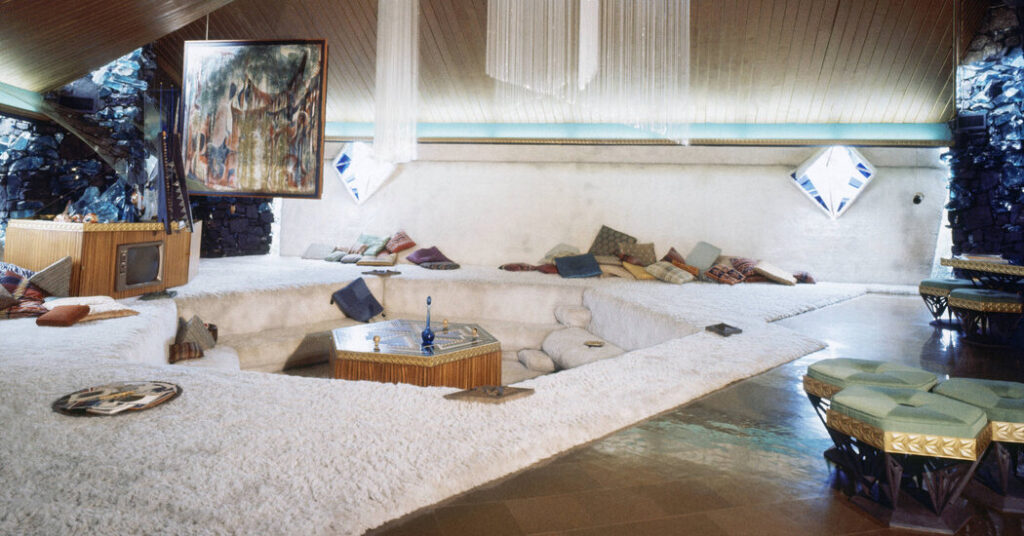
Organized by Alison Fisher and Craig Lee, the retrospective includes a model of Wright’s Price tower, borrowed from MoMA, along with drawings, furniture and photographs documenting the white-shag pleasure palace Goff designed for Joe Price, called Shin’en Kan. The architect’s magnum opus, it fell victim to suspected arson in the mid-1990s.
In all, there are in the show some 200 drawings, paintings and objects from the architect’s archives, which passed to the Art Institute after Goff’s death, presented in tame and formal galleries.
By objects, I mean wildly patterned shirts that Goff famously wore, music he composed for player pianos and 38 of his abstract paintings. There is a drawing by Gustav Klimt, a portfolio of whose prints he acquired as a 13-year-old by mail order from the Gotham Book Mart in New York. Goff recalled in an interview years later that the store’s owner shipped them to him with instructions that he could pay for the art once he was old enough to land a job.
Klimt obviously became a lifelong source for Goff’s bricolage aesthetic, which mashed everything together. We also see in the show some swatches of the shag carpets with which he lined conversation pits and the occasional rooftop. There are samples of cullet — recycled waste glass — that Goff implanted in walls and windows to refract sunlight.
Conservatives today, rehashing clichés about modernism’s unpopularity, are again demanding that federal buildings resemble Greek temples. Americans needs more marble and gold, is the message from Pennsylvania Avenue.
But modernism is a vast universe, and Goff was a populist as well as a modernist in the vein of uncategorizable figures he loved like Antoni Gaudi, Hans Scharoun and Erich Mendelsohn. As a teenager Goff helped design a superb Art Deco and Neo Gothic limestone church that is a landmark in Tulsa. Before Robert Venturi and Denise Scott Brown “discovered” Las Vegas for coastal elites, Goff proposed a splendiferous hotel and casino for the Las Vegas Strip, sadly never built.
I said earlier that he reminds Americans of our better selves. I mean that his output is a love letter to optimism and the American experience in all its openness. We see Goff in video clips, wearing his signature bolo ties and patterned shirts, a self-effacing, soft-spoken gentleman with the manner of a country doctor.
Clients adored him. They included shoe salesmen and working-stiff oil riggers, Main Street bankers and turkey farmers, sculptors and dentists. When budgets were tight, Goff made do with dime-store ashtrays to decorate front doors, and he contrived D.I.Y. techniques for clients to build their own houses.
His Bavinger House from the 1950s was a spiral, D.I.Y. phantasmagoria for artist-friends, now sadly demolished. Goff suspended its interior on wires held aloft by a metal mast.
His clients had asked him to bring the outdoors inside. So Goff cooked up a living space in the guise of a tropical grotto, which the Bavingers built and partly financed with $1 contributions from curious visitors and architectural pilgrims, its bedrooms suspended like hammocks over an open-plan living room with a series of pools running through it.
There are amazing drawings of the Bavinger House in the show by Herb Greene, Goff’s gifted associate. Greene will be one of the show’s surprises to those who don’t know him. We see Goff’s own drawings for the house and for others he designed, like the one he did for an artist named Ruth Van Sickle Ford and her engineer husband, Sam, in Aurora, Ill.
Goff enlisted in the Navy after Pearl Harbor and adapted materials and construction methods that emerged during the war effort. For the Ford house, he repurposed military-style Quonset hut parts to compose a trio of domes, akin to Tibetan nomad tents, which resembled mushrooms or clamshells. The Fords’ neighbors were not amused.
In response, the Fords posted a sign outside the construction site: “We don’t like your house either.”
Goff worked on some 500 projects before his death, nearly 130 of which were ultimately built, an astonishing total for someone who, during his last years, worked out of a spare room in a borrowed house in Tyler, Tex. that he shared with his cat and mother.
David G. De Long, Goff’s biographer, writing in the show’s catalog, recalls visiting Goff at that house, watching him sketch and tend to his correspondence from a glass-topped desk adorned with Christmas ornaments and a vase of peacock feathers. Each afternoon at half past four, De Long remembers, Goff quit to watch “Star Trek” reruns.
The Chicago show is a revelation and hoot, but you can also get a dose of Goff by visiting the new home for the Los Angeles County Museum of Art, when it opens this spring.
It’s a showstopper on stilts, bestriding Wilshire Boulevard, designed by the Swiss architect Peter Zumthor. I mention it because Goff designed the pavilion next door. Zumthor’s floor-to-ceiling windows provide a new High Line-level view of the neighbor, which Goff conceived to house Joe Price’s Japanese art collection.
A quasi-pagoda structure, its spiky roof rears up like mastodon tusks, just a few yards away from the famous tar pits. Translucent walls resemble shoji screens. A curvaceous interior of swooping balconies and ramps featured babbling waterfalls and ponds when the pavilion opened.
It was among the last projects Goff worked on before his death, completed by his colleague Bart Prince in 1988. The architecture shocked Angelenos at the time. It is now embraced as a civic icon. It’s a masterpiece of 20th century Americana.
I suspect it will give Zumthor’s behemoth a run for its money.
Michael Kimmelman is The Times’s architecture critic and the founder and editor-at-large of Headway, a team of journalists focused on large global challenges and paths to progress. He has reported from more than 40 countries and was previously chief art critic.
The post The Bedazzling, Wild Designs of Modernism’s Forgotten Genius appeared first on New York Times.